Introduction
Red fruit oil Papua is an oil produced from buah merah (Pandanus conoideus Lam.), a distinctive fruit-bearing pandan strongly associated with Papua and Papuan food traditions. The mature fruit is processed and softened so its naturally colored oily material can be separated from the pulp, producing the product commonly called red fruit oil or buah merah oil.
Pandanus conoideus belongs to the Pandanaceae family. Kew’s Plants of the World Online recognizes it as an accepted species and records its native fruit range from Maluku through New Guinea to several parts of the western Pacific. This means buah merah has an especially strong cultural and agricultural connection with Papua, but the species itself is not found only there.
It is also useful to distinguish the fruit from the finished oil. Buah merah refers to the fruit itself, while Papua red fruit oil refers to the oily fraction obtained after the fruit has been processed. Indonesian ethnobotanical records also document P. conoideus as a food plant used in Papua.
This guide explains what Papua red fruit oil is, where it comes from, how the fruit is traditionally processed, what the oil typically looks and tastes like, and how it differs from products such as red palm oil and pandan leaf preparations. It will also cover cultivation, storage, product identification, and the terminology international buyers may encounter when looking for authentic buah merah products.
1. What Is Red Fruit Oil from Papua?
Red fruit oil from Papua is the oily product obtained by processing mature buah merah (Pandanus conoideus) fruit. During preparation, the fruit is softened and its pulp is worked so the naturally colored oily fraction can be separated. The finished oil commonly ranges from reddish-orange to deeper red and has a long-established place in Papuan food traditions.
The botanical source is important because the phrase “red fruit oil” can sound quite general in English. In this context, it specifically refers to oil derived from Pandanus conoideus, an accepted species in the Pandanaceae family. Kew records the plant as native to New Guinea as well as Maluku, the Bismarck Archipelago, Caroline Islands, Solomon Islands, and Vanuatu.
Although the plant has a wider natural distribution, Papua red fruit oil is closely connected with Indonesian Papua through the local identity of buah merah, its cultivation, and its use as a traditional food ingredient. The term describes a processed fruit product rather than the whole fresh fruit.
1.1 Is Red Fruit Oil the Same as Buah Merah Oil?
Yes, generally. In English-language descriptions and commercial contexts, red fruit oil and buah merah oil usually refer to the same type of product: oil obtained from processed Pandanus conoideus fruit.
The terminology becomes easier to understand when separated into three parts:
- Buah merah is the Indonesian name commonly used for the fruit.
- Red fruit is its straightforward English rendering.
- Buah merah oil or red fruit oil refers to the oily fraction separated after the fruit has been processed.
This distinction matters because a whole buah merah fruit and a bottle of its oil are different forms of the same botanical source. The fruit contains pulp, structural material, and naturally oily components, while the bottled oil represents the separated oily portion.
When identifying a product, therefore, the name Pandanus conoideus provides a clearer reference than the words “red fruit” alone. It connects the oil to a specific plant rather than to any fruit that happens to have a red color.
2. What Fruit Is Red Fruit Oil Made From?
Red fruit oil is made from the mature fruit of buah merah (Pandanus conoideus). This is a fruit-bearing tropical pandan rather than a palm fruit, cactus fruit, or the familiar fragrant pandan leaf commonly used in Southeast Asian cooking.
The fruit provides the raw material for both traditional processed buah merah and the separated oil. After maturity, its edible outer material can be softened and worked away from the harder structural parts. The naturally oily portion of this processed fruit is what eventually becomes buah merah oil or Papua red fruit oil.
2.1 Pandanus conoideus
The accepted scientific name of Papua red fruit is Pandanus conoideus Lam. The abbreviation “Lam.” refers to the botanist associated with the scientific naming of the species and is part of its formal botanical authorship.
According to Kew’s Plants of the World Online, Pandanus conoideus is an accepted species classified as follows:
- Family: Pandanaceae
- Genus: Pandanus
- Species: Pandanus conoideus
- Growth form: tree
- Primary biome: wet tropical
Kew records the species as native from Maluku to the western Pacific, including New Guinea. This wider distribution is worth keeping in mind when discussing Papua red fruit. The plant is closely associated with Papua, but its botanical range extends beyond Indonesian Papua.
Using the scientific name is particularly helpful for international readers. The everyday term “red fruit” can refer to many unrelated fruits, whereas Pandanus conoideus identifies the exact botanical source of the oil.
2.2 Is Buah Merah a Type of Pandan?
Yes. Buah merah is a type of pandan. It belongs to the genus Pandanus within the Pandanaceae family.
However, it should not be confused with the fragrant pandan commonly used to flavor rice, desserts, and other foods in Southeast Asia. That plant is generally identified as Pandanus amaryllifolius, which Kew recognizes as a separate accepted species.
The distinction can be summarized simply:
- Pandanus conoideus produces the buah merah fruit used to make red fruit oil.
- Pandanus amaryllifolius is a different pandan species widely known for its aromatic leaves.
- Both belong to Pandanaceae, but they are separate botanical species with different characteristics and culinary uses.
So, describing buah merah as a red pandan fruit can help explain its botanical relationship, provided the term does not suggest that it comes from the same plant as culinary pandan leaves. For product identification, Pandanus conoideus remains the clearest name to look for.
3. What Does Papua Red Fruit Look Like?
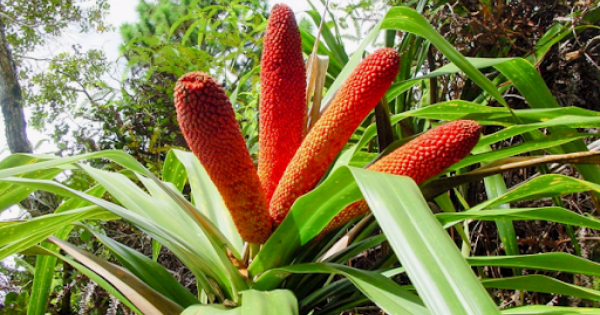
Before it becomes oil, Papua red fruit is a large, elongated fruit produced by Pandanus conoideus. Its appearance is quite different from familiar fruits such as apples, mangoes, or dragon fruit.
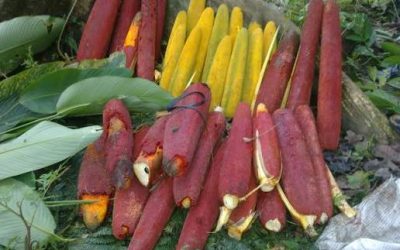
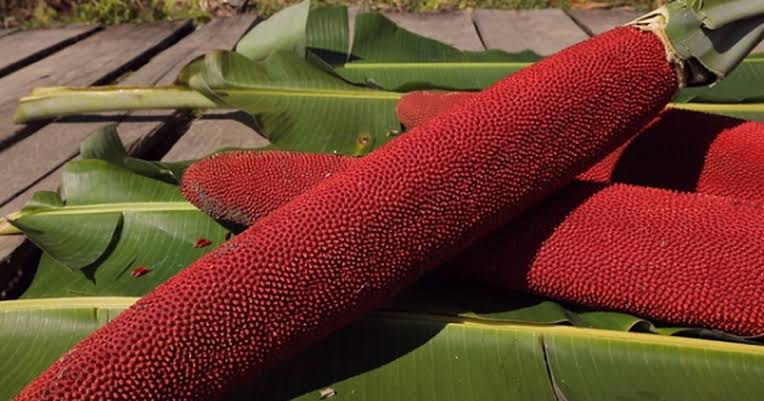
The fruit is generally long and cylindrical to somewhat tapered, with many tightly packed individual fruit units arranged around a central core. As it matures, the outer surface can develop shades ranging from reddish-orange to deep red or maroon. The exact appearance is not identical in every plant because local forms and cultivated types can vary in color, size, shape, and overall structure.
Inside, the fruit contains harder central and fibrous parts surrounded by softer material that becomes easier to separate after cooking. This outer fruit material contains the naturally oily component that is collected during traditional processing.
Several visual features are commonly associated with mature buah merah:
- an elongated or cylindrical overall form;
- densely arranged fruit units along the surface;
- reddish, orange-red, or darker mature coloration;
- a firm central structure;
- softer outer material after heating or cooking;
- noticeable variation between different local forms.
Because of this natural diversity, it is better to describe buah merah by its general botanical features rather than assume that every fruit has the same dimensions or exact shade.
3.1 Why Is It Called “Red Fruit”?
The Indonesian name buah merah literally means “red fruit.” The name refers to the prominent red coloration seen in many mature forms of Pandanus conoideus and in the processed fruit material.
That color also carries through into the oily fraction. After the fruit is softened and processed, the separated oil commonly appears reddish-orange to deeper red, although the final shade can differ depending on the fruit and the way it was prepared.
The name is simple, but it can create confusion for international readers because “red fruit” may refer to many unrelated foods. In discussions about Papua, buah merah specifically refers to Pandanus conoideus. Using the scientific name alongside the common name helps make that distinction clear.
4. Where Does Papua Red Fruit Grow?
Papua red fruit (Pandanus conoideus) is strongly associated with Papua and the island of New Guinea, but its natural distribution extends beyond Papua. Kew’s Plants of the World Online records the species from Maluku through New Guinea and several western Pacific island groups.
This distinction is useful when discussing red fruit oil Papua. Papua is an important part of the fruit’s cultural and product identity, yet describing P. conoideus as a plant that grows naturally nowhere else would be inaccurate.
Kew also classifies the species as a tree that primarily occurs in the wet tropical biome. Its association with tropical New Guinea therefore reflects both its botanical distribution and its long presence in local landscapes.
4.1 Papua and New Guinea
Papua occupies the western part of the island of New Guinea, while the independent country of Papua New Guinea occupies the eastern part. From a botanical perspective, Kew lists New Guinea as a whole within the native range of Pandanus conoideus.
In Indonesian Papua, the plant is commonly known as buah merah and is particularly familiar as a cultivated food plant. Its close connection with Papua comes from more than geography: local cultivation, food preparation, and community knowledge have helped make the fruit recognizable as part of Papuan food culture.
This is why terms such as Papua red fruit, buah merah Papua, and Papuan red fruit oil are common even though the botanical species has a wider distribution.
4.2 Is Pandanus conoideus Found Only in Papua?
No. Pandanus conoideus is not found naturally only in Papua.
Kew currently records its native distribution in:
- Maluku
- New Guinea
- Bismarck Archipelago
- Caroline Islands
- Solomon Islands
- Vanuatu
The most accurate way to describe its origin, therefore, is to say that buah merah is especially associated with Papua and Papuan food traditions, while Pandanus conoideus has a broader native range across New Guinea and parts of the western Pacific.
This wording preserves the important Papua connection without turning a cultural association into an inaccurate claim about the plant’s entire natural distribution.
5. Why Is Buah Merah Strongly Associated with Papua?
Although Pandanus conoideus has a natural range extending beyond Papua, buah merah has a particularly strong connection with Papuan agriculture and food culture. That connection comes from generations of cultivation, local knowledge, traditional preparation, and the fruit’s familiarity within a number of Papuan communities.
Indonesian agricultural literature documents buah merah in several areas of Papua, particularly in and around the central highlands. Locations associated with its cultivation include parts of Jayawijaya, Wamena, Tolikara, Pegunungan Bintang, Yahukimo, and other Papuan regions. Agricultural research also describes the fruit as part of everyday food practices among communities in Papua’s central mountain areas.
One reason for this strong identity is that the plant has traditionally been maintained within local gardens and agricultural systems rather than existing only as an unfamiliar wild species. Growers have selected and cultivated different forms of buah merah, resulting in variation in fruit color, size, shape, and local naming. Research from Papua has recorded multiple cultivated accessions, illustrating how communities have maintained their own plant material over time.
Its culinary role is equally important. In some Papuan highland communities, processed buah merah has been used as part of meals and as an accompaniment or seasoning for other foods. The exact preparation and importance of the fruit can differ from one community to another, so it is more accurate to describe it as a recognized Papuan food plant rather than suggest that every Papuan group prepares it in the same way.
Local terminology also reflects this cultural diversity. Different communities may use different names for Pandanus conoideus or for particular local forms. Buah merah is the widely recognized Indonesian term, while names such as kuansu appear in some sources. Other community-specific names also exist, which is why no single local name should be presented as universal across Papua.
This combination of longstanding cultivation, regional food traditions, local plant diversity, and continued familiarity explains why products made from the fruit are commonly identified internationally as Papua red fruit or Papua red fruit oil. The Papua connection is therefore primarily cultural, agricultural, and culinary rather than a claim that the species occurs nowhere else.
6. How Is Red Fruit Oil Made?
Red fruit oil is made by processing mature buah merah (Pandanus conoideus) so the oily portion can be separated from the fruit material. Traditional methods commonly involve softening the fruit, separating the pulp from harder parts, and then using heating, pressing, settling, or filtering to collect the oil.
There is no single preparation method used throughout Papua. Research on traditional processing notes differences between regions, including the amount of water used, heating time, and the way oil is separated. A common principle is wet extraction, where water and heat help release oil from the processed fruit.
6.1 Selecting Mature Red Fruit
Processing begins with mature buah merah. At this stage, the fruit has developed the coloration and fruit material needed for further preparation.
Fruit condition matters because damaged, spoiled, or heavily contaminated material can affect the finished product. In household and small-scale processing, unwanted material may therefore be removed before the fruit moves to the next stage.
Maturity should not be judged by one universal shade of red. Different P. conoideus forms can vary naturally, so experienced growers and processors may use several characteristics rather than color alone.
6.2 Cleaning the Fruit
The harvested fruit is generally cleaned before processing. Dirt and unwanted plant material are removed, and the fruit may be divided into more manageable portions.
Traditional practices differ according to location and available equipment. The important purpose of this stage is straightforward: prepare the fruit for softening while reducing unwanted material that could enter the pulp and oil.
6.3 Cooking or Softening the Fruit
One of the key steps is softening the fruit through heat. Traditional descriptions from Papua include boiling or other forms of cooking, often with water. Heating changes the firm fruit material into a softer form that can be worked more easily.
The exact technique is not universal. Some communities use cooking vessels, while documented food traditions in other areas use locally adapted heating methods. The length and intensity of heating can also differ.
For this reason, it is more accurate to describe cooking as a general processing stage rather than present one specific recipe as the traditional Papuan method.
6.4 Separating the Pulp
Once softened, the fruit material can be worked away from the harder structural portions. Depending on the local method, this may involve crushing, rubbing, pressing, or manually working the cooked fruit.
The goal is to obtain the softer pulp and oily material while separating components that are not intended to remain in the finished oil.
This stage also helps explain why a bottle of buah merah oil looks so different from the original fruit. The finished liquid is only one separated portion of a much larger and more structurally complex fruit.
6.5 Separating the Oil
The processed pulp then undergoes further separation. In documented traditional methods, this can involve additional heating, pressing, or allowing the mixture to separate so that the oily layer can be collected.
Oil and water behave differently, so an oily layer may become distinguishable from the wetter fruit mixture during processing. The processor can then separate that fraction from the remaining pulp and liquid.
Some traditional methods rely more heavily on heat, while others incorporate pressing and gravity. This regional variation is an important part of understanding traditional red fruit processing.
6.6 Filtering the Oil
After separation, the collected oil may still contain small particles of fruit material or other suspended matter. Filtering or settling can help remove some of these solids before the oil is placed into a container.
The degree of clarification varies. A household-produced oil may not have exactly the same appearance as a more extensively filtered commercial product.
Research on crude buah merah oil also shows that freshly extracted oil can contain non-oil components that may be reduced through additional refining or clarification processes.
This means a difference in clarity does not, by itself, prove that one oil is authentic and another is not.
6.7 Traditional vs Commercial Processing
The basic goal is the same in both settings: separate usable oil from Pandanus conoideus fruit. The equipment and level of process control, however, can differ.
| Traditional Processing | Commercial Processing |
| Often household or community scale | Usually organized for repeated production |
| May rely on manual handling and simple equipment | May use dedicated processing equipment |
| Commonly uses locally adapted heating or wet extraction | May use controlled wet or dry extraction methods |
| Pressing, settling, or simple filtering may be used | Filtration and clarification can be more standardized |
| Methods can vary considerably by community | Greater emphasis may be placed on batch consistency and packaging |
Research comparing extraction methods confirms that processing conditions matter, particularly factors such as the presence of water, heating temperature, and heating duration. It also shows that wet extraction and dry extraction are distinct approaches rather than one universal procedure.
Commercial processing should therefore not be understood simply as a mechanized copy of one traditional recipe. A producer may adjust extraction, clarification, filtration, and packaging according to its equipment and intended product.
Likewise, traditional production is not a single fixed technique. Methods documented in different parts of Papua show meaningful variation in how the fruit is softened, pressed, heated, and separated. What connects these approaches is the same basic transformation: a mature buah merah fruit is processed until its naturally oily fraction can be collected as red fruit oil.
7. What Does Red Fruit Oil Look Like?
Red fruit oil typically has a naturally reddish to red-orange appearance, although the exact shade can vary from one product to another. Some oils may look brighter and more orange, while others appear deeper red or slightly darker.
The oil is produced from the processed pulp of mature buah merah (Pandanus conoideus), so its color reflects both the fruit itself and the way it has been handled. Depending on the processing method, the finished oil may look relatively clear, slightly opaque, or contain a small amount of natural sediment.
Its texture is generally oily and fluid, although thickness can vary with temperature and processing. A less refined or minimally filtered product may look different from a more thoroughly clarified commercial oil.
Several factors can influence the final appearance:
- Cultivar or local plant form: different buah merah types can vary naturally.
- Fruit maturity: the stage of ripeness can affect the starting material.
- Processing method: heating, pressing, and separation methods may change the appearance.
- Heating conditions: differences in temperature and processing time can affect color.
- Filtration: more filtering may remove suspended fruit particles and produce a clearer oil.
- Storage: prolonged exposure to heat, light, or air may gradually alter the oil’s appearance.
For this reason, color should not be used as a stand-alone test of authenticity or quality. A very dark red oil is not automatically better than a lighter red-orange product, and a brighter shade does not necessarily mean that the oil is fresher.
The most useful visual description is therefore broad rather than rigid: Papua red fruit oil is usually a reddish, red-orange, or darker red oily liquid whose exact appearance depends on the fruit and processing conditions.
8. What Does Red Fruit Oil Taste and Smell Like?
Red fruit oil has a distinctive aroma and flavor associated with processed Pandanus conoideus fruit. Its sensory character can vary, however, because different fruit types and processing methods do not always produce exactly the same result.
Research describing red fruit oil in food products refers to a recognizable red-fruit-specific aroma and taste, while other studies describe its flavor as relatively mild or neutral. This variation makes it difficult to define the oil with one universal flavor description.
In general, a red fruit oil product may have:
- a recognizable cooked-fruit or red-fruit aroma;
- a mild to more noticeable fruit character;
- a rich, oily mouthfeel;
- a flavor influenced by heating and clarification;
- varying aroma intensity depending on processing and storage.
The oily texture is another noticeable part of the experience. Sensory research involving foods prepared with red fruit oil describes an oily mouth-coating sensation, which is expected from an ingredient whose main physical form is oil.
Processing can make a substantial difference. Oil produced using prolonged heating may develop a different aroma from oil processed under other conditions. Filtering and clarification can also change how much fruit material remains in the final product, which may influence both flavor and smell.
Storage matters as well. Like other food oils, red fruit oil can change when exposed unnecessarily to air, heat, or light. An unusual odor in an old or poorly stored product should therefore not be treated as the normal aroma of buah merah.
Because cultivars, traditional methods, and commercial processing practices vary, two genuine red fruit oils do not necessarily need to taste or smell identical. A particular level of sweetness, fruitiness, or aroma strength should not be used by itself as proof that a product is authentic.
9. How Is Buah Merah Traditionally Used as Food?
Buah merah has long been used as a food ingredient in parts of Papua, especially after the fruit has been cooked and processed. Rather than commonly being eaten in the same way as a fresh table fruit, Pandanus conoideus is traditionally softened so its oily pulp can be separated and incorporated into food.
An Indonesian ethnobotanical study of edible Pandanaceae records Pandanus conoideus among pandan species used as food and describes buah merah as a source of a vegetable-based sauce or seasoning in Papua. Agricultural literature likewise reports its use in the central highlands of Papua as an accompaniment or seasoning for staple foods.
The traditional food context can include:
- processing the softened fruit into an oily pulp or sauce;
- adding the processed fruit material to other foods;
- using it as an accompaniment to staple dishes;
- preparing it during household or community meals;
- separating some of its oily portion for culinary use.
This helps explain why red fruit oil and whole buah merah are closely related but not identical food forms. Traditional preparation may retain more of the processed pulp, whereas bottled red fruit oil is the separated oily fraction.
It is also important not to present Papuan food culture as a single uniform tradition. Papua contains many communities with different languages, crops, preparation methods, and local names. Agricultural sources note that the diversity of ethnic groups in Papua has influenced the naming and identification of different buah merah forms.
Names for the plant can therefore vary locally. Buah merah is the widely used Indonesian term, while names such as kuansu and other community-specific terms appear in published sources. The safest description is that Pandanus conoideus is a recognized traditional food plant in several Papuan communities, rather than implying that every community prepares or consumes it in exactly the same way.
For international readers, this culinary background is useful because modern Papua red fruit oil is often encountered first as a bottled product. Its origin, however, lies in a much broader tradition of processing the fruit as food and separating its naturally oily material for use alongside other foods.
10. Red Fruit Oil vs Whole Buah Merah
Red fruit oil and whole buah merah come from the same plant, Pandanus conoideus, but they are different forms of the product. Whole buah merah is the complete fruit, while red fruit oil is the oily fraction separated after the fruit has been processed.
This distinction is useful because the terms are sometimes used too loosely in English. A fresh or harvested buah merah still contains its central structure, fruit units, pulp, moisture, and oily material. By contrast, a bottled red fruit oil product has already gone through several preparation steps to separate the oil from much of the remaining fruit material.
| Feature | Whole Buah Merah | Red Fruit Oil |
| Form | Whole Pandanus conoideus fruit | Processed oily fraction |
| Appearance | Large, elongated red to maroon fruit | Red-orange to deeper red oil |
| Preparation | Requires softening and processing | Oil has already been separated |
| Culinary form | Processed pulp or fruit material | Concentrated oily product |
| Structure | Includes pulp, core, and other fruit parts | Mainly the separated oil portion |
| Storage | Depends on fresh-fruit handling conditions | Depends on packaging and producer instructions |
The whole fruit generally requires preparation before it is used as food. Traditional processing softens the fruit so the pulp and oily material can be worked away from the harder structural parts. That processed pulp may itself be used in food, or its oily portion may be separated further.
Red fruit oil is therefore a processed form of buah merah, not a different fruit or plant species. Both ultimately come from Pandanus conoideus.
The difference also affects how consumers encounter the product. Outside Papua, whole buah merah may be difficult to find because it is bulky, perishable, and requires preparation. Red fruit oil, on the other hand, can be filtered, bottled, labeled, and transported as a finished product.
For product identification, it is helpful to think of the relationship this way:
Buah merah fruit → processed fruit pulp → separated red fruit oil
This simple sequence shows why buah merah, buah merah oil, and Papua red fruit oil are closely connected terms while still describing different physical forms.
11. Red Fruit Oil vs Red Palm Oil
Papua red fruit oil and red palm oil are different oils from entirely different plants. Their reddish appearance can make the names sound similar, but their botanical sources are unrelated.
Papua red fruit oil comes from buah merah (Pandanus conoideus), a species in the Pandanaceae family. Kew recognizes P. conoideus as an accepted species native from Maluku through New Guinea to parts of the western Pacific.
Red palm oil, by contrast, is typically produced from the fruit of the African oil palm (Elaeis guineensis). Kew places this species in the Arecaceae, or palm, family and records its native range in tropical Africa.
The basic distinction is clear:
| Feature | Papua Red Fruit Oil | Red Palm Oil |
| Botanical source | Pandanus conoideus | Typically Elaeis guineensis |
| Plant family | Pandanaceae | Arecaceae |
| Plant group | Pandan | Palm |
| Raw material | Buah merah fruit | Oil palm fruit |
| Geographic association | Strongly associated with Papua and New Guinea | Originates from tropical Africa |
| Typical color | Red-orange to deeper red | Orange-red to red |
| Same product? | No | No |
The plants are also classified in different botanical orders. Pandanus conoideus belongs to Pandanales, while Elaeis guineensis belongs to Arecales.
For shoppers, the botanical name is therefore more useful than color alone. A red or orange appearance does not show that an oil comes from buah merah. If a product is presented as Papua red fruit oil, its ingredient information should identify Pandanus conoideus or clearly state that it is derived from buah merah.
Despite their similar reddish colors, Papua red fruit oil and red palm oil come from completely different botanical plants and should not be treated as interchangeable names for the same oil.
12. Red Fruit Oil vs Pandan Oil
Papua red fruit oil should not automatically be treated as the same thing as “pandan oil.” The word pandan can refer to many plants within the genus Pandanus, so a product described only as pandan oil may come from a different species or plant part.
Papua red fruit oil specifically comes from the fruit of Pandanus conoideus. By contrast, pandan products used for their familiar fragrance are commonly associated with Pandanus amaryllifolius, a separate species whose leaves are widely used as an aromatic culinary ingredient.
Kew recognizes both P. conoideus and P. amaryllifolius as separate accepted species within the genus Pandanus and family Pandanaceae.
The distinction is easier to see when the botanical source and plant part are compared:
| Feature | Papua Red Fruit Oil | Pandan Leaf Products |
| Typical botanical source | Pandanus conoideus | Commonly Pandanus amaryllifolius |
| Main plant part | Fruit | Leaves |
| Product identity | Oil separated from processed buah merah | Extract, flavoring, or aromatic preparation |
| Main association | Papua red fruit and its food traditions | Fragrant pandan used in Southeast Asian cooking |
| Same species? | No | No |
The term “pandan oil” can be ambiguous because it does not identify either the species or the plant part. It might be used commercially for a pandan leaf preparation, aromatic flavoring, or another product associated with plants in the Pandanus genus. The ingredient list is therefore more informative than the broad product name.
There is also an important botanical connection between the two plants. Both belong to Pandanaceae, and both are members of Pandanus. That family relationship explains why buah merah may reasonably be described as a type of pandan fruit. It does not mean that red fruit oil is produced from the same plant used for fragrant pandan leaves.
For clear identification, look for Pandanus conoideus when the intended product is buah merah oil or Papua red fruit oil. This scientific name removes the ambiguity created by the more general term “pandan oil.”
13. Red Fruit Oil vs Dragon Fruit
Papua red fruit and dragon fruit are completely different fruits. The confusion mainly comes from the broad English phrase “red fruit,” which does not identify a particular plant unless additional context is provided.
Papua red fruit is buah merah (Pandanus conoideus), a member of the Pandanaceae family. Kew recognizes it as an accepted Pandanus species native from Maluku through New Guinea to parts of the western Pacific.
Dragon fruit, by contrast, comes from climbing cactus species in the genus Selenicereus. One widely cultivated example is Selenicereus undatus, formerly known as Hylocereus undatus. Kew classifies this plant in the Cactaceae, or cactus family.
The two can be distinguished easily:
| Feature | Papua Red Fruit | Dragon Fruit |
| Botanical group | Pandanus conoideus | Selenicereus species |
| Family | Pandanaceae | Cactaceae |
| Plant type | Fruit-bearing pandan | Climbing cactus |
| Typical fruit form | Long, compound fruit with densely arranged units | Rounded to oval fruit with prominent outer scales |
| Connection to red fruit oil | Source of Papua red fruit oil | Not used to make buah merah oil |
The name buah merah, meaning “red fruit” in Indonesian, refers to the characteristic coloration of mature P. conoideus fruit and its processed material. It does not refer to dragon fruit simply because some dragon fruit varieties have red skin or flesh.
For this reason, using the phrase Papua red fruit (buah merah, Pandanus conoideus) is especially useful for international readers. It makes clear that the subject is a Papuan pandan fruit rather than dragon fruit or another unrelated red-colored fruit.
14. How Is Buah Merah Cultivated?
Buah merah (Pandanus conoideus) is cultivated in gardens and around settlements in parts of Papua, alongside its presence in the wider New Guinea region. In the Balim Valley of Jayawijaya, for example, Indonesian research records local cultivation in household yards and gardens.
The species is associated with tropical environments, but growing conditions are not identical across its range. Cultivated forms can occur from lower elevations into highland areas of New Guinea, reflecting the ecological diversity of the species and the varieties maintained by local growers.
Buah merah can be propagated in several ways:
- Offshoots or suckers growing from established plants;
- Stem cuttings taken from suitable plant material;
- Seeds, providing a generative method of propagation.
Research published through BRIN notes that P. conoideus is commonly propagated vegetatively through offshoots and stem cuttings, while propagation from seed is also possible.
Cultivation practices vary according to location, available planting material, and local knowledge. For that reason, it is better to view Papua red fruit cultivation as a collection of locally adapted practices rather than one standardized farming system.
14.1 Why Vegetative Propagation Matters
Vegetative propagation means producing a new plant from part of an existing plant rather than starting from a seed. In buah merah cultivation, this can involve offshoots or stem cuttings.
One practical advantage is that the new plant originates from the selected parent plant. This can help growers preserve recognizable characteristics of a preferred local form more consistently than propagation from genetically variable seedlings.
That point is especially relevant for buah merah because considerable diversity exists among cultivated plants. Fruit appearance and other characteristics can differ between local forms, so maintaining selected planting material can be important to growers who want to continue a particular type.
Seed propagation still has a role, particularly in plant diversity and reproduction. However, documented cultivation in Papua shows why vegetative methods remain useful where growers wish to reproduce established plants with familiar characteristics.
15. Are There Different Types of Papua Red Fruit?
Yes. Considerable variation exists among Papua red fruit plants, and different cultivated forms of Pandanus conoideus can differ in their visible characteristics. This diversity is one reason it is difficult to describe every buah merah fruit using a single fixed size, shape, or shade of red.
Published ethnobotanical literature specifically refers to the diversity of Pandanus conoideus from Papua, while botanical research in New Guinea distinguishes cultivated forms from wild material.
Differences between local forms may include:
- fruit size and length;
- overall fruit shape;
- color at maturity;
- size and arrangement of fruit units;
- characteristics of the parent plant;
- names used by particular communities or growers.
Research on P. conoideus in Papua has also documented the importance of cultivation. A botanical study from the Foja-Mamberamo area described the discovery of a wild form after the species had long been particularly well known through cultivated plants in New Guinea. The researchers observed differences between the wild fruiting structure and cultivated forms, illustrating the effects that long-term cultivation and selection can have on plant appearance.
Local naming adds another layer of complexity. A name used for one cultivated form in a particular area should not automatically be assumed to have the same meaning throughout Papua. Communities may classify plants according to characteristics that are locally useful or familiar.
For consumers, this diversity has a practical implication: genuine buah merah does not have to look exactly the same in every photograph or produce oil with precisely the same shade. Differences in the original plant material can contribute to variation in the fruit and its processed products.
Rather than treating one local form as the universal standard, it is more accurate to recognize Papua red fruit as a botanically identifiable species that includes substantial cultivated variation. The scientific name Pandanus conoideus provides the common botanical reference even when individual fruits differ in appearance.

16. What Determines the Quality of Red Fruit Oil?
The quality of red fruit oil depends on more than its color. The condition of the buah merah fruit, processing method, cleanliness, packaging, and storage can all influence how the finished oil looks, smells, and remains stable over time.
Research on Pandanus conoideus oil shows that extraction conditions are particularly important. Temperature, heating time, and the presence of water during processing can affect characteristics of the resulting oil. A 2025 study also found that changing heating conditions during dry extraction influenced oil yield and measured chemical properties.
Important factors include:
- Raw fruit condition: mature fruit in suitable condition provides a better starting material than damaged or deteriorated fruit.
- Clean handling: unwanted dirt and plant material should be kept out of the processed pulp and oil.
- Heating conditions: temperature and processing time can influence the finished product.
- Oil separation: effective separation helps distinguish the oily fraction from water and remaining fruit material.
- Filtration or clarification: these steps influence the amount of suspended material in the bottled oil.
- Exposure to air and heat: unnecessary exposure can contribute to changes during storage.
- Packaging: a properly closed container helps protect the oil from contamination and outside conditions.
- Storage: temperature and storage time can affect oil stability.
Storage research on red fruit oil found that quality indicators changed more rapidly as storage temperature and time increased. Studies have therefore used dark bottles and controlled temperatures when evaluating how the oil changes during storage.
These factors also explain why two products made from genuine P. conoideus fruit may not look completely identical.
16.1 Color Alone Is Not Enough
A common mistake is to judge Papua red fruit oil quality only by how red it looks.
A darker oil is not automatically better, and a bright red-orange oil is not automatically more authentic. Natural color can be influenced by:
- the particular buah merah form or cultivar;
- maturity of the fruit;
- heating conditions;
- extraction method;
- filtration and clarification;
- storage conditions and duration.
Research on extraction confirms that heating conditions can alter characteristics of red fruit oil, including its naturally occurring pigments.
Color is therefore useful as a general descriptive feature, but it should be considered together with labeling, packaging, producer information, and the condition of the product.
The same caution applies to sediment. A small amount of suspended material may reflect the level of filtration, but sediment by itself cannot prove either authenticity or poor quality.
16.2 Ingredient Transparency
For a commercially packaged buah merah oil, the label can provide more reliable information than visual inspection alone.
Useful details to check include:
- a clear product name;
- an identifiable ingredient list;
- buah merah or Pandanus conoideus where botanical identification is provided;
- the name and address of the producer or importer;
- production or batch information;
- expiry or best-before information;
- storage instructions where applicable;
- intact, properly sealed packaging;
- applicable Indonesian food-registration or labeling information.
BPOM’s guidance for packaged processed foods in Indonesia lists information such as the product name, ingredients, producer or importer identity, production code, expiry information, and applicable authorization details among the elements that may be required on food labels.
This approach is more dependable than judging authenticity from dark color, strong aroma, sediment, or price alone. None of those characteristics can independently confirm that a bottle contains genuine Pandanus conoideus oil.
For buyers, credible product identification therefore comes from a combination of clear botanical or ingredient information, traceable labeling, sound packaging, and appropriate storage guidance, rather than one dramatic visual characteristic.
17. How Should Red Fruit Oil Be Stored?
Red fruit oil should be stored according to the instructions provided on the product label. As with other packaged food oils, protecting it from unnecessary heat, light, air exposure, moisture, and contamination can help preserve its normal appearance and sensory qualities.
General storage practices include:
- keep the container tightly closed when not in use;
- store it away from direct sunlight;
- avoid placing it close to stoves, ovens, or other heat sources;
- use clean, dry utensils if the product is transferred or handled;
- prevent water or food particles from entering the container;
- follow any refrigeration or temperature guidance given by the producer;
- observe the stated expiry or best-before information.
The type of packaging also matters. Dark or light-resistant containers can reduce unnecessary exposure to light, while a properly fitted cap helps limit contact with air and outside contaminants.
Storage conditions may also affect the oil’s color, aroma, and overall stability. Research on Pandanus conoideus oil has found that storage temperature and duration can influence measured oil-quality characteristics, which is why controlled storage is an important part of handling the finished product.
There is no single universal shelf life for every Papua red fruit oil. A product’s usable storage period can depend on several factors, including:
- the extraction method;
- degree of filtration or clarification;
- packaging material;
- manufacturing controls;
- storage temperature;
- how frequently the container is opened.
For this reason, it is better to follow the producer’s labeled guidance than assume that every traditional or commercially bottled red fruit oil remains suitable for the same length of time.
Changes in appearance alone should also be interpreted cautiously. Some products may naturally differ in clarity or contain a small amount of sediment because processing methods vary. If a packaged oil develops an unexpected odor, damaged seal, leaking container, or other obvious sign of deterioration, the safest practical approach is to rely on the producer’s handling instructions rather than trying to judge quality from color alone.
Good storage does not require complicated treatment. The basic goal is simply to keep the oil properly closed, clean, and protected from excessive heat and light for as long as the manufacturer recommends.
18. Is Papua Red Fruit Oil the Same as a Supplement?
Not necessarily. Red fruit oil itself is a processed product derived from buah merah (Pandanus conoideus), but that does not automatically make every red fruit oil product a supplement.
The distinction depends on how a particular product is formulated, labeled, registered, and marketed. A bottle containing red fruit oil may be presented as a food-derived oil or ingredient, while another commercial preparation containing red fruit oil could fall into a different regulatory category.
In Indonesia, BPOM defines processed food (pangan olahan) as food or drink produced through a particular processing method, with or without added ingredients. BPOM separately defines health supplements (suplemen kesehatan) according to their intended purpose and composition.
This means the botanical ingredient alone does not tell you the legal category of a finished product.
Depending on the specific formulation and applicable regulations, products associated with buah merah may be encountered as:
- a processed food product;
- a culinary or food ingredient;
- a formulated commercial product containing red fruit oil;
- another legally defined product category indicated on its packaging.
For consumers, the practical approach is to read the product label rather than assume that all buah merah oil is a supplement. Look at the stated product category, ingredient list, producer information, directions for intended use, and any applicable registration details.
This distinction is also useful when reading about traditional Papua red fruit. Historically, buah merah belongs within a food and culinary context, whereas the modern term “supplement” describes a particular type of regulated commercial product. The two ideas should not be treated as interchangeable.
In short, Papua red fruit oil describes what the product is made from, while “supplement” describes how a specific finished product may be formulated and regulated. The label and applicable regulatory information provide the clearest answer for an individual product.
19. How to Identify a Credible Red Fruit Oil Product
When choosing Papua red fruit oil, a credible product should provide enough information for the buyer to understand what it contains, who produced it, and how it should be stored. Appearance alone cannot confirm that an oil is genuine Pandanus conoideus oil.
Start with the label. Useful information to look for includes:
- a clear product name;
- an identifiable ingredient list;
- buah merah or Pandanus conoideus where botanical identification is provided;
- producer or importer name and address;
- production or batch information;
- expiry or best-before information;
- storage instructions where applicable;
- intact, sealed packaging;
- applicable registration or authorization information.
For packaged processed foods sold under Indonesian regulations, BPOM states that labels generally include details such as the product name, ingredients, net contents, producer or importer identity, production date and code, expiry information, and applicable authorization number.
The botanical name can be particularly useful for an international buyer. Words such as “red fruit,” “red oil,” or “pandan oil” can describe very different products. A reference to Pandanus conoideus helps establish that the ingredient is connected specifically with buah merah rather than red palm fruit or aromatic pandan leaves.
Packaging condition deserves attention as well. A properly sealed container with readable labeling provides more useful information than an unmarked bottle whose origin or contents cannot easily be traced. Batch or production codes can also help identify a particular production run.
For products marketed in Indonesia with BPOM registration, consumers can use BPOM’s official product database to search by details such as product name, brand, registration number, registrant, or composition.
19.1 Do Not Judge Authenticity by Color Alone
A deep red color may look characteristic of buah merah oil, but it is not proof of authenticity.
As discussed earlier, color can vary because of:
- the local form or cultivar of P. conoideus;
- fruit maturity;
- heating conditions;
- extraction method;
- filtration;
- storage.
The same caution applies to aroma and sediment. A strong smell does not automatically indicate a more authentic product, while a clearer oil is not necessarily less genuine than one containing visible particles.
Price is equally unreliable as a stand-alone measure. A higher price can reflect packaging, transportation, processing, branding, or other commercial factors. It does not independently prove botanical identity or product quality.
19.2 Look for Clear and Realistic Product Information
Credible labeling should explain the product in straightforward terms rather than relying on vague descriptions or exaggerated promises.
For red fruit oil Papua, useful product information focuses on points such as:
- what plant the oil comes from;
- the listed ingredients;
- where the product was manufactured;
- how it was packaged;
- how it should be stored;
- when it should be used by.
This type of information gives the buyer practical ways to evaluate a product without relying on folklore or visual assumptions.
For Indonesian packaged foods, BPOM also provides for production codes and storage instructions on labels where relevant, helping consumers trace and handle products appropriately.
In practical terms, identifying a credible buah merah oil product is less about finding the darkest bottle or strongest aroma and more about transparent labeling, identifiable ingredients, traceable producer information, sound packaging, and appropriate regulatory details.
20. What Is the Difference Between Papua and Papua New Guinea Red Fruit?
The main difference is geographic terminology, not necessarily the botanical species. In this article, Papua refers to the Indonesian side of New Guinea, while Papua New Guinea is the independent country occupying the eastern portion of the island.
This distinction matters because the island of New Guinea crosses an international border. A fruit growing on the western side may be described in an Indonesian Papua context, whereas similar plant material on the eastern side would be located in Papua New Guinea.
For Pandanus conoideus, however, the political border does not define the plant’s natural distribution. Kew records New Guinea as part of the species’ native range, together with Maluku, the Bismarck Archipelago, Caroline Islands, Solomon Islands, and Vanuatu.
In simple terms:
| Term | Meaning in This Context |
| Papua | Indonesian territory on the western side of New Guinea |
| Papua New Guinea | Independent country occupying most of the eastern side of New Guinea |
| New Guinea | The island shared mainly by Indonesia and Papua New Guinea |
| Pandanus conoideus | A botanical species native to New Guinea and other parts of the region |
| Buah merah | Indonesian name strongly associated with P. conoideus in Papua |
The phrase “buah merah Papua” is particularly connected with Indonesian language and Papuan product identity. “Buah merah” literally means “red fruit” in Indonesian, so it is natural to encounter this terminology more often in products, agricultural publications, and food discussions originating from Indonesian Papua.
That does not mean Pandanus conoideus stops occurring at the international border. Kew’s botanical distribution treats New Guinea as part of the species’ native range rather than restricting it to one country’s territory.
For international readers, it is therefore useful to separate product identity from botanical distribution. “Papua red fruit oil” usually points to the Indonesian Papuan context of buah merah, while Pandanus conoideus itself belongs to a broader New Guinea and western Pacific botanical region.
21. Why the Scientific Name Pandanus conoideus Matters
The scientific name Pandanus conoideus helps identify exactly which plant is meant by Papua red fruit. This is especially useful for international readers because the phrase “red fruit” is broad and can refer to many unrelated fruits.
Kew recognizes Pandanus conoideus Lam. as an accepted species in the Pandanaceae family and Pandanus genus. Its native range includes New Guinea as well as Maluku and several western Pacific island groups.
Using the botanical name helps separate buah merah from products or plants that may have similar everyday names. For example, “red fruit” could otherwise be understood as:
- dragon fruit;
- red palm fruit;
- berries or other red-colored fruits;
- another pandan species;
- a product whose name describes only its color.
The scientific name also prevents confusion with the aromatic pandan commonly used in Southeast Asian cooking. That plant is Pandanus amaryllifolius, which Kew recognizes as a separate species, even though both plants belong to the genus Pandanus and family Pandanaceae.
For this reason, a useful first reference in an English-language article or product description is:
Papua red fruit (buah merah, Pandanus conoideus)
After the plant has been clearly established, shorter terms such as buah merah, Papua red fruit, red fruit, or P. conoideus can be used naturally.
The same principle applies to the oil. Red fruit oil alone can sound ambiguous, while red fruit oil derived from Pandanus conoideus identifies its botanical source much more precisely.
Scientific naming therefore does more than add technical terminology. It provides a stable reference that connects the fruit, the plant, and buah merah oil while distinguishing them from unrelated products that happen to share similar common names.
If you’re looking for Papua herbal products, start with a trusted source. Experience authentic, high-quality red fruit products at Cahya Red Fruit Papua New Guinea! We offer a wide variety of items besides Red Fruit Papua New Guinea — including Papua ant nest and Papua kebar grass. Check out our herbal wellness product in our website!