In Papua New Guinea, sugar fruit is a local name for a particularly sweet type of passionfruit associated with the Highlands. PNG agricultural literature records a passionfruit known locally as “sugar fruit,” and the name is commonly connected with sweet granadilla (Passiflora ligularis).
The fruit is generally eaten fresh for its sweet, seed-filled pulp. Despite its name, it should not be confused with sugar apple or sugarcane, which are completely different plants. “Sugar fruit” is a common name rather than a formal botanical category, so local usage may vary.
Although this fruit is grown and familiar in Papua New Guinea, Passiflora ligularis did not originate there. Kew records the species as native to tropical America, from Panama through parts of northern South America to Peru.
1. What Is Sugar Fruit in Papua New Guinea?
Sugar fruit is a local Papua New Guinea name for a particularly sweet passionfruit grown especially in the Highlands. The term is commonly associated with sweet granadilla (Passiflora ligularis), a climbing passionfruit vine that produces rounded fruits containing soft, seed-filled pulp. PNG agricultural literature specifically identifies P. ligularis as a passionfruit known locally as “sugar fruit.”
The important point is that “sugar fruit” is a common name, not a formal botanical category. It describes how the fruit is known in a particular local setting rather than defining a separate plant group.
This distinction matters because fruit names can change between countries, markets, and communities. The same plant may be called sugar fruit in one place, sweet granadilla in another, or simply granadilla elsewhere. Likewise, a familiar common name does not always identify a species with complete certainty.
For clearer identification, the botanical name is more useful. The PNG crop commonly described as sugar fruit is associated with Passiflora ligularis, an accepted species in the Passifloraceae family. It belongs to the genus Passiflora, the same broader plant group that includes other fruits commonly called passionfruit. Kew recognizes P. ligularis as an accepted species.
So, when you encounter the phrase “PNG sugar fruit,” the simplest interpretation is a sweet passionfruit—most commonly identified as sweet granadilla—known by a local name in Papua New Guinea. However, because vernacular names can vary, the scientific name remains the more precise way to identify the plant.
2. Why Is It Called Sugar Fruit?
The name “sugar fruit” appears to come from the fruit’s noticeably sweet taste. In Papua New Guinea, agricultural publications also record the spelling “suga prut” for Passiflora ligularis, particularly in the Highlands.
This sweetness helps explain why the local name became useful. Research on edible fruits in PNG notes that several fruits commonly grown in Highland environments, including purple passionfruit, tamarillo, pineapple, and strawberry, can have a more tart character. In comparison, P. ligularis is described as very sweet, and its popularity in the Highlands has increased over time.
The term should therefore be understood as a descriptive common name, rather than a statement about the fruit’s measured sugar content. There is no need to assume that sugar fruit contains more sugar than every other passionfruit species or variety.
A more accurate interpretation is simple: the name “sugar fruit” appears to highlight its characteristically sweet flavor, especially when compared with the sharper taste of some other fruits familiar in Papua New Guinea’s Highlands.
3. Is Sugar Fruit the Same as Sweet Granadilla?
In the Papua New Guinea context, sugar fruit is commonly associated with sweet granadilla (Passiflora ligularis). PNG agricultural literature uses the local name “sugar fruit” for this passionfruit, while outside PNG the fruit is more often known as sweet granadilla or simply granadilla.
However, common names should be treated with some care. “Sugar fruit” is not a scientific name, so its use may differ between communities or markets. When a precise identification is needed, the botanical name provides a clearer reference.
3.1 The Botanical Name Passiflora ligularis
The plant usually associated with PNG sugar fruit is Passiflora ligularis Juss. Kew’s Plants of the World Online currently recognizes it as an accepted species. Its basic classification is:
- Genus: Passiflora
- Species: Passiflora ligularis
- Family: Passifloraceae
- Common English name: Sweet granadilla
- Plant group: Passionfruit
Passiflora ligularis belongs to the same genus as many other fruits described as passionfruit. This shared genus explains why sweet granadilla can accurately be described as a type of passionfruit, even though it is a different species from the familiar purple or yellow passionfruit often associated with Passiflora edulis.
Kew also records “granadilla” as a vernacular name associated with P. ligularis. The species is a climbing plant, which is another characteristic it shares with other members of the passionfruit group.
3.2 Why Local Names Can Be Confusing
One fruit can have several names depending on who is describing it and where it is being sold or grown. For example, Passiflora ligularis may be identified through different naming systems:
- Scientific name: Passiflora ligularis
- Widely used common name: Sweet granadilla
- PNG-associated local name: Sugar fruit
- Broader plant group: Passionfruit
The word “granadilla” can create additional confusion because common plant names are not always used consistently from one country to another. A market name, English common name, and local language name may all point to the same species, while a similar term elsewhere can sometimes refer to another related fruit.
For that reason, it is most accurate to say that the PNG fruit called sugar fruit is commonly identified with sweet granadilla (Passiflora ligularis), rather than assuming that every use of the name “sugar fruit” worldwide must refer to exactly the same species.
4. What Does Sugar Fruit Look Like?
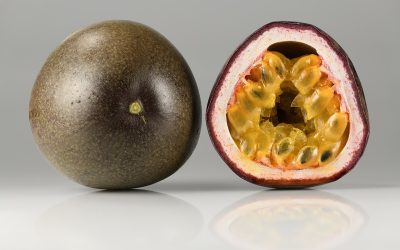
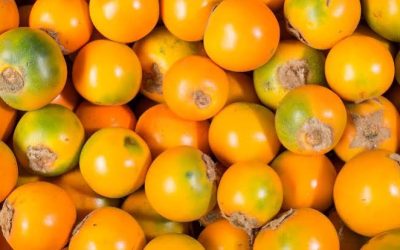
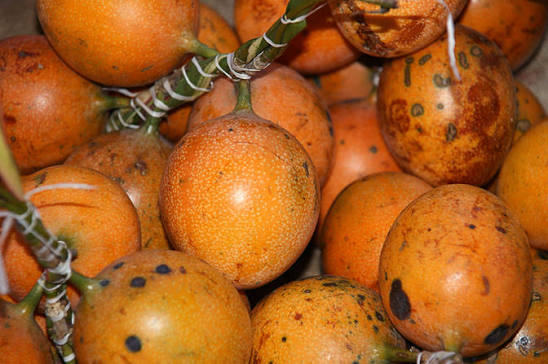
Sugar fruit, when identified as sweet granadilla (Passiflora ligularis), has the rounded shape and seed-filled center typical of passionfruits, but its exterior is distinctive. The OECD describes sweet granadilla fruit as ovoid, with a hard shell and a yellowish-to-orange color that may include small spots or mottling. Kew likewise describes the fruit of P. ligularis as ovoid.
4.1 Outside the Fruit
A mature sweet granadilla is generally round to oval, with a relatively smooth, firm rind. Its skin commonly develops yellow or orange tones as the fruit ripens. Unlike the softer-looking interior, the outer shell provides a sturdy covering around the pulp and seeds.
This appearance can make it look somewhat different from the purple passionfruit familiar in many supermarkets, even though both belong to the same Passiflora genus.
4.2 Inside the Fruit
Cut the fruit open and the relationship with passionfruit becomes much easier to recognize. Inside is a central mass of soft, translucent or pale jelly-like pulp surrounding numerous dark seeds. The OECD identifies the pulp of sweet granadilla as edible and containing black, flat seeds.
This seed-filled center is one of the most recognizable features of the fruit. The fleshy material around each seed is called an aril, a structure commonly found around seeds in the passionfruit family.
4.3 What Does the Sugar Fruit Plant Look Like?
Sugar fruit does not grow on a conventional fruit tree. Passiflora plants are vines, and the genus includes climbing species that use tendrils for support. Sweet granadilla therefore develops on a climbing passionfruit vine rather than from upright tree branches.
Its combination of yellow-to-orange fruit, firm rind, translucent seed-filled pulp, and climbing growth habit provides useful visual clues when identifying it. However, appearance alone cannot confirm a species because several Passiflora fruits can look similar.
Suggested image alt text: sugar fruit Papua New Guinea sweet granadilla
5. What Does Papua New Guinea Sugar Fruit Taste Like?
The defining characteristic of sugar fruit is its sweet flavor. When the PNG name refers to sweet granadilla (Passiflora ligularis), the fruit has a noticeably sweeter profile than many familiar passionfruits. The OECD describes sweet granadilla as having a sweet, distinctive taste, while purple and yellow passionfruit are described as sweet-sour.
Inside the firm rind, the edible portion consists of soft pulp surrounding numerous seeds. This gives the fruit the familiar passionfruit combination of juicy or jelly-like pulp and noticeable seeds. The seeds are normally eaten together with the pulp, rather than removed individually.
Compared with the sharper flavor people may associate with common passionfruit, sugar fruit generally tastes milder and more strongly sweet. Its flavor still has the distinctive character of a passionfruit, so it is more complex than simply tasting sugary.
Individual fruits can differ, however. Ripeness, growing environment, and natural variation between plants can influence flavor and texture. For this reason, it is better to describe PNG sugar fruit as generally sweet and pleasantly aromatic rather than assume that every fruit will taste exactly the same.
This sensory difference is also useful for understanding the local name: “sugar fruit” emphasizes sweetness, while many other passionfruit types combine sweetness with a more noticeable tart or acidic character.
6. Sugar Fruit vs Regular Passionfruit
Sugar fruit and regular passionfruit are closely related, but they are not necessarily the same species. The PNG fruit commonly called sugar fruit is associated with sweet granadilla (Passiflora ligularis), while the familiar purple and yellow passionfruits are generally forms of Passiflora edulis.
The OECD treats sweet granadilla, purple passionfruit, and yellow passionfruit as separate passionfruit types within the Passifloraceae family. Their differences are especially noticeable in flavor, skin color, and appearance.
| Feature | Sugar Fruit / Sweet Granadilla | Common Passionfruit |
| Common PNG name | Sugar fruit | Passionfruit |
| Typical species | Passiflora ligularis | Often Passiflora edulis |
| Flavor | Generally sweet and mild | Often sweet-tart |
| Outer skin | Yellow to orange, with a relatively hard shell | Commonly purple or yellow, depending on type |
| Interior | Soft pulp surrounding numerous seeds | Jelly-like, seed-filled pulp |
| Growth form | Climbing vine | Climbing vine |
These distinctions help explain why calling sugar fruit simply “passionfruit” is botanically correct but not always specific enough. Passionfruit is a broader group, while sweet granadilla refers to a particular species within that group.
FAO’s Pacific Islands Food Composition Tables, for example, lists passionfruit and purple/yellow passionfruit under Passiflora edulis. This provides another useful example of why the scientific name matters when distinguishing one passionfruit from another.
6.1 Why They Are Both Called Passionfruit
Both fruits belong to the genus Passiflora, which contains many species of climbing plants commonly known as passionflowers or passionfruits. Sweet granadilla is P. ligularis, whereas the widely cultivated purple and yellow passionfruits are associated with P. edulis.
So, sugar fruit can be described as a passionfruit, but that does not mean every passionfruit is sugar fruit. It is similar to using a broad group name and a more specific species name: “passionfruit” tells you the general plant group, while “sweet granadilla” identifies the fruit more precisely.
For someone trying to recognize Papua New Guinea sugar fruit, the most useful clues are its sweet flavor, yellow-to-orange firm exterior, seed-filled center, and association with Passiflora ligularis.
7. Sugar Fruit vs Sweet Granadilla vs Granadilla
The terms sugar fruit, sweet granadilla, and granadilla can overlap, but they are not equally precise. In Papua New Guinea, sugar fruit is a local name associated with a sweet passionfruit. Sweet granadilla is the more widely used common name for Passiflora ligularis, while granadilla is a less specific common-name term that may be used differently from one country to another.
Understanding these names is useful when searching for the fruit outside PNG.
7.1 Sugar Fruit
Sugar fruit is the name most relevant to the Papua New Guinea context. It reflects local terminology rather than formal botanical classification.
When PNG agricultural sources use this name for the Highlands fruit, they associate it with Passiflora ligularis. Someone encountering “sugar fruit” in a PNG market, agricultural discussion, or local food context may therefore be referring to the fruit internationally recognized as sweet granadilla.
The same term should not automatically be applied to fruits with similar names elsewhere because common names can develop independently in different places.
7.2 Sweet Granadilla
Sweet granadilla (Passiflora ligularis) is the clearer international name for the species commonly linked with PNG sugar fruit.
Kew recognizes Passiflora ligularis as an accepted species in the Passifloraceae family and records granadilla among its vernacular names. The species belongs to the genus Passiflora, placing it within the broader passionfruit group.
Using the full expression “sweet granadilla (Passiflora ligularis)” is particularly helpful when botanical accuracy matters because it connects a familiar common name to a specific species.
7.3 Granadilla
The word granadilla requires a little more care. It has a long association with passionfruit plants, but common-name usage varies by region and language. Historically, Granadilla has even appeared in botanical naming connected with the Passiflora group, illustrating how closely the terms have been linked.
For everyday identification, the distinction can be summarized simply:
- Sugar fruit: PNG-associated local name
- Sweet granadilla: common English name for Passiflora ligularis
- Granadilla: a common term whose exact meaning can depend on regional usage
- Passiflora ligularis: the scientific name that provides the clearest species-level identification
So, if you see PNG sugar fruit described as sweet granadilla, the two names are generally referring to the same fruit in this context. If a label simply says “granadilla,” checking the scientific name is a useful way to confirm whether the fruit is Passiflora ligularis.
8. Sugar Fruit vs Sugar Apple: They Are Different Fruits
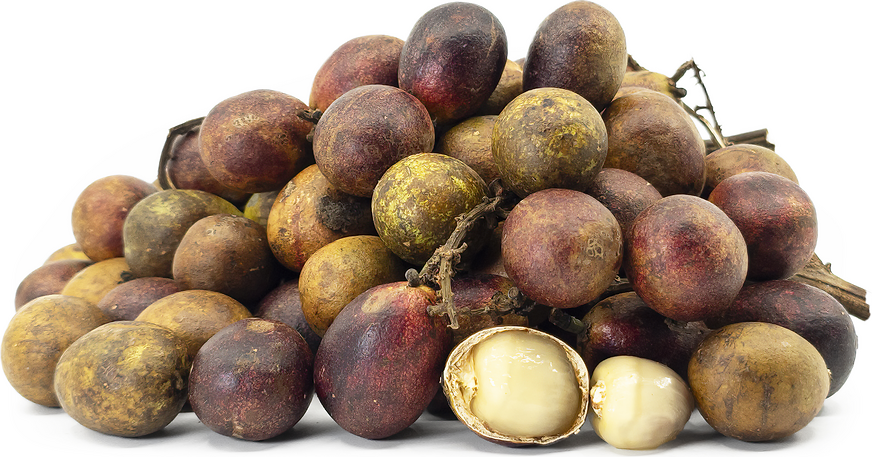
Despite the similar names, sugar fruit and sugar apple are completely different plants. In the Papua New Guinea context, sugar fruit is associated with the passionfruit species Passiflora ligularis. Sugar apple, by contrast, is Annona squamosa, a species in the Annonaceae family. Kew recognizes both as separate accepted species belonging to different botanical families.
Their growth habits are also different. Sugar fruit grows as a climbing Passiflora plant, while Annona squamosa grows as a shrub or small tree.
The fruits are easy to distinguish once you know what to look for:
| Feature | Sugar Fruit | Sugar Apple |
| Likely botanical identity | Passiflora ligularis | Annona squamosa |
| Plant family | Passifloraceae | Annonaceae |
| Growth form | Climbing vine | Shrub or small tree |
| Fruit exterior | Generally smooth and yellow to orange when mature | Distinctive segmented or scaly-looking surface |
| Interior | Jelly-like pulp surrounding numerous seeds | Soft flesh divided around numerous seeds |
| Broader fruit group | Passionfruit | Annona fruit |
Kew also lists “sugar apple” as a common name for Annona squamosa, which helps explain why online searches for “sugar fruit” can sometimes produce confusing results.
For this article, the geographical context is important. Sugar fruit in the Papua New Guinea context should not automatically be interpreted as sugar apple. When PNG agricultural sources discuss the Highlands fruit called sugar fruit, the name is connected with a passionfruit rather than Annona squamosa.
The same distinction applies to sugarcane. Despite sharing the word “sugar,” sugarcane is another unrelated plant. The word in “sugar fruit” functions as part of a local common name and appears to describe the fruit’s sweet character rather than its botanical relationship to other plants containing “sugar” in their names.
9. Is Sugar Fruit Native to Papua New Guinea?
No—if the PNG name “sugar fruit” refers to sweet granadilla (Passiflora ligularis), the species is not native to Papua New Guinea. Kew’s Plants of the World Online records its native range in tropical America, from Panama through parts of northern South America to Peru. More specifically, Kew lists Bolivia, Colombia, Panama, Peru, and Venezuela within its native distribution.
This is an important distinction because a fruit can become strongly associated with a place without having originated there.
A native fruit is one that occurs naturally within a particular geographical region as part of its original distribution. An introduced fruit, by comparison, comes from somewhere else and is later brought into cultivation or becomes established in a new area.
There is also a practical third category: a fruit can become locally familiar through gardens, farms, food traditions, and markets even though its botanical origins lie elsewhere. This helps explain sugar fruit in PNG. Agricultural use and local naming can make a plant part of the everyday fruit landscape without changing where the species originally evolved.
In other words, sugar fruit can be considered a local fruit of Papua New Guinea in an agricultural and culinary sense without being botanically native to the country.
The distinction is particularly useful here because the broader genus Passiflora has a much wider natural distribution. Kew records native Passiflora species in New Guinea, but that does not mean every species in the genus originated there. The specific species associated with sugar fruit, Passiflora ligularis, has its native range in the Americas.
So, describing sugar fruit as grown in Papua New Guinea, especially in the Highlands, is more accurate than calling it a native PNG fruit.
10. Where Does Sugar Fruit Grow in Papua New Guinea?
Sugar fruit is especially associated with Papua New Guinea’s Highlands. Agricultural literature from PNG classifies Passiflora ligularis, sometimes written locally as “suga prut,” among the fruit species grown in Highland environments. One agricultural review reports it across an approximate altitudinal range of 800–2,350 metres, while another PNG crop study gives a usual observed range of about 1,350–2,350 metres.
These records help explain why sugar fruit is often described as a Highland passionfruit rather than a fruit strongly associated with PNG’s hot coastal lowlands. Higher parts of the country generally provide cooler tropical conditions that suit this species better than very warm low-elevation environments.
In practice, fruit production in Papua New Guinea is often connected with village and smallholder agriculture. A National Agricultural Research Institute publication notes that villagers are the main growers of many fruit species in PNG and identifies sugar fruit among the less common Highland fruits with potential for production and sale.
Sugar fruit also moves beyond the gardens where it is grown. Research on PNG fresh-produce supply chains records it among relatively perishable produce transported from the Highlands to Port Moresby, showing that the fruit can enter wider domestic markets rather than remaining solely for household consumption.
It is safest, however, not to assume that sugar fruit is produced equally throughout every Highland province. Available agricultural sources establish a strong connection with the PNG Highlands as a region, but they do not support the same level of production in every province.
So, when asking where sugar fruit grows in Papua New Guinea, the clearest answer is: it is particularly associated with elevated Highland farming areas, where the cooler tropical environment is well suited to this climbing passionfruit.
11. Why Sugar Fruit Grows Well in Highland Areas
The strong association between sugar fruit and the Papua New Guinea Highlands makes sense when its natural growing environment is considered. Sweet granadilla (Passiflora ligularis) is a tropical plant, but it is particularly associated with elevated, humid environments rather than uniformly hot lowland conditions.
Kew records P. ligularis primarily within a wet tropical biome and documents the species at elevations of roughly 1,000–3,000 metres in Colombia, part of its native South American range. FAO’s Ecocrop database similarly describes sweet granadilla as a fruit grown at high elevations in tropical regions and notes that it thrives under humid conditions.
Papua New Guinea’s Highlands provide a comparable broad environmental pattern. Although the country lies in the tropics, increasing elevation produces conditions that are generally cooler than those of the coastal lowlands. This creates suitable settings for fruits that favor tropical highland environments.
Several characteristics help explain the connection:
- Elevation: Sugar fruit is repeatedly associated with elevated tropical growing areas.
- Cooler tropical conditions: Highland elevations moderate the heat found at lower levels.
- Moist environments: P. ligularis is associated with wet tropical habitats and humid growing conditions.
- Climbing growth: As a Passiflora species, sugar fruit grows as a climbing plant rather than a conventional fruit tree. Kew describes P. ligularis as a climber.
- Garden agriculture: Highland village gardens and smallholder plots can provide spaces where climbing fruit plants become part of mixed local production.
This does not mean that every part of the Highlands provides identical conditions, or that the fruit cannot grow elsewhere. Elevation, rainfall, local terrain, and garden conditions vary considerably across Papua New Guinea.
The broader point is that sweet granadilla is naturally suited to the kind of humid, elevated tropical environment found in many PNG Highland areas. That ecological fit helps explain why the locally named sugar fruit has become particularly associated with this part of the country.
12. How Does Sugar Fruit Grow?
Sugar fruit grows as a climbing Passiflora plant. Kew’s botanical description of Passiflora ligularis describes it as a strong herbaceous climber that attaches itself to surrounding support using long tendrils. These curling structures help the vine climb rather than stand upright like a conventional fruit tree.
The plant develops leaves along its stems and produces the distinctive flowers associated with the passionflower group. P. ligularis flowers can be several centimetres across, with pale petals and a more elaborate central corona containing bands of color. After successful flower development, the ovary matures into the familiar rounded or oval fruit.
Inside a mature fruit are numerous seeds surrounded by soft pulp. This arrangement is characteristic of the Passifloraceae family, whose seeds are commonly enclosed by fleshy arils. These arils form much of the juicy material eaten when the fruit is opened.
In simple terms, the growth sequence is:
- a climbing vine develops stems, leaves, and tendrils;
- tendrils help the plant hold onto surrounding support;
- passionflowers appear along the vine;
- the flowers develop into fruits;
- mature fruits contain many pulp-covered seeds.
This climbing habit is one reason sugar fruit fits naturally into discussions of passionfruit vines rather than fruit trees.
12.1 Sugar Fruit Is a Vine, Not a Fruit Tree
Although people may casually talk about a “sugar fruit plant,” sweet granadilla is best understood as a climbing vine. Kew specifically describes Passiflora ligularis as climbing by tendrils, a characteristic commonly seen throughout the passionfruit group.
That distinction can help with identification. If you see rounded yellow-orange fruits hanging from a climbing Passiflora vine with tendrils and characteristic passionflowers, those features are more consistent with sweet granadilla than with a tree-grown fruit such as sugar apple.
The climbing form also explains why sugar fruit may spread across supporting vegetation or garden structures rather than forming a single upright trunk and canopy.
13. How Is Sugar Fruit Eaten in Papua New Guinea?
Sugar fruit is mainly enjoyed as a fresh fruit. Once ripe, the firm outer shell is opened to reveal the soft pulp and numerous seeds inside. The edible pulp can then be scooped out and eaten directly.
As with many passionfruits, the seeds are normally eaten together with the surrounding pulp. There is no need to separate each seed from the soft, jelly-like interior. This simple way of eating the fruit makes it suitable as fresh produce rather than requiring complicated preparation.
PNG agricultural research places sugar fruit within a broader group of fruits grown and eaten by local communities. Much of Papua New Guinea’s fruit production comes from village growers, with produce serving both household consumption and local sale. Sugar fruit, or Passiflora ligularis, is specifically identified among the less common Highland fruits that can also be marketed.
Its sweetness is an important part of its appeal. Agricultural descriptions from PNG note that the sweet flesh is appreciated in the Highlands, particularly in contrast with several locally grown fruits that have a more tart flavor.
In everyday terms, eating sugar fruit is straightforward:
- open the ripe fruit;
- scoop out the soft interior;
- eat the pulp together with the seeds;
- discard the firm outer rind.
The fruit may also appear as fresh produce in local markets, allowing growers to sell part of their harvest beyond household use. PNG research records sugar fruit being sold beyond Highland growing areas, including occasional sales in lowland towns.
Its role in Papua New Guinea is therefore best understood as that of a fresh, sweet Highland fruit: grown by local producers, eaten directly, and sometimes sold through domestic produce markets.
14. Sugar Fruit in Papua New Guinea Local Markets
Sugar fruit is part of Papua New Guinea’s Highland fresh-produce economy, where fruit grown by village and smallholder producers may be eaten locally or sold through markets. A PNG agricultural review identifies Passiflora ligularis, locally called suga prut, among the less common Highland fruits with potential for further production and marketing. It also notes that fruit production in PNG is largely carried out by villagers, usually in relatively small quantities.
The fruit is not limited to the places where it is grown. PNG research reports that sugar fruit is commonly sold in Highland markets and can also reach some lowland markets.
Transport is an important part of that connection. A study of fresh-produce supply chains recorded sugar fruit among the more perishable, relatively high-value produce moved directly by air from the Highlands to Port Moresby, alongside crops such as tomato, broccoli, cauliflower, and lettuce. The study contrasted these products with hardier produce that could tolerate longer road and sea journeys.
This provides useful context for understanding sugar fruit as more than a garden curiosity. It can move through PNG’s domestic food system from Highland production areas to consumers in larger towns and cities.
14.1 Why It Can Be Hard to Find Outside PNG
One reason the fruit may seem unfamiliar internationally is terminology. Someone searching outside Papua New Guinea is more likely to encounter Passiflora ligularis under the name sweet granadilla rather than “sugar fruit.”
Its fresh-market character may also limit how widely the PNG name travels. Sugar fruit has been treated as relatively perishable in PNG supply-chain research, while agricultural studies describe it as a fruit produced mainly within small-scale Highland farming systems.
So, the fruit itself is not unique to Papua New Guinea, but “sugar fruit” is especially useful as a PNG-associated market and local name. Internationally, looking for “sweet granadilla” or Passiflora ligularis will usually provide a clearer botanical reference.
15. Is Sugar Fruit Only Found in Papua New Guinea?
No. If sugar fruit refers to sweet granadilla (Passiflora ligularis), the species is found well beyond Papua New Guinea. What is particularly PNG-specific is the local name “sugar fruit,” rather than the fruit itself.
Kew records the native range of Passiflora ligularis from Panama to Venezuela and Peru, including Bolivia, Colombia, Panama, Peru, and Venezuela. It also records the species as introduced in a number of other places, including parts of Central America, Hawaii, Jamaica, Java, Sri Lanka, Taiwan, and Zimbabwe.
This wider distribution helps separate two ideas that can easily become confused. Sweet granadilla is an internationally occurring passionfruit species, while “sugar fruit” is a name associated with its use in Papua New Guinea. In another country, a shopper or grower may recognize the same species as sweet granadilla or granadilla without ever using the PNG term.
The genus Passiflora itself is even more widespread. Kew records members of the genus across the New World and parts of tropical and subtropical Asia and the southwest Pacific, including New Guinea. However, the presence of native Passiflora species in New Guinea does not make P. ligularis native there.
This distinction provides a useful way to understand the fruit:
- Sugar fruit: a Papua New Guinea-associated common name
- Sweet granadilla: a widely used name for Passiflora ligularis
- Passiflora ligularis: a species native to tropical America
- Papua New Guinea: one of the places where the fruit has become established in cultivation and local food systems
So, “sugar fruit” is primarily a Papua New Guinea common name, not a fruit species found only in Papua New Guinea.
16. Other Passionfruits Found in Papua New Guinea
Sugar fruit is part of a broader group of passionfruits known in Papua New Guinea. Agricultural references for PNG mention several Passiflora types, which is another reason the word “passionfruit” alone may be too broad when identifying a particular fruit.
FAO material concerning Papua New Guinea lists passionfruits including Passiflora edulis and related cultivated types, as well as a banana passionfruit formerly recorded under the name Passiflora mollissima.
For everyday identification, the most useful comparison is with Passiflora edulis. This species is closely associated with the familiar purple and yellow passionfruits. FAO’s Pacific Islands Food Composition Tables lists both general passionfruit and purple or yellow passionfruit under P. edulis.
These fruits share several characteristics with sugar fruit:
- they belong to the genus Passiflora;
- they grow as climbing vines;
- their fruits contain pulp surrounding numerous seeds;
- they are cultivated for their edible fruit.
They should not, however, be treated as identical species. Sugar fruit is commonly associated with Passiflora ligularis, whereas familiar purple and yellow passionfruit are generally associated with Passiflora edulis. International standards likewise distinguish sweet granadilla (P. ligularis) from purple and yellow forms of P. edulis.
This wider passionfruit diversity provides useful context for the PNG name. A person in Papua New Guinea may encounter more than one kind of passionfruit, so the local term “sugar fruit” helps distinguish the notably sweet Highlands fruit from other passionfruit types.
The key point is therefore not that every passionfruit grown in PNG is sugar fruit. Instead, sugar fruit represents one particular fruit within a broader Passiflora group, commonly identified as sweet granadilla.
17. Sugar Fruit and Papua New Guinea’s Highland Produce
Sugar fruit occupies a distinctive place among Papua New Guinea’s Highland fruits because sweetness is one of its most frequently noted characteristics. PNG agricultural research observes that many fruits grown successfully in the Highlands have a noticeably tart taste, while Passiflora ligularis stands out as a sweet option. This difference has helped create local interest in the fruit.
The crop also illustrates the diversity of Highland agriculture. Alongside staple foods and vegetables, smallholder and village gardens can include introduced fruit species suited to elevated tropical conditions. An overview of PNG fruit production lists P. ligularis, or suga prut, among Highland crops and records it at substantially higher elevations than lowland yellow passionfruit.
Agricultural literature suggests that sugar fruit changed from being a relatively minor crop to becoming more common over time. One review describes it as a minor Highland species in earlier decades but notes that its production subsequently expanded, with its sweet flesh appreciated by local consumers.
Demand is another part of the picture. Research discussing PNG food production notes a wider appetite for sweet fruit in Highland communities, while a fresh-produce feasibility study characterizes sugar fruit as having limited supply but strong domestic demand.
This does not mean sugar fruit is one of Papua New Guinea’s dominant crops. It is better understood as a smaller Highland fruit crop within a diverse fresh-produce system. Studies of commercial development place it among less common fruits with some potential for additional production and marketing rather than among PNG’s major agricultural commodities.
Its role therefore connects several parts of the Highland food landscape: smallholder cultivation, fresh-fruit consumption, local market demand, and agricultural diversification. Sugar fruit is a useful example of how an introduced plant can become familiar within a particular environment and develop its own place in Papua New Guinea’s produce markets.
18. Does Papua, Indonesia Also Have Sugar Fruit?
The island of New Guinea is divided between Papua New Guinea in the east and Indonesian territory in the west, so similar tropical and Highland environments occur on both sides of the international border. However, a local fruit name used in PNG should not automatically be assumed to have the same meaning in Indonesian Papua.
There is evidence that Passiflora ligularis occurs in Indonesia. The Digital Flora of Indonesia records the species as introduced to Indonesia, although this does not establish that “sugar fruit” is a commonly used name for it specifically in Indonesian Papua.
For this reason, “sugar fruit” is best treated as a PNG-associated name unless more specific local evidence shows otherwise. In Indonesia, the same species may be recognized under different common or market names.
New Guinea also has fruits with much deeper regional botanical and cultural connections. One example is buah merah (Pandanus conoideus), a completely different plant widely associated with Papua. Research describes P. conoideus as an indigenous New Guinea plant occurring in both Indonesian Papua and Papua New Guinea.
This makes an important distinction:
- Sugar fruit: an introduced Passiflora commonly associated with PNG Highland agriculture
- Buah merah: a Pandanus species with a longstanding association with the wider New Guinea region
The two fruits are not botanically related. Sugar fruit belongs to the passionfruit group, while buah merah belongs to the genus Pandanus. This difference is useful when exploring other Papua fruits, traditional fruits of New Guinea, or buah merah Papua without treating every fruit found on the island as part of the same botanical tradition.
19. Sugar Fruit vs Buah Merah Papua
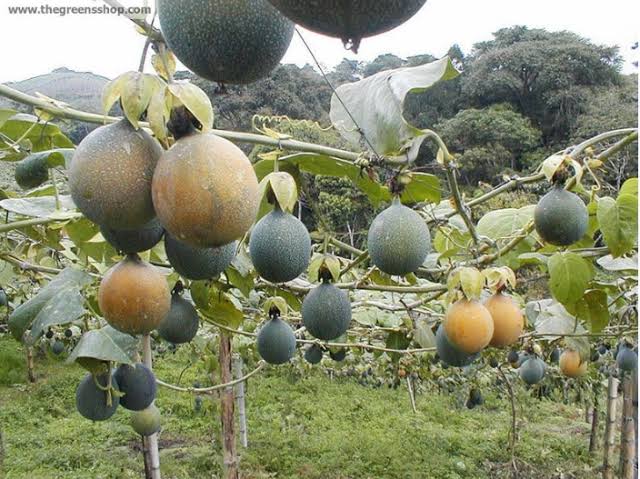
Sugar fruit and buah merah are both associated with the wider New Guinea region, but botanically they are very different plants. Sugar fruit is commonly identified with sweet granadilla (Passiflora ligularis), a climbing passionfruit introduced to Papua New Guinea. Buah merah is generally identified as Pandanus conoideus, a member of the Pandanaceae family.
Kew recognizes Pandanus conoideus as an accepted species and records New Guinea within its native range. It grows as a tree rather than a climbing vine, which immediately separates it from sugar fruit.
| Feature | Sugar Fruit | Buah Merah |
| Botanical group | Passiflora | Pandanus |
| Commonly associated species | Passiflora ligularis | Pandanus conoideus |
| Plant form | Climbing vine | Tree-like Pandanus plant |
| Fruit form | Round or oval individual fruit | Large, elongated aggregate fruit |
| Regional association | Particularly PNG Highlands agriculture | New Guinea, including Indonesian Papua |
| Typical food use | Pulp eaten fresh with seeds | Traditionally processed or cooked before eating |
Their histories in New Guinea are also different. Sweet granadilla originated in tropical America and later became established in PNG agriculture. Pandanus conoideus, by contrast, has a native distribution that includes New Guinea.
The way the fruits are eaten provides another clear contrast. Sugar fruit can be opened and its soft, seed-filled pulp eaten directly. Traditional preparations of buah merah are more involved. Ethnobotanical research from Papua, Indonesia, describes communities cooking and processing the fruit as part of food preparation, sometimes combining the prepared material with staple foods.
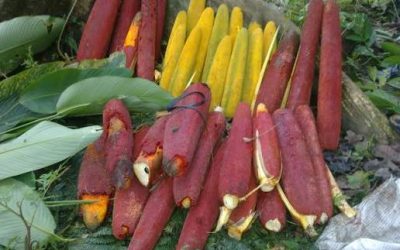
Their different appearances make confusion unlikely once you see the actual fruits. Sugar fruit resembles other passionfruits, with a firm outer rind surrounding a jelly-like center. Buah merah forms a much larger, elongated fruit made up of many tightly packed sections.
The main point is simple: sugar fruit and buah merah are unrelated botanical species despite both being connected with the New Guinea region. Sugar fruit belongs to the Passiflora group, while buah merah belongs to Pandanus. This distinction is useful when exploring Papua fruits, buah merah Papua, Pandanus conoideus, or other traditional fruits of New Guinea.
20. How to Identify Sugar Fruit
If you are trying to recognize sugar fruit in Papua New Guinea, look for the features associated with sweet granadilla (Passiflora ligularis). The fruit has several useful visual clues, although appearance alone cannot provide absolute botanical identification.
Typical characteristics include:
- Round to slightly oval shape: Kew describes the fruit as ovoid, while commercial descriptions also place it within a rounded-to-oval form.
- Yellow to orange exterior: Mature sweet granadilla commonly develops a yellowish or orange-colored shell, sometimes with small spots or mottling.
- Relatively firm shell: The outer covering is harder than its soft interior and protects the pulp and seeds inside.
- Soft, seed-filled center: Opening the fruit reveals pale or translucent pulp containing numerous dark seeds.
- Climbing growth habit: P. ligularis grows as a vine and uses long tendrils to climb surrounding supports.
- Sweet flavor: Sweet granadilla is known for a predominantly sweet, distinctive taste rather than the stronger sweet-sour character associated with some other passionfruits.
The combination of a yellow-orange shell, seed-filled soft interior, sweet pulp, and climbing Passiflora vine provides a practical starting point for recognition.
However, several passionfruit species can share similar shapes, seeds, and internal structures. Fruit color can also vary naturally. For that reason, appearance alone should not be used for definitive botanical identification. When exact identification matters, features of the vine and flowers, the geographical context, and the scientific name are more reliable than a local fruit name by itself.
21. Interesting Facts About Sugar Fruit in Papua New Guinea
Sugar fruit has an interesting story because its local identity in Papua New Guinea is different from its botanical origin. A few key facts make the fruit easier to understand:
- “Sugar fruit” is primarily a common name. In the PNG context, it is associated with a particularly sweet passionfruit rather than a formal botanical category.
- It belongs to the passionfruit group. The fruit commonly linked with the name is sweet granadilla, Passiflora ligularis, a member of the Passifloraceae family. Kew currently recognizes P. ligularis as an accepted species.
- It grows as a climbing plant. Sweet granadilla develops on a Passiflora climber rather than on a conventional fruit tree. Kew records the species as climbing and primarily associated with wet tropical environments.
- Its edible part surrounds numerous seeds. Like other passionfruits, the fruit contains soft pulp around the seeds, creating the characteristic seed-filled center seen when it is opened.
- The fruit is particularly associated with Papua New Guinea’s Highlands. PNG agricultural sources use the local sugar fruit name in a Highland growing context, helping distinguish it from other passionfruit types cultivated in the country.
- It did not originate in Papua New Guinea. Kew places the native distribution of Passiflora ligularis in tropical America, from Panama through Venezuela and Peru, with Bolivia and Colombia also included in its recorded native range.
- The wider Passiflora genus is more geographically diverse. Kew records the genus as naturally occurring across the New World and parts of tropical and subtropical Asia and the southwest Pacific, including New Guinea. This does not change the American origin of P. ligularis itself.
- International naming can be different. Someone outside Papua New Guinea is more likely to encounter this species under the name sweet granadilla or granadilla than “sugar fruit.” Kew records granadilla among the common names connected with P. ligularis.
These details explain why sugar fruit is an interesting example of a plant that can become strongly associated with a local agricultural landscape even though its original botanical range lies on another continent.
22. Frequently Asked Questions About Sugar Fruit Papua New Guinea
22.1 What Is Sugar Fruit in Papua New Guinea?
Sugar fruit is a local Papua New Guinea name for a sweet type of passionfruit associated especially with the Highlands. PNG agricultural literature commonly identifies it with sweet granadilla (Passiflora ligularis). Because “sugar fruit” is a common rather than scientific name, its meaning should still be interpreted within the local context.
22.2 Is Sugar Fruit a Passionfruit?
Yes. The fruit commonly called sugar fruit in PNG is associated with Passiflora ligularis, which belongs to the genus Passiflora and the family Passifloraceae. This places it in the same broad plant group as other fruits known as passionfruit. Kew recognizes both the species and genus in its current botanical database.
22.3 What Is the Scientific Name of Sugar Fruit?
The PNG fruit commonly called sugar fruit is generally associated with sweet granadilla, Passiflora ligularis Juss. Kew recognizes P. ligularis as an accepted species.
The cautious wording is important because “sugar fruit” is a vernacular name rather than a taxonomic name. Regional usage can vary, while the scientific name refers to a defined botanical species.
22.4 What Does Sugar Fruit Taste Like?
Sugar fruit is known mainly for its sweet, aromatic flavor. Compared with many familiar purple or yellow passionfruits, its taste is generally less sharply tart.
The interior has soft, juicy or jelly-like pulp surrounding numerous seeds. Flavor can vary somewhat according to ripeness, growing conditions, and the individual fruit, so sweetness should be understood as a general characteristic rather than an identical taste in every specimen.
22.5 What Does Sugar Fruit Look Like?
Sweet granadilla is generally round to oval, with a firm rind that develops yellow to orange tones as it matures. Inside are numerous dark seeds surrounded by soft, translucent pulp.
The fruit grows on a climbing vine rather than a conventional fruit tree. Kew describes P. ligularis as a climbing species associated mainly with wet tropical environments.
22.6 Is Sugar Fruit Native to Papua New Guinea?
No, if sugar fruit refers to Passiflora ligularis. Kew records the species as native to Panama, Bolivia, Colombia, Peru, and Venezuela, placing its original distribution in tropical America rather than New Guinea.
It can therefore be locally familiar in Papua New Guinea without being botanically native to the country.
22.7 Where Does Sugar Fruit Grow in PNG?
Sugar fruit is particularly associated with the Papua New Guinea Highlands, where elevated tropical environments provide conditions suited to this type of passionfruit.
It may be grown in village gardens and smallholder farming systems and can enter local fresh-produce markets. Its Highland association is more useful than assuming it is equally common throughout every province of PNG.
22.8 Is Sugar Fruit the Same as Sugar Apple?
No. They are unrelated fruits.
Sugar fruit in the PNG context is associated with Passiflora ligularis, a climbing passionfruit vine. Sugar apple is Annona squamosa, which grows as a shrub or small tree and produces a fruit with a distinctive segmented exterior.
The similar English names do not indicate a botanical relationship.
22.9 Is Sugar Fruit the Same as Sweet Granadilla?
In Papua New Guinea, the name sugar fruit is commonly associated with sweet granadilla (Passiflora ligularis). For international readers, “sweet granadilla” is usually the clearer name because it connects the fruit with a recognized species.
However, local common names can vary between communities. It is therefore more accurate to say that PNG sugar fruit is commonly identified as sweet granadilla rather than treating every possible use of “sugar fruit” as taxonomically fixed.
22.10 Can You Eat Sugar Fruit Seeds?
The soft pulp of sweet granadilla is normally eaten together with the seeds, as is common with many edible passionfruits. The fruit is typically opened and the seed-filled interior scooped from the rind.
This is a culinary description of how the fruit is commonly eaten rather than a nutritional or medicinal recommendation.
22.11 Why Is It Called Sugar Fruit?
The common name most likely refers to the fruit’s characteristically sweet taste. In PNG agricultural discussions, sugar fruit is distinguished from passionfruits and other Highland fruits that can have a noticeably more tart character.
The name should not be interpreted as a scientific statement about measured sugar levels. It is better understood simply as a local descriptive name highlighting sweetness.
If you’re looking for Papua herbal products, start with a trusted source. Experience authentic, high-quality red fruit products at Cahya Red Fruit Papua New Guinea! We offer a wide variety of items besides Red Fruit Papua New Guinea — including Papua ant nest and Papua kebar grass. Check out our herbal wellness product in our website!