What Is Papua New Guinea Culture
A quick definition of Papua New Guinea culture
When people talk about Papua New Guinea culture, they are referring to a wide and layered mix of customs, values, languages, arts, social systems, and ceremonial traditions practiced by many different communities across the country. It is not a single, unified way of life. Instead, it is a mosaic shaped by hundreds of distinct groups, each with their own identity and practices.
One of the most important things to understand early on is that there is no single version of cultural fact here. Life in the highlands can feel very different from life along the coast or in island communities. In some areas, traditions are shaped by mountain environments, while in others they are influenced by the sea, rivers, or dense forest landscapes similar to parts of the papua new guinea jungle.
Cultural expression also shifts between:
- Highlands communities with strong ceremonial exchange systems
- River and Sepik regions known for artistic traditions
- Coastal societies connected to trade and seafaring
- Island cultures with deep maritime heritage
- Urban areas where traditional and modern lifestyles blend
Language is another key part of this definition. Papua New Guinea officially recognizes Tok Pisin, English, and Hiri Motu, but beyond these, hundreds of indigenous languages are still actively spoken. These languages carry stories, songs, and local knowledge, making them central to cultural identity.
In everyday life, culture is not just something performed during festivals. It appears in how families organize themselves, how food is prepared and shared, how stories are told, and even how people relate to the land and environment—including the use of local resources that come from diverse Papua New Guinea plants.
Why Papua New Guinea is considered culturally unique
Papua New Guinea is often described as one of the most culturally diverse places in the world, and that reputation comes from real, observable complexity rather than exaggeration.
One major reason is its extraordinary language diversity. With hundreds of languages spoken across the country, even neighboring communities may have completely different ways of speaking and expressing ideas. This level of variation is rare globally and shapes everything from storytelling to ritual practices.
Geography has also played a big role. Mountains, islands, rivers, and forests historically limited interaction between groups. As a result, many communities developed their own traditions over long periods of time. This helps explain why cultural practices can vary so much from one region to another.
It is important, though, not to frame this diversity as isolation alone. Instead, it reflects living heritage—systems of knowledge, art, and social organization that continue to evolve. Today, people move between villages and cities, participate in national events, and share ideas, while still maintaining local identities.
Another key point is that Papua New Guinea culture is not just about dramatic festival imagery or what is sometimes shown in travel media. While those moments—like large gatherings or ceremonial displays—are visually striking, they represent only one layer of a much deeper cultural structure rooted in daily life, relationships, and community values.
Even something as simple as preparing papua new guinea food or participating in village routines reflects long-standing traditions shaped by environment, history, and the experiences of Papua New Guinea native people across generations.
Cultural Diversity Across Papua New Guinea
Many peoples, many languages
One of the most defining features of Papua New Guinea culture is the sheer number of peoples and languages that exist within a single country. It is often noted that Papua New Guinea has hundreds of living indigenous languages, making it one of the most linguistically diverse places on earth.
In daily life, many people grow up speaking their local language first, which connects them to family, clan, and land. At the same time, Tok Pisin acts as a widely used lingua franca, helping people from different language groups communicate with one another. This layered way of speaking reflects how identity works in Papua New Guinea—local and shared at the same time.
Language is not just a tool for conversation. It shapes:
- Songs and ceremonial chants
- Oral storytelling and myths
- Ritual language used in important events
- Kinship terms that define relationships
- Local knowledge about land, rivers, and forests
In many communities, stories are passed down without written records. This means language carries memory—of ancestors, migration, and daily life. In areas near dense forest environments, including regions similar to the Papua New Guinea jungle, vocabulary may reflect deep familiarity with plants, animals, and seasonal patterns.
An important detail often overlooked is that many languages in Papua New Guinea have relatively small numbers of speakers. Some are spoken by only a few thousand people or less. Because of this, cultural preservation becomes closely tied to language preservation. When a language fades, unique ways of understanding the world can also disappear.
Main cultural regions to mention
Although Papua New Guinea culture is incredibly diverse, it is often helpful to understand it through several broad cultural regions. These are not strict boundaries, but they give a general sense of how traditions vary across the country.
Highlands cultures
In the mountainous interior, communities are known for strong clan systems, ceremonial exchanges, and elaborate gatherings. Agriculture, especially root crops, plays a central role in daily life. Cultural expressions here often include bold body adornment and group performances.
Sepik and river cultures
Along major rivers such as the Sepik, artistic traditions are especially prominent. Carving, masks, and ceremonial structures are closely tied to social and spiritual life. The river itself is central—not just for transport, but as part of cultural identity.
Coastal Motu Koita traditions
In coastal areas near Port Moresby, the Motu Koita people are known for historical trade networks, including the Hiri voyages. Their traditions reflect long-standing relationships with the sea and exchange between communities.
Milne Bay maritime heritage
Further east, island and coastal communities in Milne Bay have strong seafaring traditions. Canoes, navigation, and fishing practices shape both daily life and cultural expression.
Island cultures in New Britain and New Ireland
These regions feature distinct ceremonial practices, including masked performances and community rituals tied to land and ancestry. Cultural forms here often combine performance, storytelling, and visual art.
Across all these regions, differences can be seen in:
- Housing styles and settlement patterns
- Clothing and ceremonial dress
- Body ornament and materials used
- Trade systems and exchange practices
- Music, dance, and performance traditions
Even food habits can vary significantly. What people eat in highland villages may differ from coastal diets, showing how environment influences culture—including the use of local ingredients that connect to broader themes like Papua New Guinea food and traditional resource knowledge.
Taken together, this regional diversity shows that Papua New Guinea is not defined by one narrative. It is a collection of many cultural worlds, shaped by geography, history, and the lived experiences of papua new guinea native people across generations.
Language and Identity in Papua New Guinea
Tok Pisin, English, and Hiri Motu
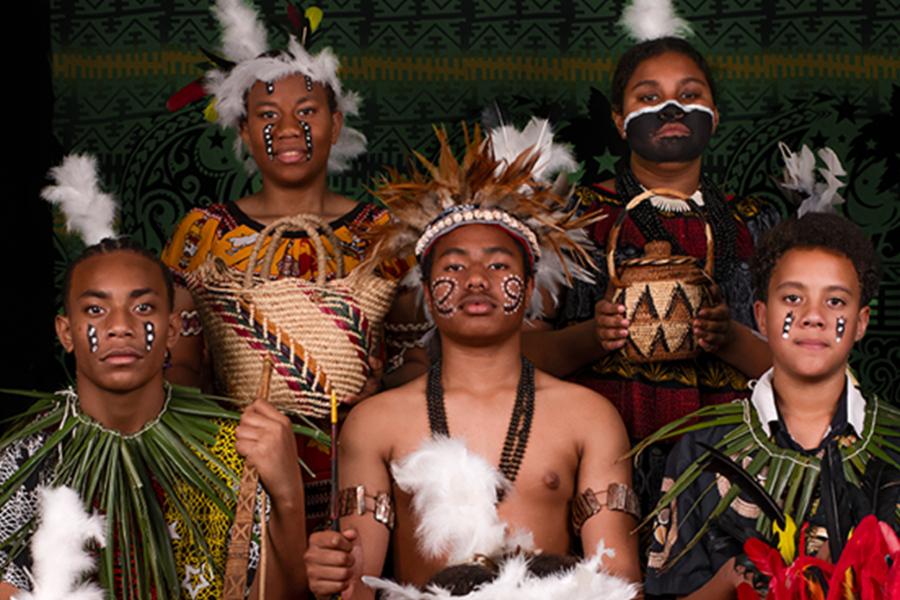
Language plays a central role in shaping identity across Papua New Guinea. While hundreds of indigenous languages are spoken, three official languages help connect people across regions: Tok Pisin, English, and Hiri Motu.
Tok Pisin is the most widely used language in everyday life. It developed over time as a way for different groups to communicate, especially in trade and shared spaces. Today, it is spoken in markets, towns, and across communities where people may not share the same local language. For many, Tok Pisin acts as a cultural bridge.
English is commonly used in formal settings such as education, government, and business. It connects Papua New Guinea to global systems while also serving as a shared language in official communication. In schools, English often plays a role in written learning, while local languages continue to shape early understanding.
Hiri Motu has historical roots in the Papua region, especially linked to coastal communities and traditional trade networks. While it is less widely spoken than Tok Pisin today, it still holds cultural importance and reflects a specific regional identity tied to history and movement along the coast.
Together, these languages form a layered system. A person may speak their local language at home, Tok Pisin in daily interaction, and English in formal contexts. This multilingual way of life reflects how identity is both local and shared at the same time.
Why language matters in culture
In Papua New Guinea, language is more than communication—it is a way of preserving culture itself.
Much of cultural knowledge is passed down through oral traditions. Stories, songs, and spoken histories carry lessons about ancestry, land, and community values. These are not always written down, which makes language essential for keeping them alive.
Language also shapes:
- Storytelling traditions, where myths and histories are shared across generations
- Songs and chants, often performed during ceremonies or gatherings
- Kinship systems, where specific terms define relationships and responsibilities
- Ritual vocabulary, used in important cultural practices
In some regions, vocabulary reflects a deep understanding of the environment. Words may describe specific plants, landscapes, or seasonal changes, especially in areas influenced by dense ecosystems like the papua new guinea jungle. This shows how language connects people to place, not just to each other.
Because many languages have small speaker populations, there is growing awareness around preservation. When a language is no longer used, it can mean the loss of unique cultural knowledge—stories, meanings, and ways of seeing the world that cannot be easily translated.
This is why cultural diversity in Papua New Guinea is not only something you can see in clothing or festivals. It exists at a deeper level—in speech, memory, and social structure. The voices of papua new guinea native people carry generations of knowledge, shaping identity in ways that go far beyond words alone.
Traditional Social Life and Community Values
Family, clan, and extended kinship
In many parts of Papua New Guinea, daily life is closely tied to family and clan relationships. Rather than focusing only on the nuclear family, communities often organize themselves around extended kinship networks that include relatives across multiple generations.
These relationships shape everyday routines. People may work together in gardens, build homes collectively, and share responsibilities such as childcare and food preparation. In many villages, cooperation is not just helpful—it is expected as part of social life.
Clan identity also plays an important role. A clan can connect individuals to:
- Land and natural resources
- Ancestral history
- Social responsibilities and roles
- Ceremonial participation
Customary ties often influence where people live, how they farm, and how they relate to others in the community. In some regions, land is not owned individually in a modern sense but held collectively through clan connections. This reinforces a strong link between identity and place.
Even as people move to towns or cities, these kinship systems often remain meaningful. Visits back to home villages, participation in ceremonies, and ongoing support between relatives help maintain these bonds across distance.
Exchange, reciprocity, and status
Another key aspect of Papua New Guinea culture is the idea of exchange and reciprocity. These systems go beyond simple trade. They are deeply connected to social relationships, status, and community balance.
Well-known examples often discussed include the moka exchange in the Highlands and the kula ring in parts of the wider New Guinea region. While they differ in form, both reflect a shared idea: giving is a way of building relationships and reputation.
In these systems:
- Items such as food, shells, or other valuables may be exchanged
- Giving is often public and ceremonial
- The act of giving can strengthen alliances
- Reciprocity—returning gifts over time—is expected
Importantly, exchange is not only economic. It can be social, ceremonial, and even political. A person’s standing in the community may be shaped by their ability to contribute, host, and share with others.
This way of thinking highlights a different perspective on status. Instead of focusing only on accumulation, prestige can be expressed through generosity and participation.
Food often plays a central role in these exchanges. Shared meals—sometimes featuring traditional dishes connected to papua new guinea food—become part of how relationships are maintained.
Across different regions, whether in highland valleys or coastal areas near environments like the papua new guinea jungle, these systems reflect long-standing values of connection, balance, and mutual support among papua new guinea native people.
Ceremonies, Festivals, and Sing-Sing Traditions
What is a sing-sing
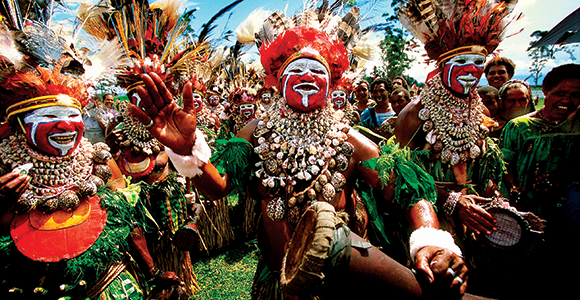
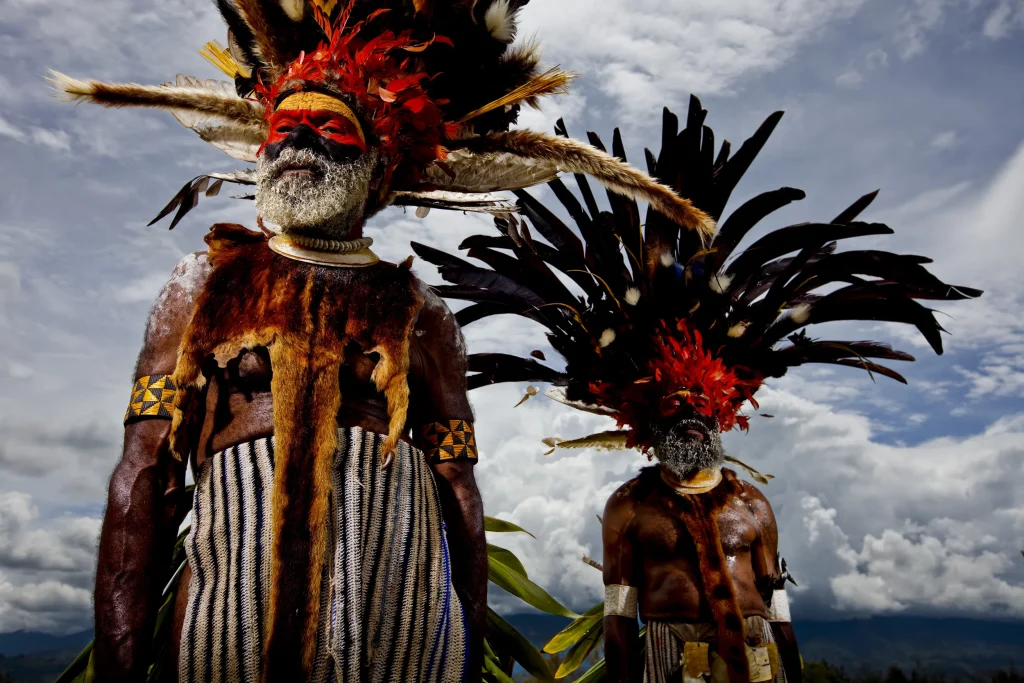
A sing-sing is one of the most recognizable cultural gatherings in Papua New Guinea. It brings together different groups to present songs, dances, and ceremonial dress in a shared space.
At a sing-sing, you may see:
- Coordinated group dances and rhythmic movement
- Chants or songs passed down through generations
- Elaborate body paint and decoration
- Feathers, shells, and natural materials arranged into striking designs
These elements often represent clan identity, history, or social meaning.
For many visitors, sing-sings are a first introduction to Papua New Guinea culture. However, they are only one visible expression of deeper traditions.
Famous cultural festivals to include
Goroka Show
A major gathering in the Eastern Highlands that brings together many cultural groups.
Mount Hagen Show
A large Highlands event known for energetic performances.
Hiri Moale Festival
Celebrates traditional maritime trade journeys of the Motu Koita people.
Sepik Bilum and Basket Show
Focuses on weaving traditions and craftsmanship.
Performance elements to describe
- Traditional dance and group song
- Ceremonial dress known as bilas
- Feathers, shells, paint, and natural materials
- Drums such as kundu and garamut
These performances reflect traditions of papua new guinea native people and continue to evolve.
Traditional Dress, Bilas, and Body Adornment
What bilas means in cultural context
Bilas refers to ceremonial adornment, expressing identity, status, and belonging.
It may include feathers, shells, beads, body paint, and plant-based materials drawn from environments like the papua new guinea jungle.
Styles vary widely across regions, reflecting the diversity of papua new guinea native people.
The importance of bilum
A bilum is a woven bag used in daily life for carrying goods and babies.
It is also a cultural symbol, used in exchange and identity. Bilum reflects creativity, tradition, and knowledge of papua new guinea plants.
Art, Craft, and Material Culture
Carving, masks, and spirit houses
Art connects to ceremony and ancestry. In regions like the Sepik, carving and haus tambaran structures carry deep meaning.
Musical instruments and sound culture
- Kundu drums for rhythm and ceremony
- Garamut drums for signaling and communication
Other craft forms worth mentioning
- Canoes in maritime regions
- Pottery in coastal areas
- Basketry and weaving
- Shell ornament
These reflect environment and knowledge, including materials from the papua new guinea jungle.
Food Culture and Everyday Living
Staple foods in Papua New Guinea
Common foods include kaukau, sago, taro, yam, banana, fish, and pork.
Diet varies by region, showing how papua new guinea food is shaped by environment.
Mumu and communal eating
Mumu is an earth oven cooking method used for gatherings.
Food plays a role in sharing, ceremony, and relationships among papua new guinea native people (not African).
Belief Systems, Ancestors, and Sacred Spaces
Traditional beliefs and later religious influence
Customary beliefs and Christianity often coexist. Traditions include ancestor respect and environmental connection.
Sacred spaces and ceremonial houses
Structures like haus tambaran represent ritual, memory, and identity.
Sacred spaces may also include landscapes such as forests or rivers tied to the papua new guinea jungle.
Famous Cultural Groups and Symbolic Traditions
Asaro Mudmen
Known for clay masks and festival presence, but represent only one part of PNG culture.
Huli Wigmen and Highlands ceremonial identity
Recognized for wigs, feathers, and symbolic adornment tied to identity.
Motu Koita and Hiri heritage
Known for maritime trade and the Hiri tradition, remembered through festivals.
Papua New Guinea Culture in Modern Life
Urbanization and cultural continuity
Culture continues in cities through festivals, language, and family ties.
Women, craft, and the creative economy
Bilum and weaving connect tradition with modern livelihoods and creativity using papua new guinea plants.
Common Misconceptions About Papua New Guinea Culture
It is not one single tribal culture
There are hundreds of distinct cultures, not one unified identity.
Culture is living, not museum only
Traditions continue to evolve in daily life and modern settings.
Why Papua New Guinea Culture Matters Globally
Language diversity and heritage preservation
PNG offers insight into linguistic diversity and cultural knowledge systems.
Lessons for readers
- Cultural resilience
- Community identity
- Environment and culture connection
- Respect for diversity
Also read: Papua and West Papua Facts, Regions and Traditions
Conclusion
Final takeaway
Papua New Guinea culture is a diverse, living system shaped by language, family, ceremony, art, and daily life.
From the papua new guinea jungle to shared meals of papua new guinea food, it reflects the experiences of papua new guinea native people across generations.
Understanding it means recognizing diversity, respecting tradition, and seeing culture as something that continues to grow and evolve.