Papua New Guinea native fruits include marita (Pandanus conoideus), ton (Pometia pinnata), bukabuk (Burckella obovata), Malay apple (Syzygium malaccense), watery rose apple (Syzygium aqueum), rukam (Flacourtia rukam), and several indigenous figs. A major review of PNG fruit plants records these among species traditionally grown or eaten in the country. However, “native,” “indigenous,” “traditional,” and “commonly grown in PNG” do not always mean the same thing. Some species occur across the wider island of New Guinea or beyond, rather than being exclusive to modern Papua New Guinea; for example, Pandanus conoideus and Pometia pinnata both have native ranges extending outside PNG. This guide explains the main fruits by their common and scientific names, appearance, growing environment, distribution, and traditional food use while keeping native species separate from introduced tropical fruits.
1. What Fruits Are Native to Papua New Guinea?
Papua New Guinea has many indigenous fruits, including marita (Pandanus conoideus), ton (Pometia pinnata), bukabuk (Burckella obovata), Malay apple (Syzygium malaccense), watery rose apple (Syzygium aqueum), rukam (Flacourtia rukam), mon (Dracontomelon dao), coastal pandanus (Pandanus tectorius), traditional mango (Mangifera minor), and native figs such as Ficus copiosa and Ficus dammaropsis. These are among the species discussed in R. Michael Bourke’s review of indigenous fruit in Papua New Guinea.
The list is much broader than these examples. Bourke recorded around 40 fruit species in the indigenous category and noted that even this was not a complete inventory. Some are familiar across large parts of New Guinea, while others have a more limited regional presence.
This is also why the term “native fruit” needs some explanation. A fruit can belong to a long-established PNG food tradition without being found only within the political borders of Papua New Guinea.
1.1 What Does “Native Fruit” Mean in Papua New Guinea?
When discussing the native fruits of Papua New Guinea, three related categories are useful.
1. Indigenous fruits in PNG food traditions
In Bourke’s research, “indigenous fruit” has a historical meaning. It covers fruits grown and eaten by Papua New Guineans before major outside settlement and crop introductions from around 1870 onward. Importantly, this category can include species that are endemic, naturally native, or that reached the area from elsewhere much earlier.
This definition focuses on the fruit’s place in established local food systems rather than requiring it to have evolved exclusively inside modern PNG.
2. Species native to New Guinea or a wider region
Some important PNG fruits naturally occur across the island of New Guinea and sometimes farther into Melanesia, Southeast Asia, or the Pacific.
Marita is a good example. Kew lists Pandanus conoideus as native to New Guinea as well as several surrounding island regions. Ton provides another example: Pometia pinnata occurs naturally across New Guinea but also has a much wider native range extending through parts of tropical Asia and the South Pacific.
The same pattern appears in several Syzygium fruits. Kew records both Syzygium malaccense and Syzygium aqueum as native to New Guinea, although neither species is exclusive to it.
So, calling a fruit a New Guinea native fruit does not necessarily mean it is endemic to Papua New Guinea.
3. Introduced tropical fruits now grown in PNG
A different group consists of fruits that became established after being brought from elsewhere. Papua New Guinea now grows many familiar tropical fruits, so seeing a fruit in a village garden or local market does not by itself prove that the species is indigenous.
PNG agricultural literature separately discusses introduced fruits such as avocado, orange, pawpaw or papaya, pineapple, rambutan, mangosteen, and commercial mango. Historical agricultural records also document many crop introductions beginning in the late nineteenth century.
Bananas require extra care because New Guinea has an important place in the long history of banana cultivation and domestication, while additional varieties were introduced in later periods. For that reason, broad labels such as “banana is native to PNG” or “banana is introduced to PNG” can oversimplify a much more complicated crop history.
The practical distinction is simple: a fruit can be common in Papua New Guinea without being a Papua New Guinea native fruit. Scientific identity, natural distribution, and historical cultivation all need to be considered before applying the label.
2. 15 Papua New Guinea Native Fruits Worth Knowing
Papua New Guinea’s indigenous fruit traditions include familiar botanical groups such as figs and mango relatives as well as species that rarely appear in international supermarkets. The following examples are drawn mainly from R. Michael Bourke’s review of indigenous PNG fruits, with current botanical references used to clarify distribution and taxonomy.
2.1 Marita (Pandanus conoideus)
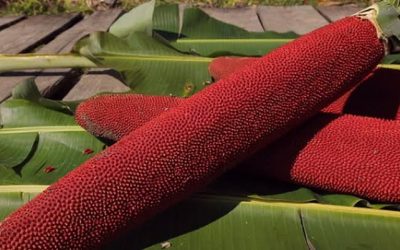
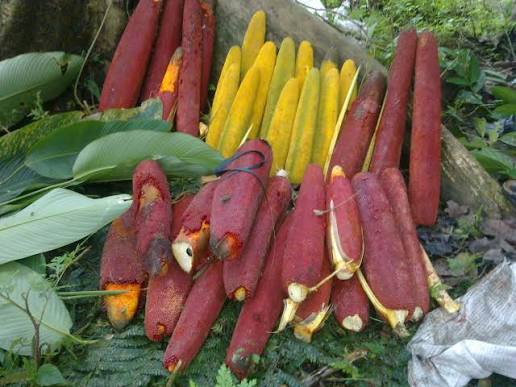
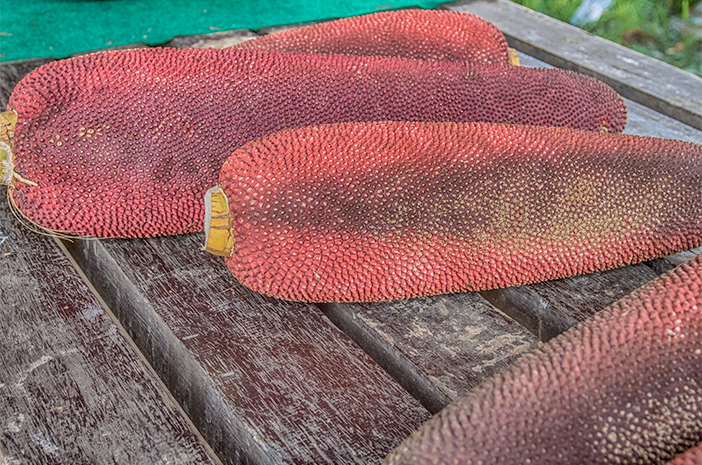
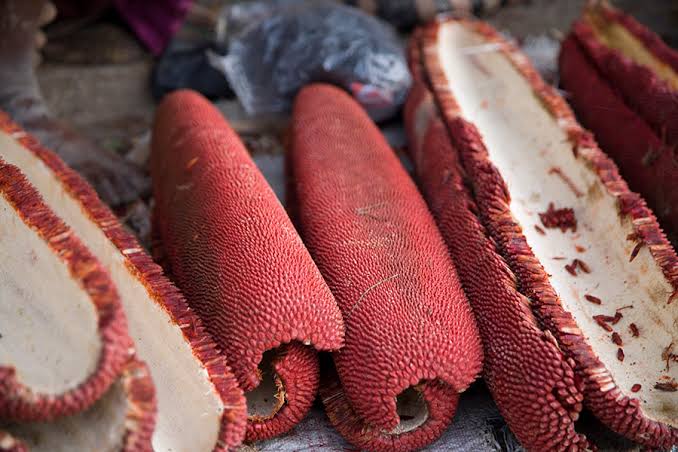
Marita, sometimes written marata, is a cultivated pandanus with a large, elongated compound fruit made up of many tightly packed sections. Forms vary considerably, but mature fruits commonly develop vivid red, orange-red, or related warm colors.
Unlike an ordinary hand fruit, marita is traditionally processed as food. The edible material is separated during preparation and can become part of sauces and meals. The species is closely connected with New Guinea food traditions rather than being exclusive to the country of Papua New Guinea.
Kew records Pandanus conoideus as native to New Guinea as well as the Bismarck Archipelago, Maluku, Solomon Islands, Vanuatu, and Caroline Islands. On the Indonesian side of New Guinea, the same species is widely known as buah merah. This shared botanical identity is important: Papua New Guinea and Indonesian Papua are different territories, even though plants naturally cross the modern political boundary.
2.2 Ton (Pometia pinnata)
Ton is the PNG name commonly used in agricultural literature for Pometia pinnata. Indonesian readers may know the same species as matoa.
The tree produces fleshy fruits containing a central seed surrounded by edible tissue. World Agroforestry describes the edible layer around the seed as potentially thick and sweet-tasting.
Ton occurs in lowland New Guinea forests and is also encountered in primary and secondary forest environments. Kew notes that Pometia can grow in riverine areas, swamps, and other lowland habitats and is seldom collected above about 900 meters.
Its natural range extends far beyond PNG, from parts of tropical Asia through New Guinea to Pacific islands. The names ton and matoa therefore provide a useful example of why scientific names matter when comparing fruits across New Guinea.
2.3 Bukabuk (Burckella obovata)
Bukabuk (Burckella obovata) is one of the lesser-known indigenous PNG fruits documented by Bourke. It belongs to the Sapotaceae family and grows as a tropical tree.
Current botanical records place its native range from Maluku through New Guinea and the Bismarck Archipelago to the Solomon Islands and Vanuatu. It is primarily associated with wet tropical environments.
Bukabuk is traditionally used as a local fruit but has little international commercial visibility. That makes it a good reminder that Papua New Guinea fruits are much more diverse than the tropical produce usually sold abroad. A species can be familiar within particular communities or environments while remaining almost unknown to consumers elsewhere.
2.4 Malay Apple (Syzygium malaccense)
The Malay apple (Syzygium malaccense) belongs to the same broad botanical family as several other fruits commonly called rose apples or water apples.
Its fruit is generally oval to somewhat oblong, with smooth skin that may become deep red, purplish, yellowish, or pale depending on the form. Inside is pale, juicy flesh surrounding a seed. World Agroforestry describes ripe fruits as juicy and commonly eaten fresh.
In PNG research, Malay apple is included among indigenous fruit species, although it is certainly not endemic to Papua New Guinea. The tree occurs across a much wider tropical region. This broader distribution is typical of several fruits that have long histories within PNG food systems.
2.5 Watery Rose Apple (Syzygium aqueum)
Watery rose apple (Syzygium aqueum) is another traditional Syzygium fruit recorded in PNG. As its English name suggests, it is valued as a fresh, moisture-rich fruit with a crisp to tender texture.
It can be confused with related Syzygium species because their fruits may share a bell-like form and smooth skin. Keeping the scientific names separate avoids that problem:
- Malay apple: Syzygium malaccense
- Watery rose apple: Syzygium aqueum
Both appear in Bourke’s account of indigenous PNG fruit, but they are separate species.
The distinction also illustrates a recurring problem with common fruit names: terms such as “rose apple,” “water apple,” and similar names do not always identify the same plant from one country to another.
2.6 Rukam (Flacourtia rukam)
Rukam (Flacourtia rukam) is a tropical fruit tree whose fruits change appearance as they mature, generally moving from green toward darker red or purple shades.
It has a broad natural distribution rather than a PNG-only range. Kew records the species from the Nicobar Islands through parts of Southeast Asia and New Guinea into several Pacific island groups. It grows mainly in wet tropical environments.
Rukam has a history of local food use and is included in PNG indigenous-fruit literature. This is another case where indigenous in a PNG food-history context should not be confused with endemic to PNG. A longstanding traditional fruit can occur naturally across several neighboring regions.
2.7 Coastal Pandanus (Pandanus tectorius)
Coastal pandanus (Pandanus tectorius) is easily recognized by its large compound fruits, which are divided into numerous wedge-like segments. The species is strongly associated with tropical coastal and island environments.
Its range is extensive. Kew records it as native from parts of the Philippines and eastern Malesia across New Guinea and much of the Pacific. Different communities across this enormous area have developed their own uses for pandanus plants, including food uses where suitable varieties are available.
Bourke includes coastal pandanus among PNG’s indigenous fruits. Its coastal association also shows why habitat matters when describing PNG native fruit trees: species occurring near shorelines can have very different distributions from plants associated with inland highlands.
2.8 Marita vs Coastal Pandanus
Marita and coastal pandanus belong to the same genus, but they are not the same fruit.
- Marita: Pandanus conoideus
- Coastal pandanus: Pandanus tectorius
Marita is especially associated with traditional cultivated forms of P. conoideus in New Guinea, while P. tectorius has a vast coastal and Pacific distribution. Both produce compound fruits, so photographs without proper identification can be misleading.
Using the species name is therefore more reliable than simply calling either plant “pandanus fruit.”
2.9 Mon (Dracontomelon dao)
Mon is the name used in PNG fruit literature for Dracontomelon dao, a large tropical forest tree in the Anacardiaceae family, which also contains mangoes and cashews.
The species produces fleshy fruits containing a hard inner structure. Its importance in this article is primarily culinary and botanical: Bourke records mon among indigenous fruits used in PNG.
The tree is far from exclusive to the country. Kew gives Dracontomelon dao a broad native range extending from parts of South and Southeast Asia through New Guinea to the Solomon Islands. It is mainly a wet-tropical tree.
2.10 Traditional Mango (Mangifera minor)
The word mango can create confusion when discussing native PNG fruits. The familiar commercial mango is usually Mangifera indica, but PNG fruit literature also records a traditional mango identified as Mangifera minor.
That species has its own botanical identity. Kew recognizes M. minor as an accepted species native from the Lesser Sunda Islands through parts of Papuasia and neighboring islands, including New Guinea.
This distinction matters because two plants belonging to the genus Mangifera are not automatically the same fruit. When discussing traditional PNG food plants, writing simply “mango” can therefore hide useful information about which species is actually involved.
2.11 Kumu Musong (Ficus copiosa)
Kumu musong (Ficus copiosa) introduces another important group of indigenous PNG fruits: native figs.
Like other Ficus species, it produces the specialized rounded structures commonly recognized as figs rather than a conventional single-seeded fruit. Bourke lists Ficus copiosa among the indigenous fruits eaten in Papua New Guinea.
Its distribution is wider than PNG. Kew records the species as native to New Guinea along with Maluku, Sulawesi, the Bismarck Archipelago, Solomon Islands, Vanuatu, Queensland, and several other areas. It primarily grows in the wet tropical biome.
Kumu musong helps show how easily fig diversity can be overlooked when people think about tropical fruit.
2.12 Highland Fig (Ficus dammaropsis)
Ficus dammaropsis is one of the more visually distinctive New Guinea fig species. It is known for exceptionally broad leaves and large fig structures, giving the tree a very different appearance from the small-leaved ornamental figs familiar to many readers.
Unlike several fruits on this list that extend widely into Southeast Asia or the Pacific, Kew records the native range of Ficus dammaropsis specifically as New Guinea. It is a wet-tropical tree.
Bourke includes the species among indigenous fruits used in PNG. Its presence in the literature is a useful reminder that New Guinea’s traditional fruit diversity includes multiple fig species rather than a single generic “native fig.”
2.13 Ficus wassa
Another fig documented in PNG indigenous-fruit research is Ficus wassa. It is a tree of wet tropical environments and has a natural range extending from the Lesser Sunda Islands through Maluku and New Guinea to the Solomon Islands and Vanuatu.
Compared with internationally traded fruits, Ficus wassa receives little attention outside botanical and regional food literature. Yet its inclusion alongside Ficus copiosa, Ficus dammaropsis, and other figs shows that the genus forms a meaningful part of traditional New Guinea plant diversity.
This is also a case where the scientific name is more useful than trying to assign a single English common name that may not be widely recognized.
2.14 Pouteria maclayana
PNG literature lists Pouteria maclayana among its indigenous fruits, but modern taxonomy adds an interesting detail. Kew currently accepts the species as Planchonella maclayana, while Pouteria maclayana is treated as a synonym.
The tree belongs to the Sapotaceae family, the same family that includes bukabuk. Its current documented native range extends from Borneo through Maluku and New Guinea to the Solomon Islands, primarily in wet tropical environments.
For readers searching older PNG agricultural publications, retaining the name Pouteria maclayana is useful because that is how the fruit commonly appears in those sources. The updated name can then be provided for botanical accuracy.
2.15 Golden Apple (Spondias dulcis)
Golden apple is listed by Bourke under the older scientific name Spondias cytherea. Current Kew taxonomy treats that name as a synonym of the accepted Spondias dulcis.
The plant is a tropical tree producing oval fruits that generally become yellowish as they mature. The fruit has a firm, often fibrous interior surrounding a distinctive hard, spiny stone. It is used as food in various parts of its range.
Kew places the species’ native distribution from eastern Malesia through the Santa Cruz Islands, a range that includes the broader New Guinea region. As with many entries here, “PNG indigenous fruit” describes its established place in local food history rather than exclusive country-level endemism.
2.16 Additional Indigenous Figs and Local Fruits
These 15 examples still do not represent the full range of traditional fruits found in Papua New Guinea. Bourke’s review lists about 40 species and explicitly describes the inventory as incomplete.
Additional plants recorded in the literature include Ficus tinctoria and other locally utilized figs, along with species whose common names are rarely encountered outside PNG. The repeated appearance of Ficus, Pandanus, Syzygium, Pometia, Burckella, and other genera shows how varied the country’s traditional fruit resources are.
Many of these plants make more sense when viewed as part of New Guinea flora and local food systems rather than as exotic substitutes for familiar supermarket fruit. Their distribution, local names, habitats, and traditional preparation can be just as important for identification as flavor or appearance.
3. Quick Guide to Papua New Guinea Native Fruits
The table below gives a compact comparison of several important indigenous and traditional fruits recorded in Papua New Guinea. Because some species also occur elsewhere in New Guinea, Southeast Asia, or the Pacific, the environment column describes their general ecological association rather than implying that each fruit is unique to PNG.
| Fruit | Scientific Name | Fruit Type | Typical Environment | Key Identification Feature |
| Marita | Pandanus conoideus | Compound pandanus fruit | New Guinea highlands and other suitable wet tropical areas | Large elongated fruit, often red to orange-red when mature |
| Ton | Pometia pinnata | Fleshy tree fruit | Mainly lowland tropical forests and cultivated areas | Edible flesh surrounding a single central seed |
| Bukabuk | Burckella obovata | Sapotaceae tree fruit | Wet tropical forests | Lesser-known local fruit produced by a tropical forest tree |
| Malay apple | Syzygium malaccense | Fleshy Syzygium fruit | Tropical lowlands, gardens, and humid environments | Smooth, usually oval or oblong fruit with juicy flesh |
| Watery rose apple | Syzygium aqueum | Fleshy Syzygium fruit | Humid tropical lowlands and cultivated settings | Bell-like form and crisp, watery flesh |
| Rukam | Flacourtia rukam | Small fleshy tree fruit | Wet tropical forests and cultivated areas | Fruit changes from green toward red or dark purple as it ripens |
| Coastal pandanus | Pandanus tectorius | Segmented compound fruit | Coastal vegetation and tropical islands | Large fruit made up of many wedge-shaped segments |
| Mon | Dracontomelon dao | Fleshy forest-tree fruit | Lowland and wet tropical forests | Fruit contains a hard inner stone beneath the flesh |
| Traditional mango | Mangifera minor | Mango-family fruit | Tropical forest and cultivated environments in the New Guinea region | A distinct Mangifera species rather than the familiar commercial mango |
| Kumu musong | Ficus copiosa | Fig | Wet tropical forest | Rounded fig structures growing on a native Ficus tree |
This comparison also highlights why scientific names are useful. A local term may change between communities, while one English common name can sometimes be applied to several related fruits. Botanical names make it easier to distinguish, for example, marita from coastal pandanus or Malay apple from watery rose apple.
The table should therefore be read as an identification guide rather than a strict map of origin. Some of these plants are native to the broader island of New Guinea or have natural ranges extending into neighboring regions, while their long-established role in PNG food traditions is what makes them relevant to discussions of indigenous fruits.
4. Why Papua New Guinea Has So Many Distinctive Fruits
Papua New Guinea sits within one of the richest botanical regions on Earth. Its fruit diversity is connected to the wider natural diversity of the island of New Guinea, where tropical climate, varied terrain, extensive forests, and major differences in elevation create many different environments for plants.
This does not mean that every traditional PNG fruit is endemic to the country. Many species also occur in Indonesian New Guinea, neighboring islands, or other parts of the tropical Pacific. The important point is that New Guinea provides an unusually varied collection of habitats in which many plant groups have developed, spread, and been used by local communities.
4.1 New Guinea’s Exceptional Plant Diversity
New Guinea contains an exceptionally large variety of plant species. A major botanical checklist published in 2020 recorded 13,634 vascular plant species from 1,742 genera and 264 families across the island. At the time of the study, this made New Guinea the island with the greatest documented plant diversity in the world. About 68% of the recorded species were considered endemic to New Guinea.
Several geographical features help explain this richness. New Guinea includes environments ranging from mangroves and coastal plains to lowland rainforest, mountain forests, high-elevation grasslands, and alpine areas. Its position between Southeast Asia, Australia, and the Pacific also contributes to a complex mixture of plant lineages.
For fruit plants, this environmental variety means that there is no single typical PNG habitat. A fruit tree suited to humid lowland forest may have a very different natural distribution from a pandanus cultivated in upland areas or a species adapted to coastal vegetation.
This broader biodiversity also helps explain why discussions of rare fruits Papua New Guinea can be misleading if “rare” simply means unfamiliar internationally. Some locally used plants receive little attention in global fruit markets even though they have an established place in particular PNG environments and food traditions.
4.2 Fruits Grow Across Very Different Elevations
Elevation is especially important in Papua New Guinea because conditions can change considerably from the coast to the mountainous interior. Temperature, rainfall patterns, soils, and surrounding vegetation vary with location, affecting where particular fruit species can grow successfully.
Bourke’s review of indigenous PNG fruits therefore considers each major species according to factors such as its distribution within Papua New Guinea, altitudinal range, seasonality, consumption, and marketing.
As a general way to understand this variety, traditional fruits can be associated with several broad environments:
Coastal environments
- Coastal pandanus (Pandanus tectorius) is strongly associated with shorelines and island environments.
- Some Syzygium species occur in warm, humid tropical areas.
Lowland and rainforest environments
- Ton (Pometia pinnata) is mainly associated with tropical lowlands.
- Bukabuk (Burckella obovata) grows in wet tropical environments.
- Mon (Dracontomelon dao) is a large tropical forest tree.
- Several native Ficus species occur in humid forest habitats.
Upland and highland environments
- Marita (Pandanus conoideus) is particularly important in parts of New Guinea’s upland food systems.
- Certain native figs and other traditional plants also occur at higher elevations.
These groupings are deliberately broad. Individual species may extend across more than one ecological zone, and their occurrence can differ from one part of PNG to another.
Seasonality adds another layer of variation. Research on PNG fruit and nut production shows that fruit supply can change during the year as flowering and fruiting respond to factors such as temperature, moisture, and day length. As a result, what appears in a local market or household garden at one time of year may differ considerably from what is available several months later.
Looking at elevation, habitat, and season together gives a more accurate picture of Papua New Guinea biodiversity than treating all PNG native fruits as if they came from the same tropical environment.
5. Native Fruits and Traditional Gardens in Papua New Guinea
Native fruits in Papua New Guinea are connected to several forms of local food production. Some fruit trees are deliberately planted near houses or in village gardens, while others may grow in forested areas, abandoned garden sites, or places where useful plants have been retained over time. Because PNG contains many environments and cultural groups, there is no single gardening system that represents the entire country.
Research on indigenous PNG fruits reflects this variety. Bourke’s review includes information on where particular species grow, their altitudinal ranges, seasonal production, consumption, and local marketing. It also distinguishes fruits commonly grown by rural households from species with more limited distributions.
5.1 Household and Village Gardens
Traditional gardens in Papua New Guinea can contain several food plants rather than functioning like specialized commercial orchards. Depending on the location and community, fruit trees may grow alongside staple crops, vegetables, useful trees, and other cultivated plants.
Fruit trees are especially different from short-lived garden crops because they can remain productive in one location for years. A planted tree may therefore become part of the longer-lived structure of a household garden or village landscape.
Some indigenous fruits described in PNG literature are explicitly associated with rural cultivation. Bourke’s study, for example, focuses in part on fruits grown by rural people and considers how widely individual species occur among the population.
This helps explain why a fruit does not need to be part of a formal orchard to be an important cultivated plant.
5.2 Cultivated, Semi-Wild, and Gathered Fruits
The boundary between a cultivated fruit and a wild fruit is not always as simple as it appears.
A fruit tree can be intentionally planted and cared for. Another useful species may be left standing when surrounding vegetation is cleared. Some plants can occur naturally in forests while also being encouraged or cultivated near settlements.
For that reason, PNG food landscapes can include a mixture of:
- deliberately planted fruit trees;
- useful plants retained around gardens and settlements;
- species occurring in secondary vegetation;
- fruits collected from forest environments;
- plants important only in particular regions or communities.
These categories can overlap. Describing every traditional fruit as either completely “wild” or completely “cultivated” would hide much of that variation.
5.3 Fruit Availability Changes With Place and Season
Local availability also depends on when a species produces fruit. PNG research treats production pattern and seasonality as important characteristics when describing indigenous fruits.
This means the selection found in a household, village, or local market can change during the year. A fruit may be locally familiar during its main season but difficult to find at another time.
Geography matters just as much. A coastal community may have access to plants suited to shoreline and lowland environments, while people living in the Highlands encounter a different collection of useful species. Even two places at similar elevations may differ because of rainfall, soils, cultivation history, and local preferences.
Practices differ considerably among regions and communities. Papua New Guinea has hundreds of language groups and highly varied environments, so statements such as “all Papua New Guineans grow this fruit” should be avoided unless unusually strong evidence supports them.
Traditional gardens are therefore one part of a larger food landscape. Indigenous fruits can move between household cultivation, village agriculture, forest environments, seasonal gathering, and local markets, depending on the particular species and location.
6. Native Fruits vs Common Tropical Fruits in Papua New Guinea
Walking through a PNG market or garden does not provide a simple map of which fruits originated there. Indigenous species grow alongside crops introduced from other parts of the world, and some introduced fruits have become well established in local agriculture.
This distinction matters when answering what fruit grows in Papua New Guinea versus what fruit is native to Papua New Guinea. The two questions can produce very different lists.
PNG horticultural research explicitly separates indigenous fruits from introduced fruit crops. In a review of commercial opportunities for introduced fruits, Bourke discusses mango, mangosteen, rambutan, avocado, banana, orange, pawpaw, and pineapple among established or commercially relevant introduced species.
6.1 Fruits Common in PNG That Are Not Necessarily PNG-Native
Several familiar fruits can be grown in Papua New Guinea without qualifying as indigenous PNG fruit species.
Examples include:
- Pineapple (Ananas comosus) — widely grown in PNG but treated separately from indigenous fruit in agricultural literature.
- Pawpaw or papaya (Carica papaya) — an established fruit crop rather than a PNG-native species.
- Avocado (Persea americana) — cultivated in PNG but introduced from outside the New Guinea region.
- Oranges and other citrus fruits — important cultivated fruits, although their presence does not make them native New Guinea species.
- Rambutan (Nephelium lappaceum) — grown in suitable PNG environments but categorized among introduced fruit crops.
- Mangosteen (Garcinia mangostana) — another introduced tropical fruit discussed in PNG horticultural research.
- Commercial mango (Mangifera indica) — should be distinguished from traditional New Guinea Mangifera species such as Mangifera minor.
Agricultural surveys demonstrate how established some of these fruits have become. Pawpaw, pineapple, Mangifera indica mango, orange, avocado, and other introduced crops appear alongside marita, ton, bukabuk, Malay apple, and other indigenous species in lists of fruits grown by rural households.
That mixture is an important part of PNG food culture. Introduced does not mean unimportant, unusual, or recently arrived. It simply describes a different botanical and historical relationship with the region.
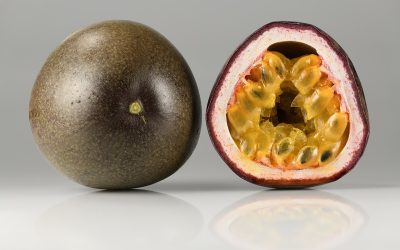
Passion fruits provide another useful example. PNG agricultural literature records several Passiflora crops, including banana passionfruit, purple passionfruit, and Passiflora ligularis. Readers searching for passion fruit papua new guinea may therefore find genuine examples of locally grown fruit, but cultivation in PNG alone is not evidence that a species originated there.
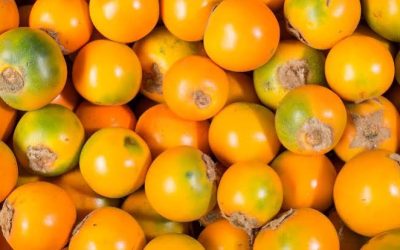
A similar distinction helps with lulo fruit papua new guinea. Lulo, also known as naranjilla, appears in Bourke’s discussion of less-common introduced fruits suitable for highland environments. Its presence in PNG horticulture does not place it among the country’s indigenous New Guinea fruit species.
Bananas deserve especially careful wording. They have a complex history of domestication and movement in the New Guinea region, and PNG agriculture includes numerous cultivated forms. For a general guide, it is more accurate to avoid treating “banana” as one simple botanical category or automatically labeling every cultivated banana either PNG-native or introduced.
The same caution applies to mangoes. Mangifera indica, the familiar cultivated mango, and Mangifera minor, a traditional species recorded from the New Guinea region, belong to the same genus but are different species. Calling both simply “mango” removes precisely the distinction that matters when discussing indigenous fruits.
A fruit growing widely in Papua New Guinea is not automatically a fruit native to Papua New Guinea.
For identification, it is better to consider the scientific species, documented natural range, and history of cultivation together. This approach keeps a list of PNG native fruits from becoming a general list of every tropical fruit currently grown in the country.
7. Papua New Guinea Fruits vs Fruits From Indonesian Papua
Papua New Guinea and Indonesian Papua share part of the same botanical landscape because both lie on the island of New Guinea. That geographical connection explains why some fruit species occur on both sides of the international border.
However, the two areas should never be treated as interchangeable. Papua New Guinea is an independent country, while the western part of New Guinea is within Indonesia. Plant distributions can cross this political boundary even though the countries, administrative systems, languages, and local naming traditions differ.
7.1 One Island, Two Different Countries
New Guinea is the large island located north of Australia. Papua New Guinea occupies its eastern portion, while Indonesia administers the western portion through several provinces.
The political border is much newer than the natural distribution of many plants. Trees, forest communities, and cultivated species developed or spread across New Guinea without following today’s national boundary. This is why a fruit documented in Papua New Guinea can sometimes also be familiar in Indonesian Papua.
The botanical record supports this wider geographic view. Kew lists species such as Pandanus conoideus and Pometia pinnata as native to New Guinea, rather than limiting their natural ranges to either modern country. Pometia pinnata has an even broader native distribution extending through parts of tropical Asia and the Pacific.
This distinction is especially useful when researching New Guinea native fruits. A shared species does not make Papua New Guinea and Papua, Indonesia, the same place. It simply reflects a plant range that extends across a political border.
7.2 Marita and Buah Merah Are the Same Species
One of the clearest examples is Pandanus conoideus.
In Papua New Guinea literature, the fruit is commonly discussed as marita or marata. Research on traditional New Guinea plant use describes marita as a widely cultivated pandanus whose elongated compound fruits often develop a strong red color. The fruit is traditionally processed, with the cooked fruit material used in local food preparation.
In Indonesian Papua, Pandanus conoideus is commonly known as buah merah, literally “red fruit.” Indonesian research and agricultural references also use the botanical name Pandanus conoideus when discussing buah merah from Papua and West Papua.
So the basic relationship is:
- Marita / marata in PNG contexts → Pandanus conoideus
- Buah merah in Indonesian Papua → Pandanus conoideus
The names differ, but they can refer to the same botanical species.
This explains why searches such as red fruit oil papua may lead readers toward Indonesian buah merah material, while PNG agricultural literature is more likely to use the word marita. The geographic wording matters: a product or article referring to “Papua” in Indonesia should not automatically be described as coming from Papua New Guinea.
The shared species offers a useful way to understand New Guinea’s botanical heritage without blurring national geography. Readers interested in buah merah can therefore compare information using the scientific name Pandanus conoideus, which is more precise than relying on regional common names alone.
7.3 Ton and Matoa Provide Another Cross-Border Example
A similar naming pattern occurs with Pometia pinnata.
Papua New Guinea agricultural literature commonly records this indigenous fruit as ton. PNG surveys list ton alongside marita, Malay apple, bukabuk, and other traditional fruit plants, and separate records explicitly connect the name ton with Pometia pinnata.
In Indonesia, the same species is widely known as matoa. Indonesian agricultural references identify matoa botanically as Pometia pinnata and document its presence in Papua as well as other parts of Indonesia.
The comparison can therefore be written simply:
- Ton in PNG → Pometia pinnata
- Matoa in Indonesia → Pometia pinnata
Unlike marita, Pometia pinnata is native across a particularly broad geographic range. Kew records it from New Guinea as well as numerous parts of South and Southeast Asia and the Pacific.
Ton and matoa demonstrate why both local names and scientific names belong in a guide to Papua New Guinea native fruits. Common names provide cultural and regional context, while botanical names allow readers to recognize when two differently named fruits are actually the same species.
8. How Native Fruits Are Traditionally Used in Papua New Guinea
Traditional uses of Papua New Guinea fruits vary by species and community. Some fruits are suitable for eating fresh, while others are cooked or processed before becoming part of a meal. Indigenous-fruit research therefore treats how a fruit is consumed as one of the important characteristics used to describe each species.
Fresh consumption is common for suitable fleshy fruits. Species such as ton, Malay apple, watery rose apple, rukam, and several figs have long been used as local foods. Depending on the fruit and location, produce may come from household plantings, village gardens, or trees growing in surrounding landscapes.
Other species require a very different approach. Marita (Pandanus conoideus) is the clearest example. Rather than being treated like a conventional fruit that is simply peeled and eaten, marita is traditionally cooked. Bourke describes the cooked fruit material being mashed with water and strained to produce a thick red sauce, which can accompany foods such as sweet potato, banana, and green vegetables.
This preparation method helps explain why appearance alone does not tell you how a PNG fruit fits into local cuisine. Two fruits may both be botanically described as edible while having completely different roles at the table.
Traditional use can include:
- eating ripe fruit fresh where appropriate;
- cooking certain fruits before use;
- preparing sauces or accompaniments;
- combining fruit preparations with staple foods and vegetables;
- consuming fruit when it is seasonally available;
- sharing or selling harvests through local fresh-food markets.
Local markets form another part of this picture. Bourke’s review specifically considers marketing alongside consumption and seasonality, showing that indigenous fruits are connected to both household food use and local exchange. Marita, for example, has been documented as being sold in fresh-food markets in producing areas, particularly in parts of the Highlands.
It is important, however, not to assume that every fruit is prepared in the same way throughout Papua New Guinea. Recipes, preferred varieties, names, and methods can differ between regions and communities.
The same caution applies to unfamiliar species. Knowing that a plant has a history as a traditional food does not automatically provide enough information for someone unfamiliar with it to prepare it correctly. For this reason, this guide describes culinary roles in general terms rather than giving preparation instructions for obscure fruits where identification and processing requirements have not been clearly established.
Taken together, these practices show that PNG native fruits are more than a collection of unusual species. They occupy different places in everyday food systems: some function as fresh seasonal fruits, some are processed into components of meals, and others circulate through gardens and local markets according to place and season.
9. Why Scientific Names Matter When Identifying PNG Fruits
Fruit names can change from one region, language, or country to another. This is especially relevant in Papua New Guinea, where local terminology may differ between communities and where several fruit species are shared with Indonesian Papua and other parts of the Pacific.
Scientific names provide a more consistent way to identify the actual plant being discussed. Bourke’s review, for example, pairs PNG fruit names such as marita and ton with their botanical names, allowing the species to be compared with records from other regions.
Consider two important examples:
- Marita / marata → Pandanus conoideus
- Ton / matoa → Pometia pinnata
A reader in Papua New Guinea may encounter the name ton, while someone in Indonesia may be more familiar with matoa. Both can refer to Pometia pinnata. Kew recognizes Pometia pinnata as an accepted species with a native distribution that includes New Guinea and many other areas of tropical Asia and the Pacific.
The same principle applies to marita and buah merah. Regional names differ, but Pandanus conoideus provides a common botanical reference. Kew recognizes the species and records its native range from Maluku through New Guinea into parts of the western Pacific.
Scientific names are also helpful when English common names sound similar. Malay apple and watery rose apple, for example, belong to the same genus but are separate species:
- Malay apple → Syzygium malaccense
- Watery rose apple → Syzygium aqueum
Kew treats both as accepted species and records New Guinea within the native distribution of each.
This prevents an easy mistake: assuming that fruits with similar common names must be the same plant.
Scientific identification becomes even more useful with vague search terms. Someone searching for sugar fruit papua new guinea, for example, has not yet provided enough information to identify one botanical species reliably. A local or informal fruit name can refer to different plants in different places. Checking the scientific name is a safer way to determine which fruit a source actually describes.
Botanical names can also clarify older literature. Plant classification changes as taxonomy is revised, so an older agricultural publication may use a scientific synonym that differs from the currently accepted name. Keeping both names where relevant helps readers connect historical PNG sources with modern botanical databases.
For a practical guide, there is no need to repeat a Latin name in every paragraph. The clearest approach is to introduce it prominently when a fruit first appears and then use the common or local name afterward.
This creates a useful two-part identification system: local names provide regional and cultural context, while scientific names establish which plant species is being discussed.
10. Are All Papua New Guinea Native Fruits Found Across the Country?
No. Papua New Guinea native fruits are not distributed evenly across the country. Some species have relatively broad ranges, while others are associated with particular elevations, environments, or regions. Bourke’s review of indigenous PNG fruits specifically examines each species by its distribution within Papua New Guinea, altitudinal range, seasonality, and the number of rural people living where it is common.
Papua New Guinea contains coastal areas, humid lowlands, river valleys, mountain forests, and highland environments. A fruit adapted to one of these settings may be uncommon or absent in another.
Coastal pandanus (Pandanus tectorius), for example, is closely associated with coastal and island environments. Marita (Pandanus conoideus), by comparison, has an important association with upland areas of New Guinea. Other species, including ton, bukabuk, mon, and several native figs, are connected mainly with tropical forest environments.
This variation means that a list of traditional PNG fruits should not be interpreted as a list of plants that can be found in every province.
Season also affects availability. Indigenous-fruit research treats crop seasonality as an important characteristic because individual species do not necessarily produce fruit throughout the year. A locally familiar fruit can therefore be plentiful during one period and much less visible at another.
Local names create another layer of variation. Papua New Guinea has extensive linguistic diversity, so the same botanical species may be known by different names between communities. Conversely, a familiar-sounding common name may not always refer to exactly the same species in every location.
For readers trying to identify a fruit, four details are especially useful:
- the scientific name;
- the province or general region where it was observed;
- the elevation and surrounding habitat;
- the local name used by the community.
These details provide more useful context than assuming that every indigenous fruit occurs throughout PNG.
Distribution should also be kept separate from cultural importance. A species does not need to grow nationwide to have a longstanding role in a particular regional food system. Bourke’s survey itself includes species with different levels of geographical importance rather than limiting the category to fruits common across most of the population.
In short, “fruit native to Papua New Guinea” describes botanical and historical relationships, not guaranteed nationwide availability. Where a fruit grows depends on the individual species, local ecology, elevation, cultivation practices, and season.
11. Are Papua New Guinea Native Fruits Available Outside PNG?
Yes, some Papua New Guinea native fruits are also found outside the country. Their availability depends on the species, its natural range, local cultivation, and whether it has entered wider commercial markets.
Several fruits discussed in this guide are native to regions extending beyond modern Papua New Guinea. Marita (Pandanus conoideus), for example, occurs across New Guinea and neighboring island groups, while ton (Pometia pinnata) has a much broader native range through parts of tropical Asia and the Pacific. Kew also records species such as Syzygium malaccense, Syzygium aqueum, and Dracontomelon dao across wider tropical regions. (powo.science.kew.org)
This means a fruit can be strongly associated with traditional PNG food systems without being limited to Papua New Guinea.
Some species are also known under different names elsewhere. Pandanus conoideus is commonly called buah merah in Indonesian Papua, while Pometia pinnata is widely known as matoa in Indonesia. A traveler or researcher may therefore encounter the same botanical species outside PNG without seeing the PNG names marita or ton.
International commercial availability is a separate issue. Many indigenous and underutilized fruit species have little presence in mainstream export markets, even when they grow across a fairly large natural area. Fruits such as bukabuk, several native figs, and lesser-known Sapotaceae species are much less visible internationally than globally traded crops such as pineapple, papaya, or commercial mango.
That difference is important because limited export presence does not automatically mean a fruit is rare in its natural environment. A species may be locally familiar but poorly suited to large-scale distribution, produced mainly for household use, sold mostly in regional markets, or simply have little recognition among international consumers.
The reverse can also happen. A fruit with a broad geographic range may still be difficult to find in ordinary shops because commercial cultivation is limited.
For this reason, it helps to separate three questions:
- Where is the species naturally found?
- Where is it traditionally cultivated or gathered?
- Where is it commercially sold?
These questions describe different aspects of availability.
When researching fruits outside Papua New Guinea, scientific names are especially useful. Searching for Pandanus conoideus rather than only “marita,” or Pometia pinnata rather than only “ton,” can reveal records from Indonesian Papua, neighboring islands, and other parts of the species’ range.
So while some indigenous PNG fruits can certainly be found elsewhere, their visibility varies greatly. A fruit may be widespread botanically yet remain unfamiliar in international food markets.
12. Papua New Guinea’s Native Fruits Reflect Its Biodiversity
The variety of indigenous fruits found in Papua New Guinea makes more sense when viewed within the wider plant diversity of New Guinea. A major botanical checklist recorded 13,634 vascular plant species across the island, spanning environments from mangroves and lowland rainforest to mountain forests and alpine grasslands. Around 68% of the documented plant species were considered endemic to New Guinea, although this percentage should not be applied directly to the fruit species discussed in this guide.
PNG’s traditional fruits illustrate this diversity on a smaller, more practical scale. They include several very different botanical groups:
- Pandanus fruits, such as marita (Pandanus conoideus) and coastal pandanus (Pandanus tectorius);
- forest tree fruits, including ton (Pometia pinnata), bukabuk (Burckella obovata), and mon (Dracontomelon dao);
- Syzygium fruits, such as Malay apple and watery rose apple;
- traditional mango relatives, including Mangifera minor;
- native figs, including Ficus copiosa, Ficus dammaropsis, Ficus wassa, and other locally used species.
Bourke’s review lists about 40 species eaten as indigenous fruits in PNG and notes that the inventory is incomplete. The study also considers differences in distribution, altitude, seasonality, consumption, and local marketing, showing that Papua New Guinea’s fruit traditions cannot be reduced to a small group of universally available species.
These fruits are significant for different reasons. Some are cultivated in gardens, some occur in forest or semi-wild environments, and some have particular associations with coastal, lowland, or highland landscapes. Their roles also differ: one species may be eaten fresh, another traditionally cooked, and another primarily familiar within a limited geographic area.
Just as importantly, PNG’s fruit diversity crosses modern borders. Marita is known as buah merah in Indonesian Papua, while ton is widely recognized as matoa in Indonesia. These examples reflect a shared New Guinea flora rather than suggesting that Papua New Guinea and Indonesian Papua are the same place.
Looking at scientific names alongside local names therefore gives a clearer picture of these plants. It helps distinguish genuinely different species, connects regional names for the same fruit, and prevents common introduced tropical crops from being automatically classified as indigenous PNG fruits.
Papua New Guinea’s traditional fruit plants are best understood as part of a much larger botanical and food landscape—one shaped by New Guinea’s varied ecosystems, local cultivation, forest resources, regional naming traditions, and long histories of using plants as food.
13. Frequently Asked Questions About Papua New Guinea Native Fruits
13.1 What Fruit Is Native to Papua New Guinea?
Papua New Guinea has many indigenous fruits, including marita (Pandanus conoideus), ton (Pometia pinnata), bukabuk (Burckella obovata), Malay apple (Syzygium malaccense), rukam (Flacourtia rukam), and several native figs. Bourke’s review records about 40 species eaten as indigenous fruits in PNG, while noting that the list is incomplete.
Many of these fruits are native to the broader New Guinea region or have ranges extending into neighboring islands. They should therefore not automatically be described as species found only in Papua New Guinea.
13.2 What Is the Famous Red Fruit From Papua New Guinea?
The distinctive red fruit commonly called marita or marata in Papua New Guinea is Pandanus conoideus. It is a large compound pandanus fruit traditionally processed as food rather than generally eaten like an ordinary fresh hand fruit.
The species is native to New Guinea and several surrounding island groups. In Indonesian Papua, the same botanical species is commonly known as buah merah.
13.3 Is Matoa Found in Papua New Guinea?
Yes. Matoa is an Indonesian name commonly used for Pometia pinnata, a species that occurs naturally in New Guinea. In Papua New Guinea literature, the fruit is commonly called ton.
Its native distribution is much wider than PNG, extending through parts of tropical Asia and the South Pacific. This is why the scientific name is useful when comparing local fruit names between countries.
13.4 Is Marita the Same as Buah Merah?
Yes, when both names refer to Pandanus conoideus.
Marita or marata is terminology found in Papua New Guinea, while buah merah, meaning “red fruit,” is widely used in Indonesian Papua. The two regions are politically different, but they share part of the same New Guinea flora. Kew records Pandanus conoideus as native to New Guinea as well as Maluku and several western Pacific island groups.
13.5 Are Papaya and Pineapple Native to Papua New Guinea?
Papaya and pineapple are grown and eaten in Papua New Guinea, but their presence in the country does not make them indigenous PNG fruits. PNG horticultural literature distinguishes such introduced fruit crops from species traditionally present in local food systems before major outside crop introductions.
This distinction is essential when making a list of native fruits: a fruit that grows successfully in PNG is not automatically native to PNG.
13.6 What Is the Difference Between Native and Introduced PNG Fruits?
In this context, indigenous fruits are species with established use or cultivation in Papua New Guinea before the major period of outside settlement and crop introductions beginning around the late nineteenth century. Bourke uses this historical framework when discussing indigenous PNG fruits.
Introduced fruits arrived from elsewhere and later became established in local cultivation. Some are now very common, but that does not change their geographic or historical origins.
13.7 Does Papua New Guinea Have Unique Fruit Species?
Yes, Papua New Guinea and the wider island of New Guinea contain many distinctive indigenous and underutilized fruit plants, including pandanus species, native figs, Pometia, Burckella, Syzygium, and other tropical fruit trees.
However, “unique” should be used carefully. Some fruits are strongly associated with New Guinea, while others have natural ranges extending into Southeast Asia, Melanesia, or the Pacific. For example, Pandanus conoideus is native to New Guinea but is also recorded from several neighboring island regions, while Pometia pinnata has an even broader distribution.
Papua New Guinea native fruits are therefore best understood through a combination of scientific identity, natural distribution, traditional food use, and local naming. Marita, ton, bukabuk, native figs, pandanus, and other indigenous fruits show how closely PNG’s food traditions are connected with the extraordinary plant diversity of the wider New Guinea region.
If you’re looking for Papua herbal products, start with a trusted source. Experience authentic, high-quality red fruit products at Cahya Red Fruit Papua New Guinea! We offer a wide variety of items besides Red Fruit Papua New Guinea — including Papua ant nest and Papua kebar grass. Check out our herbal wellness product in our website!