Introduction
Cocoa production in Papua New Guinea is a small but distinctive part of the global cocoa sector. In 2024, Papua New Guinea produced about 41,108 tonnes of cocoa, reported as 647,370 bags, making it far smaller than the world’s largest cocoa-producing countries but still important as a recognised fine or flavour cocoa origin. The industry is mainly led by smallholder and family-operated farms rather than large estates, and it remains closely connected to village livelihoods in coastal and island regions.
Papua New Guinea, often shortened to Papua New Guinea, is also different from the Indonesian provinces located in the western half of New Guinea. This article discusses the independent country of Papua New Guinea, including major cocoa-growing areas such as Bougainville, East Sepik, East New Britain, Madang, Morobe, and other suitable lowland provinces.
Papua New Guinea cocoa is often discussed for its flavour potential, but that does not mean every shipment is automatically premium. The International Cocoa Organization’s April 2024 decision classifies 80% of Papua New Guinea’s cocoa-bean exports as fine or flavour cocoa, a category linked to genetics, growing conditions, harvesting, fermentation, drying, and overall bean quality.
The sections below look at production statistics, regional growing patterns, cocoa varieties, farming systems, fermentation, drying, quality control, pests, exports, and the future outlook for the Papua New Guinea cocoa industry.
Cocoa Production in Papua New Guinea at a Glance
Papua New Guinea’s cocoa sector is best understood as a smallholder-led, export-oriented industry. The country does not produce cocoa on the scale of Côte d’Ivoire, Ghana, Ecuador, or Cameroon, but Papua New Guinea has a recognised place in the fine or flavour cocoa category. In practical terms, this means Papua New Guinea’s cocoa reputation depends not only on how many beans are produced, but also on how pods are harvested, fermented, dried, graded, stored, and exported.
The figures below should be read carefully because cocoa statistics are often reported in different ways. Some sources describe national production. Others describe export volume or export value. Some figures refer to dried exportable beans, while wet beans are a farmgate product that still need fermentation and drying before they become export-quality cocoa.
| Metric | Figure | Year | Measurement | Source |
| Production | 41,108 tonnes, reported from 647,370 bags | 2024 | Reported cocoa production; the source gives the tonne equivalent | Cocoa Board figure reported by The National |
| FAO production estimate | 43,200 tonnes | 2023 | Cocoa beans, production quantity | FAO-derived data presented by Tridge |
| Harvested or planted area | Recent FAOSTAT-derived entries appear in the range of about 102,577 to 108,908 hectares | Not clearly exposed in the open snippet | Area harvested; should be checked directly in FAOSTAT before publication | CABI Compendium snippet using FAOSTAT-style data |
| Export earnings | K1.2 billion | 2024 | Export revenue, not production volume | Cocoa Board figure reported by The National |
| Smallholder base | More than 100,000 smallholder farmers and about 151,000 households | 2026 reporting of the 2026–2028 Corporate Plan launch | Farmers and households across 14 cocoa-growing provinces | EMTV report on Cocoa Board Corporate Plan launch |
| Fine or flavour cocoa share | 80% of cocoa-bean exports | April 2024 ICCO decision | Share of national cocoa-bean exports classified as fine or flavour cocoa | ICCO Annex C classification |
| Current national target | 80,000 tonnes by 2028; 100,000 tonnes by 2030 also appears in government reporting | 2026 | Official target or policy ambition, not a forecast | Papua New Guinea Bulletin and EMTV reporting on Cocoa Board Corporate Plan |
Source note: The 2024 production figure and the 2024 export-earnings figure come from reporting attributed to the Cocoa Board of Papua New Guinea. They should not be treated as the same metric. Production refers to cocoa output, while export earnings describe the value received from cocoa exports during the reporting period. A year of high export earnings can reflect higher international prices, not necessarily a large increase in physical production volume.
Different sources can show slightly different totals for Papua New Guinea cocoa production for several reasons. First, production year and export year may not match exactly. Beans harvested near the end of one year may be sold, inspected, shipped, or recorded in another period. Second, production data and export data answer different questions. Production data estimates how much cocoa was produced inside the country, while trade data records cocoa that crossed the border.
Third, wet cocoa beans and dry cocoa beans are not the same product. Wet beans are fresh beans removed from cocoa pods after pod breaking. Dry beans are fermented and dried beans prepared for storage, grading, sale, and export. A wet-bean figure cannot be compared directly with a dry-bean figure unless the conversion method is clearly stated.
Fourth, some government and international sources use rounded estimates. FAO-style data may present annual agricultural production as a rounded national figure, while domestic industry reporting may use bags, tonnes, export receipts, or inspection records. Bags should not be converted into tonnes unless the standard bag weight for that specific report is confirmed. In the 2024 report above, the source itself gives both the number of bags and the tonne equivalent, so the article can use the stated tonne figure without making its own conversion.
How Important Is Cocoa to Papua New Guinea?
Cocoa is one of Papua New Guinea’s most important village-based agricultural commodities. The Cocoa Board of Papua New Guinea describes cocoa as the country’s third most important source of village agriculture income after coffee and fresh food, and the Board is also the statutory body responsible for promoting, regulating, and facilitating the export of cocoa beans and cocoa products.
Its importance is easiest to see at the community level. Cocoa grows mainly in warm, humid coastal and island environments, so its economic role is especially visible in places such as Bougainville, East Sepik, East New Britain, Madang, Morobe, New Ireland, and West New Britain. These are areas where cocoa can fit into mixed rural landscapes rather than replacing every other activity on a family farm.
Most Papua New Guinea cocoa is produced by smallholders, not large plantations. A 2023 Papua New Guinea National Research Institute discussion paper states that smallholders account for close to 98% of total production, while a 2026 report on the Cocoa Board’s Corporate Plan says cocoa supports more than 100,000 smallholder farmers and about 151,000 households across 14 cocoa-growing provinces.
For many households, cocoa is part of a broader farming system. A family may keep cocoa blocks alongside food gardens, coconuts, betel nut, livestock, fishing, or other local activities. In some areas, cocoa is grown under shade trees or intercropped with coconut and food crops. This mixed system matters because cocoa is not only an export crop. It is also part of how rural households organise labour, land, transport, seasonal work, and local trade.
Cocoa income can also circulate through village economies. When beans are sold, money may move through local buying points, fermentaries, transport operators, trade stores, markets, school-related expenses, church activities, and community services. This does not mean cocoa guarantees a stable income for every grower. Production can be affected by pests, disease, road access, weather, labour availability, and post-harvest quality. Still, the crop remains important because it connects many remote farming communities to a wider agricultural value chain.
Bougainville, East Sepik, and East New Britain are especially well known in Papua New Guinea cocoa discussions, but Madang and Morobe also form important parts of the wider MOMASE cocoa region. ACIAR’s Papua New Guinea cocoa project, for example, focused on smallholder cocoa enterprises in East Sepik, Madang, New Ireland, and Chimbu, showing that industry-development work has extended beyond the best-known island provinces.
National production volume alone can understate cocoa’s local significance. Papua New Guinea may produce only a small share of global cocoa, but in cocoa-growing districts the crop can shape local processing facilities, road use, farmer training, village buying networks, and export relationships. That local role is why cocoa remains a major agricultural development topic in Papua New Guinea even when the country’s total output is modest by global standards.
History and Production Trends
Development of the Papua New Guinea cocoa industry
Papua New Guinea’s cocoa industry developed from a mix of plantation agriculture, research work, and gradual smallholder expansion. Commercial cocoa became especially important in coastal and island areas where the climate suited Theobroma cacao, and East New Britain became one of the country’s best-known cocoa centres because of its plantations, exporters, research activity, and planting-material development.
Earlier in the industry’s history, plantations played a larger role. Over time, the balance shifted toward village-based production. Today, smallholder farmers are responsible for most Papua New Guinea cocoa output, with ACIAR-linked writing in 2024 noting that smallholders produce more than 80% of cocoa in the country. This shift matters because modern Papua New Guinea cocoa production is not simply an estate-crop story. It is also a story of family labour, small cocoa blocks, village fermentaries, farmer groups, wet-bean buying, dry-bean trading, and uneven access to extension services.
East New Britain remains important in this history because the province has long been associated with cocoa research and commercial development. Keravat and Tavilo are frequently mentioned in Papua New Guinea cocoa discussions because of their links with research, nurseries, breeding work, and improved planting material. In later sections, this becomes important when discussing hybrid seedlings, hybrid clones, rehabilitation, and cocoa block rejuvenation.
Production before and after the cocoa pod borer
Before the cocoa pod borer became widespread, Papua New Guinea cocoa production could reach higher national volumes than many recent years. A 2024 Devpolicy article states that national production peaked at 56,000 tonnes in 2008 before falling to 33,000 tonnes in 2015. The same article attributes much of that fall to the spread of cocoa pod borer from 2006, along with the abandonment of many cocoa blocks.
Cocoa pod borer, Conopomorpha cramerella, is one of the most important turning points in the modern Papua New Guinea cocoa story. A University of Melbourne research record describes the pest as emerging in East New Britain in 2006, after which researchers assessed the risk of its spread to other cocoa-growing areas such as Bougainville and New Ireland.
The pest changed the labour pattern of cocoa farming. In low-maintenance cocoa blocks, pods could previously be harvested less frequently. Once cocoa pod borer became established, farmers had to pay closer attention to regular harvesting, sanitation, pruning, and pest monitoring. Where these tasks were not practical, some blocks were maintained less carefully or abandoned. This helps explain why the decline was not only a biological problem, but also a farm-management and labour problem.
Since the mid-2010s, Papua New Guinea cocoa production has shown signs of recovery, although the recovery has not been even across all provinces. Devpolicy reports that production rebounded to about 43,000 tonnes in 2019 after the 2015 low, supported by integrated pest and disease management and pest-resistant, higher-yielding clones. FAO-derived data presented by Tridge gives 43,200 tonnes for 2023 and notes that production rose from 35,700 tonnes in 2019 to 43,200 tonnes in 2023.
Understanding recent production figures
Recent figures should be read with care. In 2024, the Cocoa Board figure reported by The National gave production as 647,370 bags, equivalent to 41,108 tonnes. The same report said this was only a slight increase of 1.3% from 2023 and explained that higher export earnings were strongly influenced by high world market prices, not simply by a large production increase.
A safe way to present the trend is to separate verified production points from export-value reporting:
| Year | Reported cocoa figure | What the figure represents | Source note |
| 2008 | 56,000 tonnes | National production peak reported in a 2024 industry discussion | Devpolicy / Cocoa Board Papua New Guinea chart reference |
| 2015 | 33,000 tonnes | Low point after cocoa pod borer pressure | Devpolicy / Cocoa Board Papua New Guinea chart reference |
| 2019 | About 43,000 tonnes; FAO-derived source also gives 35,700 tonnes for 2019 | Production estimates differ by dataset and reporting method | Devpolicy and FAO-derived Tridge data |
| 2023 | 43,200 tonnes | FAO-derived production quantity | Tridge, based on FAO code 0661 |
| 2024 | 41,108 tonnes | Cocoa Board figure reported as bags with tonne equivalent | The National, reporting Cocoa Board statement |
Source note: Do not combine these figures into one line chart unless the dataset is standardised first. Some figures come from Cocoa Board reporting, some from FAO-derived agricultural production data, and some from media reporting of industry statements. A production chart and an export-value chart should be kept separate.
The main lesson from the trend is that Papua New Guinea cocoa output moves in response to several factors at once. Cocoa pod borer has been a major influence, but it is not the only one. Weather, pruning, harvesting frequency, household labour, tree age, disease pressure, planting-material access, road conditions, fermentary access, and buyer demand can all influence how much cocoa is harvested and sold in a given year.
This is also why higher export earnings should not automatically be read as higher production. Export value can rise when international prices rise, even if physical output changes only slightly. Production volume, export volume, and export value answer different questions, so they should be discussed separately.
Where Cocoa Is Grown in Papua New Guinea
Cocoa in Papua New Guinea is mainly associated with warm, humid, lowland and coastal environments. The crop can be grown across many suitable parts of the country, but commercial output is concentrated in a smaller group of provinces where cocoa trees, farmer experience, buying networks, fermentaries, and export channels are already established.
Recent industry reporting says cocoa is grown in 14 of Papua New Guinea’s 22 provinces, with East Sepik, Bougainville, Madang, East New Britain, Morobe, West New Britain, and New Ireland among the major producers. A climate-risk fact sheet on Papua New Guinea cocoa also identifies East New Britain, the Autonomous Region of Bougainville, and East Sepik as three major cocoa-producing regions.
Provincial rankings should be handled carefully because they can change by year, depending on pest pressure, weather, farmer maintenance, transport access, export activity, and the way a source reports the data. For example, a 2025 Devpolicy article described Bougainville as the country’s largest cocoa-producing area in export-earning terms for that reporting period, followed by East Sepik and East New Britain. That kind of dated statement is useful, but it should not be turned into a permanent ranking without checking the latest Cocoa Board or provincial data.
Autonomous Region of Bougainville
The Autonomous Region of Bougainville is one of Papua New Guinea’s most important cocoa areas. Cocoa is widely connected with village and family livelihoods, and many producers operate through smallholder blocks rather than large estates. In many communities, farmers harvest pods, break them near the farm, and sell wet beans to local buyers or fermentaries. Others are involved in dry-bean production through village fermentaries, farmer groups, cooperatives, or local trading networks.
Bougainville’s cocoa story has also been shaped by recovery. Conflict, disrupted services, damaged infrastructure, and later pest pressure affected production and market access. Rehabilitation has therefore included more than planting trees. It has also involved restoring cocoa blocks, improving fermentaries, rebuilding buyer confidence, strengthening local extension, and improving the consistency of drying and storage.
The region is often discussed for specialty and fine-flavour potential because of its established cocoa culture, island growing conditions, and farmer interest in better post-harvest handling. However, this potential still depends on batch quality. Good genetics alone cannot compensate for poorly fermented, smoky, mouldy, or badly dried beans. For Bougainville, as for the rest of Papua New Guinea, quality is created through the full chain from tree management to export preparation.
East Sepik
East Sepik has become one of Papua New Guinea’s most visible cocoa regions. Cocoa is grown across many Sepik communities, and development programmes have supported farmer training, nurseries, block rehabilitation, fermentation, drying, market access, and cooperative activity. FAO’s EU-STREIT Papua New Guinea programme has reported recent work with East Sepik cooperatives, including a 2026 shipment of 240 bags, equal to 15 metric tonnes, to a niche overseas market in New Caledonia.
East Sepik includes both wet-bean and dry-bean production models. Some farmers sell wet beans to village or roadside buyers because they may not own fermenting and drying facilities, may need faster sale options, or may be located near active buying points. Other producers or groups ferment and dry beans before sale, which gives them more direct responsibility for post-harvest quality.
Cocoa pod borer has affected East Sepik, as it has other major cocoa provinces. The pest can make cocoa farming more labour-intensive because farmers need to harvest frequently, remove infested pods, prune trees, and keep blocks cleaner. Training in pest control, block management, fermentation, drying, and quality sorting is therefore central to the province’s cocoa development.
East Sepik also has potential for differentiated cocoa lots, but consistent quality remains essential. Transport, fermentary access, wet-bean handling time, batch separation, and farmer-buyer coordination can all influence whether beans reach export buyers in good condition.
East New Britain
East New Britain has deep historical importance in the Papua New Guinea cocoa industry. The province has long been linked with commercial cocoa development, research activity, nurseries, exporters, and improved planting material. Places such as Keravat and Tavilo are often mentioned in relation to cocoa research, seed gardens, breeding work, and the movement of improved varieties into farmer blocks.
The province was also central to the modern cocoa pod borer story. Cocoa pod borer was first reported in East New Britain in 2006, and the pest caused severe production losses in the years that followed. CABI notes that East New Britain, formerly the highest-producing province, saw production fall sharply between 2008 and 2012, with cocoa pod borer identified as the main cause.
Despite that setback, East New Britain remains important because it has cocoa knowledge, planting-material systems, extension experience, commercial exporters, and post-harvest infrastructure. Current improvement work in the province often focuses on rehabilitating cocoa blocks, using better planting material, keeping trees manageable, and improving the consistency of harvesting, fermentation, and drying. UNDP also reported 2025 support for cocoa farmers in Central Pomio LLG, East New Britain, as part of sustainable land-use and cocoa production work on New Britain Island.
Madang, Morobe, and Other Producing Provinces
Madang and Morobe are important parts of the wider MOMASE region, a name commonly used for Morobe, Madang, and Sepik. A European Commission value-chain study describes Madang-Sepik, or MOMASE, as accounting for more than half of Papua New Guinea cocoa production in the period examined, alongside East New Britain and Bougainville as key cocoa regions.
Madang and Morobe show how cocoa potential depends on more than climate. Both provinces include areas where cocoa can grow, but commercial output depends on roads, buying points, fermentaries, extension services, farmer organisation, pest pressure, and the cost of moving beans to market. A cocoa block in a suitable rainfall zone may still produce little marketable cocoa if trees are overgrown, fermentaries are inactive, or transport is unreliable.
New Ireland and West New Britain are also part of Papua New Guinea’s cocoa geography. New Ireland has been included in smallholder cocoa development work, including ACIAR-supported efforts focused on enterprise development in East Sepik, Madang, New Ireland, and Chimbu. West New Britain is also named among major cocoa-producing provinces in Papua New Guinea industry reporting.
Cocoa cultivation has also been discussed in Central Province and other suitable lowland areas, but suitability does not automatically become commercial output. Farmers still need planting material, knowledge, market access, labour, fermentary capacity, and reliable quality systems. This is why Papua New Guinea’s cocoa map is broad in climate potential but narrower in active commercial concentration.
Cocoa Varieties and Planting Material Used in Papua New Guinea
Cocoa varieties in Papua New Guinea are usually discussed through three overlapping ideas: the historical Trinitario base, later Trinitario–Amazonian hybrid seedlings, and more recent work with selected hybrid clones. These terms can sound technical, but they matter because planting material affects tree growth, bean quality, disease tolerance, harvesting convenience, and the long-term performance of a cocoa block.
Trinitario cocoa
Trinitario cocoa has been an important foundation of the Papua New Guinea cocoa industry. Historically, much of the country’s cocoa was based on Trinitario material, which is widely associated in cocoa literature with desirable flavour characteristics. In Papua New Guinea, this heritage is one reason the country is often discussed as a fine or flavour cocoa origin rather than only as a bulk cocoa producer.
However, Trinitario should not be treated as a single uniform type. Cocoa trees are naturally cross-pollinated, and seedlings grown from open-pollinated farm seeds may vary from one tree to another. A seed collected from a good tree does not automatically produce another tree with the same yield, flavour potential, disease response, or growth habit. This is because the seed contains genetic material from both the mother tree and an unknown pollen parent.
This point is important for readers who are new to cocoa genetics. A productive cocoa tree in one village block may be valuable, but its open-pollinated seeds may produce mixed results. Some seedlings may perform well. Others may grow too tall, produce fewer pods, or respond differently to pests, disease, shade, and pruning. For that reason, Papua New Guinea cocoa improvement has increasingly focused on selected planting material rather than uncontrolled seed collection.
Trinitario and Amazonian hybrids
Papua New Guinea’s later cocoa development included crosses between Trinitario material and Amazonian cocoa. The Papua New Guinea Cocoa Extension Manual explains that much Trinitario cocoa on farms was gradually replaced by SG1 and SG2 hybrid seedlings, produced by crossing original Trinitario clones with Amazonian clones introduced through earlier breeding work.
These SG1 and SG2 hybrids were important because they could produce well under good growing conditions and offered improvement over older material in some situations. A breeding paper on Papua New Guinea cocoa notes that SG1 was released in 1982 as a vascular streak dieback-resistant hybrid mixture, while SG2 was also developed and released as part of the country’s cocoa breeding strategy.
Even so, the older hybrid populations had limitations. The Papua New Guinea Cocoa Farmer’s Handbook notes that SG1 and SG2 hybrids could grow too fast, become very large, show variable yield between trees, and decline sharply after several years. This does not mean the hybrids were unimportant. It means they were not genetically identical from tree to tree. A hybrid seedling is still a seedling, so each plant is a new genetic individual.
This is why historical hybrid populations should not be described as genetically uniform. They were improved populations, not identical copies. In a farmer’s block, one SG hybrid seedling might be vigorous and productive, while another from the same seed batch might be less manageable or lower yielding. For smallholders, this variability can affect labour, pruning, harvesting, and the overall consistency of the cocoa block.
Hybrid clones and controlled propagation
Hybrid clones were developed to reduce the variability seen in seedling populations. Instead of planting seeds and accepting a wide range of tree types, breeders and technicians select superior trees, then reproduce them through controlled vegetative propagation. In Papua New Guinea, this has included budding, top grafting, budwood gardens, and nursery-based multiplication.
The basic idea is simple. A clone is a genetically consistent copy of a selected parent tree. If a selected tree has useful traits, such as manageable growth, good bean quality, good production under local conditions, or better tolerance to important pests or diseases, pieces of that tree can be propagated so that new trees carry the same genetic identity. This is different from planting seeds, where every seedling is genetically new.
Recent improvement work continues to use this approach. In 2025, UNDP reported that the Cocoa Board of Papua New Guinea provided 18 varieties of cocoa clone materials to establish budwood gardens in Central Pomio, East New Britain. The report also described certification work by the Cocoa Board’s Breeding Section to assess and tag clone varieties in farmer budwood gardens.
For readers, the key distinction is this:
| Term | Simple meaning | Why it matters in Papua New Guinea cocoa |
| Seedling | A cocoa plant grown from a seed | Each seedling is genetically different, especially when the pollen parent is unknown |
| Hybrid seedling | A seedling produced from a planned cross between selected parent types | It may have improved potential, but trees can still vary within the same seed batch |
| Clone | A vegetative copy of a selected tree, produced through methods such as budding or grafting | Trees are genetically consistent copies of the selected parent, so performance is usually more predictable when managed well |
Controlled propagation does not remove the need for good farming and post-harvest work. A clone still needs suitable shade, pruning, sanitation, harvesting, fermentation, drying, and pest and disease management. It also needs to be matched to local conditions. A planting material that performs well in one environment may not perform the same way in another province with different rainfall, disease pressure, soil conditions, or management practices.
This is why approved planting material, licensed nurseries, and well-managed budwood gardens are important for Papua New Guinea cocoa development. They help farmers and extension workers move away from random seed collection and toward more predictable cocoa blocks. At the same time, planting material should be presented as one part of the production system, not as a stand-alone solution to every challenge in the industry.
How Cocoa Is Produced in Papua New Guinea
Cocoa production in Papua New Guinea begins with the tree but depends on the whole farming system around it. A productive cocoa block needs suitable planting material, shade, pruning, harvesting, sanitation, fermentation, drying, and access to buyers. In Papua New Guinea, these tasks are usually carried out by smallholder households, farmer groups, village fermentaries, or local cocoa businesses rather than by one standard national farming model.
Because Papua New Guinea has many islands, coastal lowlands, river valleys, and remote communities, cocoa production practices can vary from one province to another. A cocoa block in East Sepik may face different rainfall, transport, labour, and pest conditions from one in Bougainville, East New Britain, Madang, or Morobe. For that reason, cocoa production in Papua New Guinea is best understood as a set of shared principles applied under local conditions.
Nursery establishment and field planting
Cocoa trees may begin as seedlings or as clonally propagated plants. Seedlings are grown from cocoa seeds, while clones are produced through methods such as budding or grafting. In either case, young plants are usually raised in a nursery before being moved into the field. The nursery stage helps protect young cocoa plants while they develop stronger stems, leaves, and roots.
Nursery care is important because weak plants often struggle after transplanting. Young cocoa plants need protection from harsh sunlight, weeds, physical damage, and poor drainage. Before planting in the field, nursery plants are commonly hardened so they can adjust gradually to outdoor conditions. This reduces stress when they are moved from a protected nursery environment into a farm block.
Field planting is usually timed with suitable rainfall so young cocoa plants have enough moisture to establish. Cocoa does not like prolonged drought, but it also performs poorly where roots are waterlogged for long periods. In Papua New Guinea’s wet tropical environments, farmers need to think about both moisture and drainage.
Shade is also important at planting. Young cocoa plants are sensitive to strong sun and heat, so temporary or permanent shade may be used. In established farms, shade may come from planted shade trees, coconuts, bananas, food crops, or existing tree cover. The goal is not to keep cocoa in deep darkness, but to create a protected growing environment while still allowing enough light and airflow for healthy growth.
Farmers also need to protect young cocoa from weeds and physical damage. Weeds compete for water and nutrients, and they can make it harder to inspect the cocoa block. Physical damage from careless cutting, animals, falling branches, or foot traffic can reduce plant survival. Good early care helps the block become easier to manage in later years.
Shade and agroforestry systems
Cocoa in Papua New Guinea is often grown in agroforestry-style systems rather than in open monoculture. This means cocoa trees may grow under managed shade and alongside other useful plants. Common companions can include coconuts, Gliricidia shade trees, bananas, food crops, timber trees, or other locally valued species.
This mixed approach fits many smallholder farms because families rarely depend on cocoa alone. Food gardens support household food needs, coconuts may provide another cash or household product, and shade trees can help moderate the cocoa environment. In some communities, cocoa blocks sit within a wider landscape of gardens, fallows, village forests, rivers, tracks, and settlement areas.
Shade has several benefits. It can reduce heat stress, protect young cocoa, slow moisture loss from the soil, and create a more stable microclimate. Soil cover from leaf litter can also help reduce erosion and support organic matter. In coastal and island conditions where heat and heavy rain can both be intense, shade can make cocoa blocks more resilient.
However, too much shade can create problems. Dense shade can keep the cocoa canopy humid, reduce airflow, make trees grow tall and leggy, and increase pressure from diseases such as black pod rot. Overgrown shade can also make it harder to see ripe pods, diseased pods, and cocoa pod borer damage. In poorly managed blocks, excessive shade can hide problems until they become serious.
The practical aim is balance. Cocoa needs enough shade to avoid stress, but enough sunlight and airflow to support flowering, pod development, and disease management. This is why pruning and shade control are often discussed together in Papua New Guinea cocoa training. A cocoa block is easier to manage when shade trees, cocoa branches, weeds, and ground cover are all considered as one system.
Pruning and keeping trees manageable
Cocoa is naturally capable of growing taller than is convenient for farmers. In a smallholder setting, an overgrown tree is difficult to harvest, inspect, prune, and protect from pests or disease. For that reason, cocoa management in Papua New Guinea often emphasises keeping trees low, open, and accessible.
The Papua New Guinea Cocoa Farmer’s Handbook promotes keeping managed cocoa trees at about 3.5 metres or less rather than allowing them to become tall and difficult to reach. This guidance is practical, not cosmetic. A shorter tree allows farmers to see pods more clearly, remove diseased or infested pods, harvest more often, and avoid damaging flower cushions and branches during harvesting.
Pruning usually includes removing dead, diseased, crossing, crowded, or low-hanging branches. It can also involve reducing dense canopy growth so air and light move through the block. Good pruning helps farmers see what is happening inside the tree. Ripe pods are easier to find. Black pods can be removed earlier. Cocoa pod borer damage may be noticed sooner. Harvesting also becomes safer and less wasteful.
Old or neglected cocoa blocks may need rehabilitation rather than simple light pruning. Rehabilitation can include reducing the canopy, selecting healthy chupons, removing unproductive stems, or using budding and top grafting to renew old trees with improved material. In some cases, replanting may be more practical, especially when trees are unproductive, badly diseased, or difficult to bring back into manageable form.
Good pruning requires judgement. Cutting too little may leave the block dark and humid. Cutting too much may expose trees to stress. The best approach depends on tree age, shade level, rainfall, planting density, pest pressure, and the farmer’s labour capacity.
Flowering, pollination, and crop seasonality
Cocoa flowers grow directly on the trunk and main branches of the tree. These flowering points are sometimes called flower cushions, and they need to be protected during harvesting and pruning. If flower cushions are repeatedly damaged, the tree may produce fewer pods in those areas.
Pollination is carried out by small insects, especially tiny midges. Not every flower becomes a pod. Successful pod development depends on pollination, tree health, weather, shade, soil condition, and the balance between vegetative growth and fruiting. A tree under stress may flower but still carry fewer pods to maturity.
Papua New Guinea cocoa production is seasonal, but the harvest calendar is not identical everywhere. Many sources describe a major cocoa flush around October to January and a minor flush around April to July. In wetter parts of southern Bougainville, production cycles may occur earlier. Local rainfall patterns, shade, tree condition, altitude, and regional climate can all shift the timing.
For that reason, it is better not to describe one national harvest calendar as universal. A general calendar can help readers understand the rhythm of cocoa production, but farmers and buyers still work according to local conditions. In some areas, harvesting may be spread across much of the year, with stronger peaks during the major and minor flushes.
Seasonality matters for labour and quality. During peak periods, farmers may need to harvest more often, move wet beans quickly, and make sure fermentaries and dryers have enough capacity. If too many pods are harvested at once and processing facilities are limited, quality can suffer. If harvesting is delayed, pods may become overripe, diseased, or more vulnerable to pests.
Harvesting and pod breaking
Cocoa harvesting begins with identifying mature pods. Depending on the variety, ripe pods may change from green to yellow, red to orange, or show other colour changes. Farmers learn to recognise maturity by experience, because pod colour can vary between tree types.
Ripe pods should be harvested carefully. Harvesting tools should avoid damaging the flower cushions, trunk, and branches because these areas can produce future flowers and pods. Pulling or tearing pods roughly can injure the tree. Careful cutting helps protect future production.
Harvesting at the right stage is important. Pods that are too immature may contain beans that do not ferment well. Pods left too long may become overripe, germinated, diseased, or damaged. In cocoa pod borer areas, delayed harvesting can also increase the risk that larvae damage the beans inside the pod.
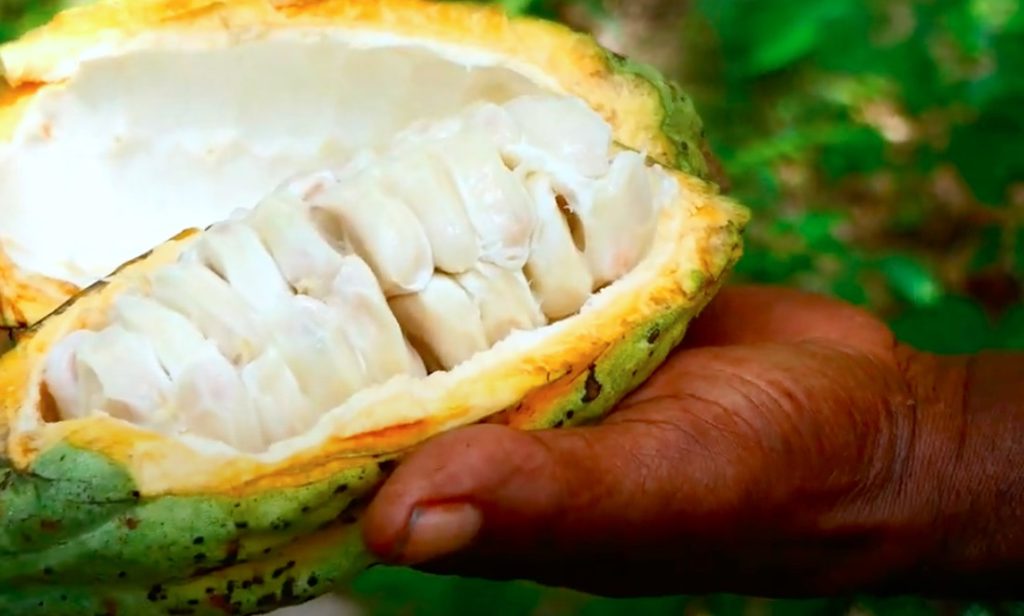
After harvesting, pods are opened during pod breaking. The wet beans and surrounding pulp are removed from the husk. Diseased, badly damaged, or infested pods should be separated so they do not reduce the quality of the fermenting batch. Pod husks and infested material also need to be handled as part of farm sanitation, especially where cocoa pod borer and black pod are present.
Wet beans should move into fermentation as quickly as practical. Once beans are removed from the pod, the pulp begins to change. Long delays, contamination with soil, mixing of poor-quality beans, or exposure to rain can reduce final quality. This is why the link between harvesting, pod breaking, and fermentation is so important in the Papua New Guinea cocoa value chain.
For wet-bean producers, the process may stop at the point of sale to a buyer or fermentary. For dry-bean producers, the household or group must also manage fermentation and drying. This difference between wet-bean and dry-bean production affects labour, infrastructure, quality control, and the farmer’s role in the wider cocoa supply chain.
Cocoa Fermentation in Papua New Guinea
Fermentation is one of the most important post-harvest stages in Papua New Guinea cocoa production. It is the point where fresh wet beans begin developing the internal changes that later support cocoa and chocolate flavour. Without proper fermentation, dried beans may look like cocoa from the outside but still carry harsh, raw, uneven, or underdeveloped characteristics inside.
In Papua New Guinea, fermentation may happen at household level, in village fermentaries, through farmer groups, or in commercial facilities that buy wet beans from surrounding communities. The quality of this stage depends on the condition of the beans, the size of the batch, the cleanliness of the fermenting box, the timing of turning, the drainage of pulp, and the skill of the people managing the process.
Why fermentation matters
Fresh cocoa beans are surrounded by sweet, sticky pulp. During fermentation, yeasts, bacteria, and natural heat begin breaking down this pulp. As the pulp drains and the temperature rises, chemical changes also occur inside the bean. These changes help reduce excessive bitterness and astringency and begin forming the flavour precursors that later develop further during drying, roasting, and chocolate making.
Fermentation is not only about flavour. It also affects colour, aroma, bean safety, storage stability, and export quality. Well-fermented beans usually show more even internal colour and more suitable aroma for cocoa processing. Under-fermented beans can remain slaty, bitter, or raw-tasting. Over-fermented beans can develop unpleasant odours, excessive acidity, or weak bean structure.
For Papua New Guinea cocoa, fermentation consistency is especially important because the country is recognised for fine or flavour potential. That potential is not created by genetics alone. A good cocoa variety can still produce poor-quality beans if pods are harvested too early, if damaged beans are mixed into the batch, if fermentation is too short or too uneven, or if beans are later dried badly.
This is why wet-bean handling matters. Beans from healthy, ripe pods should be moved into fermentation quickly. Mixing fresh beans with old beans, diseased beans, soil, excess water, or foreign matter can disturb the fermentation process. When beans from many farms are mixed together at a buying point or fermentary, careful sorting and batch control become even more important.
Box fermentation and sweat-box systems
Box fermentation is common in Papua New Guinea cocoa processing. Wooden boxes, sometimes called sweat boxes, hold the wet beans while pulp drains away and the fermenting mass heats up. A good fermentation box allows drainage, helps retain heat, and provides enough structure for the beans to be covered and turned.
The Papua New Guinea Cocoa Farmer’s Handbook describes a fermentation cycle of up to six days, with the bean mass turned five times during a six-day cycle. This should be presented as established Papua New Guinea guidance rather than a universal rule for every cocoa-growing country. Different cocoa origins, box sizes, bean types, climates, and buyer requirements may use different fermentation schedules.
In a typical Papua New Guinea box-fermentation system, wet beans are placed into a wooden box and covered, often with banana leaves, sacks, or other suitable covering material. Covering helps keep heat inside the fermenting mass while still allowing the process to breathe. As fermentation progresses, pulp drains away, the beans heat up, and the smell changes from fresh fruity pulp toward a stronger fermented cocoa aroma.
Turning is used to improve aeration and make the process more even. In larger multi-box systems, beans may be moved from one box to another. In smaller systems, the bean mass may be stirred or turned within the same box. Papua New Guinea guidance commonly describes turning roughly every 24 hours during the fermentation cycle. This helps oxygen reach the mass and reduces the chance that some beans ferment well while others remain under-fermented.
A successful fermentation can reach a peak temperature of about 50 degrees Celsius. Temperature is not the only sign of success, but it is a useful indicator. Processors may also watch the smell, the drainage of pulp, the colour inside the bean, the feel of the mass, and the general condition of the batch.
Both under-fermentation and over-fermentation can reduce quality. Under-fermented beans may be slaty, hard, and harsh in flavour. Over-fermented beans may become too soft, too acidic, or unpleasant in aroma. Uneven fermentation can create a mixed bag, where some beans are well fermented and others are defective. Export buyers and quality assessors often notice these problems through smell, cut tests, moisture checks, and physical inspection.
Fermentation also depends on batch size. Very small batches may fail to heat properly, while very large batches can be difficult to turn evenly if the box design is poor. For village fermentaries, this is one reason steady wet-bean supply, clean equipment, and trained operators matter. A fermentary may have good boxes, but it still needs enough suitable beans and careful management to produce consistent dry cocoa.
In Papua New Guinea’s cocoa value chain, fermentation is one of the main points where quality can be protected or lost. Farmers who sell wet beans depend on the buyer or fermentary to manage this stage well. Farmers or groups that produce dry beans take on more responsibility, but they also have more direct control over batch quality. In both cases, fermentation is a bridge between the farm and the export market.
Drying Cocoa Beans in Papua New Guinea
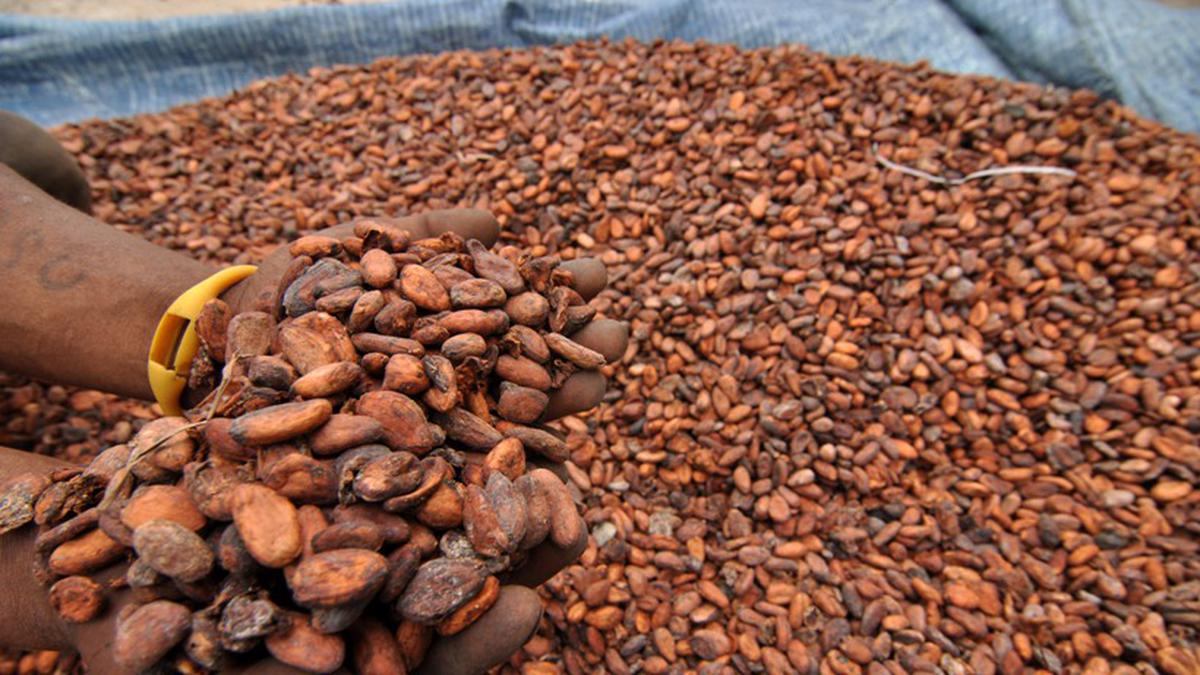
After fermentation, cocoa beans must be dried before they can be stored, graded, transported, or exported. Drying reduces moisture, helps stabilise the beans, and continues the development of cocoa aroma and colour. In Papua New Guinea, this stage is especially important because many cocoa-growing areas are humid, rainy, and close to the coast. Beans that dry too slowly can develop mould, while beans dried with poor equipment may absorb smoke or other unwanted odours.
Drying is not just a technical step after fermentation. It is a quality-control stage. Even well-fermented beans can lose value if they are exposed to rain, dried unevenly, contaminated with smoke, or stored while still too moist. For this reason, Papua New Guinea cocoa quality is strongly linked to the design, maintenance, and management of dryers.
Sun drying
Sun drying is the simplest and most traditional drying method. Fermented beans are spread on raised platforms, racks, mats, trays, or drying beds where sunlight and air can remove moisture. Beans are usually spread in controlled layers rather than thick heaps, because thick layers dry unevenly and can trap heat and moisture.
During sun drying, beans need regular turning or raking. This helps expose different sides of the beans to air and sunlight. It also allows the person drying the beans to remove foreign matter, check for mould, and notice uneven drying. If beans are left in thick layers or are not turned regularly, the outside of the layer may dry while the lower part remains damp.
Rain protection is essential. In Papua New Guinea’s humid and high-rainfall areas, drying beans in the open can be difficult because sudden rain can interrupt the process. Rewetting is a serious quality problem. Beans that absorb rain after partial drying may develop mould, sour odours, uneven colour, or storage defects. For this reason, many drying structures use movable roofs, sliding trays, or shelters that allow beans to be covered quickly.
Sun drying can produce good-quality cocoa when the weather is suitable and the drying surface is clean. It also avoids smoke exposure, which is one reason many specialty buyers prefer well-managed sun or solar drying. However, sun drying alone may be unreliable during wet weather, in high-rainfall districts, or during peak harvest periods when large bean volumes need drying at the same time.
Wood-fired and hybrid dryers
Wood-fired drying systems became common in Papua New Guinea partly because they help farmers and fermentaries dry cocoa during rainy or humid conditions. Instead of depending only on direct sunlight, these systems use heat from a firebox or kiln to warm air beneath the drying bed. A typical arrangement may include a drying platform, a kiln pipe, a chimney, and a movable roof or cover that protects beans from rain.
In many village or small commercial systems, the idea is to combine sunlight and supplemental heat. When the sun is strong, beans can dry naturally. When rain, cloud, or night conditions slow drying, wood-fired heat helps continue moisture reduction. This hybrid approach can be practical in Papua New Guinea because cocoa-growing regions often experience frequent rainfall during harvest periods.
Hybrid solar and wood-fired dryers also exist in improved designs. These may use better airflow, cleaner heat transfer, raised drying beds, transparent covers, or indirect heating so that beans receive warmth without direct smoke contact. Some active solar designs use heated air and ventilation to speed drying while reducing the risk of smoke taint.
Wood-fired systems can be useful, but they require careful operation and maintenance. Too much heat can case-harden beans, where the outside dries too quickly while the inside remains moist. Uneven heat can create mixed moisture levels within the same batch. Poorly controlled drying can also affect bean colour, aroma, and storage quality.
Smoke taint and dryer defects
Smoke taint is one of the most distinctive quality issues associated with Papua New Guinea cocoa. It is often linked to defective wood-fired dryers, especially when mild-steel kiln pipes rust, crack, or develop holes. When this happens, smoke from the fire can pass through the damaged pipe and reach the beans on the drying bed.
Once smoke enters the bean mass, it can leave smoky aromas that are difficult to remove. For chocolate makers and cocoa buyers, smoky flavour can be a serious defect unless it is specifically desired for a niche product. In most cocoa quality systems, smoke taint reduces sensory quality because it masks the natural cocoa character and can make a batch unsuitable for fine-flavour use.
Burnt fragments and poor fire management can create additional problems. If pieces of burning or charred material enter the airflow, they may add stronger smoke odours. Incomplete combustion can also create contamination concerns, including the possible presence of polycyclic aromatic hydrocarbons, often shortened to PAHs. For general readers, the practical point is simple: cocoa beans should be dried with clean heat and protected from direct smoke.
Regular dryer inspection is therefore important. Kiln pipes, chimneys, fireboxes, drying beds, covers, and joints need to be checked for rust, holes, gaps, ash leakage, and poor airflow. A dryer that worked well when new may become a quality risk after years of use in a humid environment. Maintenance is not only a mechanical issue; it is part of cocoa quality protection.
Improved solar dryers and indirect-heat designs can reduce smoke-taint risk when they are well built and properly used. These systems aim to dry beans reliably while keeping combustion gases away from the cocoa. They may be especially useful in places where rainfall makes sun drying difficult but buyers still require clean flavour.
For Papua New Guinea, better drying is one of the clearest opportunities to strengthen cocoa quality. Good genetics, careful harvesting, and proper fermentation can all be weakened if drying introduces smoke, mould, or uneven moisture. Clean, consistent drying helps protect the flavour potential that makes Papua New Guinea cocoa valuable to buyers looking for distinctive origin cocoa.
Cocoa Bean Grading and Export Quality
Cocoa bean grading is the stage where dried beans are checked to decide whether they are suitable for sale, storage, processing, or export. In Papua New Guinea, grading is important because the country’s cocoa reputation depends not only on flavour potential, but also on physical quality, moisture control, cleanliness, and freedom from serious defects.
A bag of cocoa may come from a smallholder, a village fermentary, a cooperative, a trader, or a commercial processor. By the time it reaches an exporter, the beans may have passed through several hands. Grading helps create a common quality language across that chain. It also helps separate beans that are export-ready from beans that need further drying, cleaning, sorting, or local handling.
Physical and sensory assessment
Quality assessment usually begins with sampling. A representative sample is taken from cocoa bags so the assessor is not judging only the beans visible at the top. This matters because a bag can contain mixed beans: some well dried, some damp, some mouldy, some broken, and some affected by insects or germination.
Smell is one of the first signs of quality. Clean fermented cocoa should have a recognisable cocoa aroma without strong smoke, mould, rot, chemical odour, or other unwanted smells. A smoky smell may suggest contact with smoke during wood-fired drying. A mouldy smell may suggest slow drying, rewetting, damp storage, or poor handling.
Moisture testing is also central. Beans that are too moist are more likely to develop mould during storage and shipping. Beans that are too dry may become brittle and break more easily. Moisture control is therefore both a quality issue and a storage issue.
Physical inspection commonly looks for foreign matter, bean size, broken beans, flat beans, double beans, insect-damaged beans, germinated beans, mouldy beans, and other defects. Foreign matter can include stones, sticks, pod husk pieces, soil, metal fragments, or other non-cocoa materials. Even small amounts can reduce buyer confidence and create problems during processing.
A cut test is another important quality check. Beans are cut open to inspect their internal colour and condition. Well-fermented beans usually show brown internal colour, while under-fermented beans may appear slaty or purple. The cut test can also reveal mould, insect damage, germination, and other internal defects that are not obvious from the outside.
Bean count or bean-size assessment may also be used. Larger, well-filled beans are often preferred because they can be more efficient to process. A high number of beans per kilogram usually means smaller beans, which may affect grading and buyer requirements.
Papua New Guinea handbook quality benchmarks
The Papua New Guinea Cocoa Farmer’s Handbook provides useful quality benchmarks for farmers and extension workers. These benchmarks should be treated as handbook guidance and checked against the latest Cocoa Board regulations before publication or use in formal compliance documents.
The handbook benchmarks include:
| Quality point | Handbook benchmark |
| Moisture content | Between 5.5% and 7.5% |
| Foreign matter | Below 1% |
| Bean count | Fewer than 1,000 beans per kilogram |
| Selected physical defects | Below 5% |
| Bags | Clean, correctly marked, and suitable for cocoa |
| Historical standard bag weight | 63.5 kilograms |
Source note: These values are useful for explaining Papua New Guinea cocoa quality in general terms, but formal export grading should always follow current Cocoa Board and National Agricultural Quarantine and Inspection Authority requirements. Historical handbook standards should not be presented as unchanged regulations unless confirmed with the responsible authorities.
The moisture range is especially important. Beans below or above the expected range may create handling problems. Damp beans can develop mould, while overly dry beans can become fragile. Foreign matter limits help protect the integrity of the bag. Defect limits help buyers understand whether the beans have been properly harvested, fermented, dried, sorted, and stored.
Correct bagging also matters. Export cocoa should be packed in clean bags, marked correctly, and protected from odours, moisture, pests, and contamination. A bag that smells of fuel, smoke, chemicals, mould, or other strong materials can affect cocoa quality even if the beans were well prepared earlier.
Cocoa Quality Assessors and NAQIA
Papua New Guinea’s cocoa export system includes quality assessment and quarantine inspection. A Cocoa Quality Assessor, often shortened to CQA, has a role in checking cocoa quality before exporter acceptance or export movement. This may include sampling, smell assessment, moisture testing, cut tests, physical defect checks, bag inspection, and documentation.
The purpose of quality assessment is not simply to reject beans. It helps protect the reputation of Papua New Guinea cocoa in export markets. It also gives exporters and producers a clearer basis for sorting, re-drying, reconditioning, or separating beans that do not meet requirements.
The National Agricultural Quarantine and Inspection Authority, known as NAQIA, is involved in quarantine inspection and export clearance for agricultural products. For cocoa consignments, this can include inspection procedures, export documentation, sealing, marking, and checks connected with pest, disease, and quarantine requirements.
Beans that fail export requirements may need to be dried further, cleaned, sorted, repacked, or handled through domestic channels depending on the issue and the applicable rules. A smoky batch, a mouldy batch, a damp batch, or a poorly marked batch may each require a different response.
Because regulations and procedures can change, the current grading and export process should be confirmed with the Cocoa Board of Papua New Guinea and NAQIA before publication of any operational guidance. For a general article, it is safer to explain the roles and quality principles rather than claim that every historical procedure remains unchanged today.
Why Papua New Guinea Cocoa Is Considered Fine or Flavour Cocoa
Papua New Guinea cocoa is often discussed as fine or flavour cocoa because of its genetic background, growing environments, and post-harvest potential. The International Cocoa Organization, or ICCO, currently classifies 80% of Papua New Guinea’s cocoa-bean exports as fine or flavour cocoa. This classification was confirmed in the ICCO’s Annex C decision published in April 2024.
Fine or flavour cocoa is not defined only by country name. It is linked to characteristics such as genetics, flavour profile, aroma, bean quality, and the way cocoa is harvested, fermented, dried, stored, and shipped. In Papua New Guinea, the historical Trinitario base is one part of this identity. Trinitario cocoa is widely associated with more distinctive flavour potential than ordinary bulk cocoa types, although the quality of individual trees and batches can vary.
Papua New Guinea’s island and coastal growing environments also contribute to the discussion. Cocoa is grown across places with different rainfall patterns, soils, shade systems, tree genetics, and post-harvest methods. These local conditions can influence the character of the beans. In some tasting contexts, Papua New Guinea cocoa has been described with fruity, acidic, floral, earthy, or other origin-specific notes, but such descriptions should always be tied to particular lots, regions, or tasting evidence rather than applied to every bag from the country.
The most important caution is that a national ICCO classification does not mean every shipment from Papua New Guinea is automatically premium. A well-managed lot may express attractive flavour potential, while a poorly handled lot may be smoky, mouldy, under-fermented, over-fermented, insect-damaged, or unevenly dried. In other words, Papua New Guinea can be a fine or flavour cocoa origin, but each batch still has to earn buyer confidence through quality.
Fermentation and drying are especially important. Proper fermentation helps develop flavour precursors and reduce excessive bitterness and astringency. Clean drying protects the beans from mould, smoke taint, and moisture problems. If beans pass through defective wood-fired dryers, they may absorb smoke and lose the cleaner flavour profile that specialty buyers often look for.
Traceability can also strengthen fine-flavour positioning. When buyers know where a cocoa lot came from, how it was fermented, how it was dried, and which farmer group or fermentary handled it, they can better evaluate quality. This is why geographical identity, batch separation, farmer registration, and careful post-harvest records are increasingly relevant to Papua New Guinea cocoa.
Papua New Guinea’s fine or flavour reputation is therefore best understood as potential supported by history and classification, not as a blanket guarantee. The country’s strength lies in its combination of Trinitario heritage, diverse island and coastal terroirs, smallholder production, and opportunities for careful fermentation and drying. The challenge is making that quality consistent from farm to fermentary, from fermentary to exporter, and from exporter to final buyer.
Main Challenges Facing Cocoa Production
Papua New Guinea’s cocoa industry has strong foundations, but production is affected by pests, diseases, ageing trees, labour demands, transport gaps, processing limits, and weather variability. These challenges are not the same in every province. A farmer in East Sepik may face different transport and rainfall conditions from a farmer in Bougainville, East New Britain, Madang, or Morobe. Still, the main pressure points are widely recognised across the Papua New Guinea cocoa sector.
Cocoa pod borer
Cocoa pod borer, Conopomorpha cramerella, is the most serious pest threat to Papua New Guinea cocoa production. The pest damages cocoa from inside the pod. Adult moths lay eggs on the pod surface, and the larvae bore into the pod after hatching. Once inside, they feed around the beans and pulp, where damage is difficult to see until the pod is opened.
Affected pods may ripen too early, ripen unevenly, or show external signs that do not fully reveal the internal damage. Inside the pod, beans may be small, undeveloped, discoloured, or stuck together. When the beans are badly affected, the saleable yield from that pod is reduced.
Cocoa pod borer increases labour requirements because farmers need to harvest more frequently, remove infested pods, prune trees, and keep blocks clean. It is not a pest that can be managed well through occasional attention. In neglected or overgrown blocks, damaged pods can remain in the canopy and continue the pest cycle.
The arrival and spread of cocoa pod borer changed Papua New Guinea cocoa production after 2006. In major producing areas, it contributed to lower yields, abandoned cocoa blocks, and a shift toward more intensive block management. Recovery efforts have focused on integrated pest and disease management, regular harvesting, improved sanitation, pruning, farmer training, and planting material with better tolerance or performance under pest pressure.
Black pod and other diseases
Black pod disease is another major challenge for cocoa in Papua New Guinea. It is commonly associated with Phytophthora palmivora, a plant pathogen that can infect pods and other parts of the tree. On pods, the disease causes dark lesions that can spread quickly, especially in wet and humid conditions. Once infection advances, the pod may become unusable for good-quality cocoa.
The same pathogen can also be associated with stem canker. In wet conditions, spores can be spread by rain splash, runoff, contaminated tools, soil contact, or infected plant material. Dense shade, poor airflow, and overgrown canopies can make disease pressure worse because leaves, branches, and pods remain damp for longer.
Vascular streak dieback, often shortened to VSD, has also been an important disease in the history of Papua New Guinea cocoa. It has been associated with the need for resistant or tolerant planting material, and it is one reason breeding and selection work have mattered in the industry. Older research and extension work often mention VSD when discussing the development of improved hybrids.
Other diseases, including pink disease, root rot, and secondary infections, may appear depending on local conditions. The disease picture is not identical across all cocoa-growing provinces. Rainfall, drainage, shade, tree age, planting material, and block maintenance all influence which problems become most serious.
Ageing and overgrown cocoa blocks
Many cocoa blocks become less productive when trees grow too tall, too shaded, or too difficult to manage. Overgrown trees make harvesting harder. Ripe pods can be missed. Diseased pods may remain hidden in the canopy. Cocoa pod borer damage may not be noticed until the problem has spread.
Ageing blocks also create labour problems. A farmer may need more time to harvest fewer good pods. Tall trees may require longer tools, greater effort, and more risk of damaging branches or flower cushions. Dense canopies reduce airflow and can make black pod and other moisture-related problems worse.
Rehabilitation is one response. This can include canopy reduction, removal of unproductive branches, chupon selection, improved shade management, budding, top grafting, or gradual replacement with better planting material. The right approach depends on the condition of the block, the availability of labour, the farmer’s goals, and access to approved planting material or extension support.
Labour and farm-management constraints
Cocoa can look like a low-input crop when trees are already established, but good cocoa production requires repeated attention. Farmers need to harvest ripe pods frequently, remove diseased and infested pods, prune trees, manage shade, control weeds, ferment beans, dry beans, store bags, and transport cocoa to buyers.
These tasks compete with other household responsibilities. Families may also be managing food gardens, children’s schooling, community obligations, church activities, fishing, wage work, or other crops. When labour is limited, cocoa blocks may receive less regular maintenance.
Youth participation is another issue in some areas. Younger family members may not always see cocoa as attractive work, especially if blocks are old, pest pressure is high, road access is poor, or returns are uncertain. This creates a skills-transfer challenge because good cocoa production depends heavily on practical knowledge.
There is also a difference between low-input wet-bean producers and business-oriented dry-bean producers. Wet-bean producers may focus mainly on harvesting and pod breaking, then sell fresh beans to a buyer or fermentary. Dry-bean producers need more infrastructure and skill because they manage fermentation, drying, bagging, storage, and sometimes direct relationships with traders or exporters.
Roads, transport, and fermentary access
Road and transport access strongly shape Papua New Guinea cocoa production. Many cocoa-growing communities are remote, and some areas depend on rough roads, boats, river transport, or long walking distances. When transport is difficult, farmers may have fewer buyer options and less ability to move wet beans quickly.
Wet beans are time-sensitive. If they are left too long before fermentation, quality can decline. This makes fermentary access important. A nearby functioning fermentary can help farmers sell wet beans and keep the post-harvest process moving. Where fermentaries are absent, inactive, poorly maintained, or too far away, farmers may be discouraged from harvesting regularly.
Transport problems also affect dry beans. Bags must be moved from villages to traders, cooperatives, exporters, or ports. Delays, rain exposure, poor storage, and repeated handling can reduce quality. Inconsistent transport also makes traceability more difficult because beans from different farms or batches may be mixed.
Climate and weather variability
Cocoa grows well in warm tropical conditions, but it is sensitive to weather extremes. Prolonged high temperatures can stress trees, especially where shade and soil moisture are poorly managed. Drought can reduce flowering, increase flower drop, and cause young pods to fail. Heavy rain can create waterlogging, erosion, and access problems.
Persistently wet conditions can also increase black pod pressure, especially in dense canopies with poor airflow. Rain can interrupt drying, rewet partially dried beans, and make storage more difficult. During extreme rainfall, farmers may also struggle to reach gardens, transport wet beans, or maintain dryers.
Good shade management, drainage, soil cover, locally suitable planting material, and regular block maintenance can help reduce some weather-related stress. However, climate and weather risks cannot be removed completely. They are part of the production environment that farmers, fermentaries, traders, and exporters must work around each season.
Integrated Pest and Disease Management
Integrated pest and disease management, often shortened to IPDM, is a practical approach that combines several field practices rather than relying on one single solution. In Papua New Guinea cocoa production, this is especially important because cocoa pod borer, black pod, ageing trees, dense shade, and labour constraints often interact with one another.
IPDM is not simply a chemical-control programme. For a general cocoa article, it is better to explain IPDM as a farm-management system based on observation, sanitation, pruning, harvesting discipline, shade control, tolerant planting material, and farmer training. Any use of approved farm inputs should follow local professional guidance and current Papua New Guinea regulations.
A typical IPDM approach in Papua New Guinea cocoa can include frequent harvesting. This reduces the time that mature or infested pods remain on the tree. With cocoa pod borer, frequent harvesting helps remove pods before damage increases and before the pest cycle continues through abandoned or overlooked pods.
Removing infested and diseased pods is another important part of the system. Pods damaged by cocoa pod borer, black pod, or other problems should not be left hanging in the canopy or lying unmanaged around the block. Sanitation reduces pest and disease pressure and makes the block easier to monitor.
Pruning and canopy management support IPDM because they make cocoa trees easier to inspect. A low, open tree allows farmers to see pods, identify damage, harvest more safely, and remove diseased material. Better airflow can also reduce the damp conditions that favour some diseases.
Shade control is closely connected to pruning. Cocoa needs shade, especially when young, but excessive shade can make the block humid and dark. A dense canopy may hide diseased pods and slow drying after rain. Balanced shade allows enough protection while still improving light and air movement.
Weed management also matters. Heavy weeds can make it harder to move through the block, spot fallen pods, remove diseased material, or maintain young trees. Good ground management helps farmers work more efficiently and reduces places where problems can be overlooked.
Monitoring is the habit that ties these practices together. Farmers need to observe pest and disease levels, pod condition, tree growth, shade, soil moisture, and harvest timing. Without monitoring, problems may only be noticed after they have already affected a large part of the crop.
Planting tolerant or improved clones can support IPDM, especially when old or unproductive blocks are being rehabilitated. However, planting material is not a complete solution by itself. A tolerant clone still needs pruning, harvesting, sanitation, shade balance, and good post-harvest handling.
Rehabilitating neglected blocks is often necessary where cocoa trees have become too tall, shaded, or difficult to harvest. Rehabilitation may include canopy reduction, chupon renewal, grafting, removal of poor trees, or gradual replacement with approved planting material. The goal is to return the block to a manageable structure.
Community coordination can also make IPDM more effective. Cocoa pod borer and diseases do not respect farm boundaries. If one farmer cleans and harvests regularly while nearby blocks remain abandoned, pest pressure can continue. Coordinated sanitation, farmer-group training, and local extension services can therefore support broader control.
IPDM is labour-intensive, which is one reason it can be difficult for some households. It requires regular work rather than occasional intervention. But it is generally more realistic than expecting one action to solve cocoa pod borer, black pod, ageing trees, and quality problems at the same time. In Papua New Guinea, stronger IPDM is closely connected with better tree management, more consistent harvests, and improved export-quality cocoa.
The Papua New Guinea Cocoa Value Chain
The Papua New Guinea cocoa value chain connects smallholder farms with village buyers, fermentaries, traders, exporters, domestic processors, and international cocoa markets. Although the chain can look simple from the outside, each stage affects bean quality, traceability, price formation, and the final reputation of Papua New Guinea cocoa.
The most important distinction is between wet beans and dry beans. Wet beans are fresh beans removed from cocoa pods after pod breaking. They still contain pulp and must be fermented and dried. Dry beans are fermented, dried, graded, bagged, and ready for storage, trade, processing, or export. Many misunderstandings about cocoa production begin when these two forms are treated as the same product.
From farmer to wet-bean buyer
Most Papua New Guinea cocoa begins on smallholder farms. Farmers maintain cocoa blocks, harvest ripe pods, remove diseased or infested pods, break pods, and separate wet beans from the husks. At this point, some farmers ferment and dry their own beans, but many sell wet beans to local buyers, village fermentaries, roadside buying points, cooperatives, or small cocoa businesses.
Farmers may sell wet beans for several practical reasons. They may not own fermentation boxes or dryers. They may live in a high-rainfall area where drying is difficult. They may need a faster sale after harvest. They may not have enough labour to manage both farm work and post-harvest processing. They may also be located near an active wet-bean buyer who can collect beans regularly.
The wet-bean model can help farmers participate in the cocoa economy without owning all processing infrastructure. However, it also creates quality risks. Wet beans are perishable, and delays before fermentation can reduce quality. Beans from several farms may be mixed together, which can make traceability harder. If immature, diseased, or pest-damaged beans enter the batch, the fermentary must sort carefully or the whole batch may suffer.
For this reason, the first stage of the value chain depends on trust and coordination. Farmers need to harvest ripe pods and avoid mixing poor-quality beans. Wet-bean buyers need to collect quickly, handle beans cleanly, and move them into fermentation while they are still suitable.
Fermentaries and dry-bean production
Fermentaries are central to Papua New Guinea cocoa quality. A fermentary may be a village-level facility, a farmer-group operation, a cooperative facility, or a commercial business that buys wet beans from surrounding communities. Its job is to convert wet beans into properly fermented and dried cocoa beans.
This stage includes weighing or recording wet beans, sorting, loading fermentation boxes, turning the bean mass, drying the fermented beans, checking moisture, bagging, and storing the finished dry beans. A well-run fermentary can improve quality consistency because trained operators manage the post-harvest process for many farmers.
However, fermentaries can also become weak points in the chain if they are inactive, poorly maintained, overloaded during peak harvest, or short of trained staff. Dirty boxes, poor drainage, irregular turning, defective dryers, smoke exposure, and damp storage can all reduce quality. A fermentary that mixes too many batches without records may also weaken traceability.
Batch control is especially important for specialty and fine-flavour cocoa. Buyers may want to know which village, farmer group, fermentary, or processing method produced a lot. If beans from many sources are mixed without records, it becomes harder to describe origin, assess performance, or reward consistent quality.
Dry-bean producers carry more responsibility than wet-bean producers because they manage the stages that shape export quality. This can include households with their own small fermenting and drying systems, village fermentaries, cooperatives, or commercial fermentaries. Their role is not only to dry beans for sale, but to preserve the flavour and physical quality that buyers expect.
Traders, exporters, and domestic processors
After drying and bagging, cocoa moves to licensed dealers, traders, cooperatives, exporters, or local processors. Traders and exporters check quality, consolidate bags, arrange transport, prepare documentation, and connect Papua New Guinea cocoa with overseas buyers. Exporters may handle bulk cocoa, certified cocoa, traceable lots, or specialty lots depending on their business model and buyer relationships.
Quality checks at this stage may include smell assessment, moisture testing, cut tests, bean count, inspection for mould or insects, and verification of bag condition. Exporters do not want to ship cocoa that may be rejected, downgraded, or questioned by overseas buyers. For this reason, quality control at the exporter level helps protect both individual shipments and Papua New Guinea’s wider cocoa reputation.
Most Papua New Guinea cocoa leaves the country as dried cocoa beans rather than as finished chocolate or highly processed cocoa products. This makes dry-bean export the main commercial channel. Domestic chocolate production and other value-added cocoa products do exist, but they remain smaller than the export of raw or semi-processed beans.
There are opportunities for more local value addition through better fermentation, drying, traceability, small-batch processing, local chocolate making, and origin-based marketing. These opportunities should be described carefully. They do not guarantee income or market success. They depend on quality consistency, infrastructure, skills, market access, reliable buyers, and the ability to meet food, trade, and quality requirements.
This flow can vary by province. In some areas, farmers sell wet beans soon after pod breaking. In others, farmer groups or households produce dry beans before selling. In better-organised specialty chains, the process may include farmer registration, batch codes, separate fermentation lots, sensory evaluation, and buyer feedback. The more carefully each stage is managed, the easier it becomes to protect the identity and quality of Papua New Guinea cocoa.
Where Papua New Guinea Exports Cocoa
Papua New Guinea mainly exports cocoa as cocoa beans. For international trade-data research, the relevant product category is usually HS code 180100, which covers cocoa beans, whole or broken, raw or roasted. This category is useful because it helps separate cocoa-bean exports from cocoa butter, cocoa powder, chocolate, and other cocoa preparations.
The latest open trade sources show that Papua New Guinea’s export destinations can change noticeably between reporting years. WITS, using UN Comtrade-style data, reports Papua New Guinea’s 2023 cocoa-bean exports under HS 180100 at about US$121.16 million, with Indonesia, Malaysia, the United States, China, and Belgium listed among the main destinations by export value.
For 2024, the Observatory of Economic Complexity reports a much higher cocoa-bean export value of about US$354 million, with Malaysia, Indonesia, and Singapore listed as the leading destinations. This large value increase should not be read automatically as a large production increase. It also reflects the very high international cocoa-price environment during that period.
| Destination | Export value | Export volume | Data year | Approximate share by value |
| Malaysia | US$164 million | Check original dataset before publication | 2024 | About 46% |
| Indonesia | US$99.9 million | Check original dataset before publication | 2024 | About 28% |
| Singapore | US$41.2 million | Check original dataset before publication | 2024 | About 12% |
| Other destinations | About US$48.9 million combined | Check original dataset before publication | 2024 | About 14% |
Source note: The table uses OEC’s 2024 export-value figures for Papua New Guinea cocoa beans. Export-volume fields should be checked directly in the original trade dataset before publication because some public trade tables can display unit or reporting anomalies. Do not calculate physical export volume from value alone.
A separate 2023 WITS table gives a different destination pattern. In that year, Indonesia was the largest listed destination by export value, followed by Malaysia, the United States, China, and Belgium. This does not necessarily contradict the 2024 OEC pattern. It shows that cocoa trade routes can shift from year to year depending on buyers, contracts, regional processing demand, freight routes, price conditions, and how datasets classify or update records.
| Destination | Export value | Export volume | Data year | Approximate share by value |
| Indonesia | US$53.69 million | Do not reproduce without checking unit anomaly | 2023 | About 44% |
| Malaysia | US$26.85 million | Do not reproduce without checking unit anomaly | 2023 | About 22% |
| United States | US$22.04 million | Do not reproduce without checking unit anomaly | 2023 | About 18% |
| China | US$10.13 million | Do not reproduce without checking unit anomaly | 2023 | About 8% |
| Belgium | US$5.16 million | Do not reproduce without checking unit anomaly | 2023 | About 4% |
Source note: The 2023 WITS page lists very large quantity figures that appear inconsistent with Papua New Guinea’s known production scale, so the export-volume column should be verified directly through UN Comtrade or the original reporting authority before being used in a final publication. The value figures are still useful for identifying leading destinations in that dataset.
The destination list also reflects the structure of the cocoa industry. Countries such as Malaysia, Indonesia, Singapore, Belgium, China, and the United States may act as processors, trading hubs, chocolate-manufacturing markets, or re-export points. A shipment to one country does not always mean the beans are consumed there as finished chocolate. Cocoa can move through several stages of trade and processing before it reaches its final product form.
It is also important to separate export value from export volume. Export value is affected by international cocoa prices, currency movements, buyer contracts, quality premiums, and the type of cocoa being sold. Export volume measures physical quantity. If export earnings rise sharply during a high-price year, that does not automatically prove that Papua New Guinea produced or shipped much more cocoa.
For a careful article, Papua New Guinea cocoa exports should therefore be described in three layers: the main exported product is dried cocoa beans; the leading destinations should be identified by a dated trade source; and export value should be discussed separately from production volume and export volume.
Current Improvements and Future Outlook
Papua New Guinea’s cocoa outlook depends on how well the industry can connect improved planting material, better block management, stronger processing, traceability, extension support, and market access. The country already has recognised fine or flavour cocoa potential, but future progress will rely on consistency rather than reputation alone.
Improved planting material
Improved planting material is one of the main areas of industry development. Certified nurseries, budwood gardens, selected hybrid clones, and locally adapted varieties can help replace old, unproductive, or difficult-to-manage trees. This is especially relevant in areas affected by cocoa pod borer, black pod, vascular streak dieback, ageing blocks, and uneven seedling performance.
Hybrid clones may be selected for traits such as yield potential, manageable tree form, bean quality, and tolerance to important pests or diseases. However, improved planting material should not be described as a complete solution by itself. A clone still needs suitable shade, pruning, sanitation, frequent harvesting, fermentation, drying, and local adaptation.
The future value of improved planting material will depend on whether farmers can access approved nurseries, whether budwood gardens are well maintained, and whether extension services can explain how to manage new trees. Replacing a poor tree with a better tree is useful only if the wider farm system can support it.
Better fermentation and drying
Fermentation and drying remain two of the clearest opportunities for improving Papua New Guinea cocoa quality. Better box design, clean sweat-box systems, careful batch turning, small-batch control, and more consistent fermentation records can help protect flavour potential. This is especially important for specialty lots where buyers may want to know how beans were processed.
Drying improvements are equally important. Solar dryers, improved kiln pipes, indirect-heat systems, hybrid solar and wood-fired designs, dryer inspection, and consistent moisture control can reduce mould and smoke-taint problems. These changes are especially relevant in humid and high-rainfall districts where sun drying alone may be unreliable.
Sensory evaluation can also support improvement. When fermentaries and exporters receive feedback on flavour, smoke, acidity, mould, or fermentation problems, they can adjust processing methods. Over time, this can help particular villages, cooperatives, or regions build a clearer quality identity.
Extension services and digital information
Farmer training remains central to the future of Papua New Guinea cocoa. Many production challenges are practical: keeping trees low, pruning old branches, managing shade, harvesting frequently, removing infested pods, fermenting properly, drying cleanly, and storing bags safely. These are skills that improve through demonstration, repetition, and local support.
Extension work can include farmer field schools, demonstration blocks, peer learning, family farm teams, cooperative training, and visits from cocoa officers or trained lead farmers. Because many cocoa communities are remote, extension services need to work around transport limits, language differences, seasonal labour demands, and uneven access to mobile networks.
Digital tools may support this work. Devpolicy reported in 2025 that the Papua New Guinea Cocoa App was developed to provide offline training information for farmers and that it includes modules on topics such as cocoa pod borer, block management, pruning, propagation, fermentation, drying, and business practices. Offline access is important because many cocoa-growing areas do not have reliable internet coverage.
Traceability and specialty markets
Traceability is becoming more important in cocoa trade. For Papua New Guinea, this can include farmer registration, farm mapping, batch-level records, fermentary logs, cooperative documentation, and separation of cocoa by village, region, variety, or processing method. Traceability helps buyers understand where cocoa comes from and how it was handled.
Specialty markets often require more than a country name. Buyers may ask for consistent fermentation, clean drying, flavour samples, defect control, transparent sourcing, certification, or evidence of batch separation. These requirements can create opportunities for organised producer groups, but they also require discipline and recordkeeping.
Geographical identity may also become more important. Bougainville cocoa, Sepik cocoa, East New Britain cocoa, or other regional lots may be better understood by buyers when origin, processing method, and flavour profile are documented. However, regional identity should be built carefully. It depends on consistent quality, not simply on a label.
Certification can be part of some supply chains, but it should not be presented as a guarantee of social, environmental, or financial outcomes. Certification systems have standards, audits, and buyer requirements, but results vary by implementation, market access, and local capacity.
National production targets
National production targets show the direction of official ambition, but they should not be treated as forecasts. In 2026 reporting on the Cocoa Board’s 2026–2028 Corporate Plan, Papua New Guinea’s cocoa sector target was described as 80,000 tonnes by 2028. Other government-linked reporting has also referred to a longer-term goal of 100,000 tonnes by 2030.
Those targets depend on many moving parts: planting material, cocoa block rehabilitation, extension services, IPDM, roads, fermentaries, dryer quality, export inspection, market access, farmer participation, and buyer demand. A target is an official goal. It is not a guaranteed output.
The outlook for Papua New Guinea cocoa is therefore cautiously constructive. The country has recognised fine or flavour status, established smallholder knowledge, major producing regions, and ongoing improvement programmes. At the same time, pests, ageing blocks, quality variation, infrastructure limits, and weather risks continue to shape what is possible. The strongest future path is likely to come from combining farm rehabilitation with better post-harvest quality and clearer traceability.
Papua New Guinea Compared With Major Cocoa-Producing Countries
Papua New Guinea produces much less cocoa than the world’s largest cocoa-producing countries. Côte d’Ivoire and Ghana dominate global supply, while Ecuador, Cameroon, Nigeria, Brazil, Indonesia, and other origins also produce at larger scale than Papua New Guinea in many years. Papua New Guinea’s annual production is usually discussed in tens of thousands of tonnes, while the largest origins are discussed in hundreds of thousands or millions of tonnes.
This smaller scale does not make Papua New Guinea unimportant. It simply means the country’s position is different. Papua New Guinea is not mainly known for bulk volume. Its differentiating strengths are its smallholder production base, Trinitario heritage, island and coastal growing environments, fine or flavour cocoa classification, and potential for distinctive fermented and dried lots.
Like many cocoa-producing countries, Papua New Guinea relies heavily on smallholders. Family farms, village labour, farmer groups, cooperatives, wet-bean buyers, and local fermentaries are all important parts of the chain. This is similar to the smallholder structure seen in many cocoa origins, but Papua New Guinea’s geography adds extra complexity. Islands, mountains, coastal plains, rivers, remote roads, and scattered communities can make extension, transport, and quality control more difficult.
Papua New Guinea also differs in flavour positioning. Major bulk cocoa origins often compete mainly on volume, consistency, and standard industrial supply. Papua New Guinea can supply bulk cocoa too, but its recognised fine or flavour share gives it another possible identity. The ICCO’s 2024 classification lists 80% of Papua New Guinea cocoa-bean exports as fine or flavour cocoa, while countries such as Côte d’Ivoire and Ghana are not classified with the same fine or flavour export share.
Fermentation practices are another point of comparison. In Ghana, for example, cocoa fermentation is widely associated with strong national quality systems and well-known export standards. In Papua New Guinea, fermentation quality can be more variable because beans may move through smallholder households, village fermentaries, wet-bean buyers, cooperatives, or commercial processors. This creates both opportunity and risk. A careful fermentary can produce distinctive cocoa, while a poorly managed one can create uneven or defective batches.
Papua New Guinea’s export form is similar to many producer countries in that most cocoa leaves as dried beans rather than finished chocolate. The country has domestic chocolate makers and value-added initiatives, but dry-bean export remains the dominant channel. This means Papua New Guinea’s international reputation is strongly shaped by bean quality, export inspection, traceability, and buyer experience.
| Comparison point | Papua New Guinea | Larger cocoa origins |
| Annual production scale | Tens of thousands of tonnes in recent reporting years | Often hundreds of thousands to millions of tonnes |
| Main farming structure | Mostly smallholder and family farms | Also heavily smallholder in many countries, but with larger national supply systems |
| Flavour positioning | Recognised fine or flavour cocoa origin; 80% classified share of cocoa-bean exports | Many major origins are more strongly associated with bulk cocoa, though quality varies by country and lot |
| Genetic background | Strong Trinitario heritage plus hybrids and clones | Varies widely by country |
| Processing model | Household, village, cooperative, and commercial fermentary systems | Ranges from farm-level fermentation to highly standardised national systems |
| Export form | Mainly dried cocoa beans | Often mainly dried cocoa beans, with varying levels of domestic processing |
| Main constraints | Cocoa pod borer, black pod, ageing blocks, transport limits, smoke taint, uneven quality | Pest, disease, ageing trees, labour, prices, climate, quality, and infrastructure challenges vary by country |
The key point is that Papua New Guinea’s cocoa future should not be measured only against the largest producers. The country is unlikely to compete through scale alone. Its stronger position is likely to come from quality consistency, traceability, improved planting material, clean drying, better fermentation, and stronger regional identity.
Quality still varies between producers and batches. Some Papua New Guinea cocoa may be suitable for specialty buyers. Some may enter ordinary bulk channels. Some may be downgraded because of smoke, mould, poor drying, or inconsistent fermentation. For buyers and researchers, the most accurate view is to treat Papua New Guinea as a small but distinctive cocoa origin whose best opportunities depend on post-harvest discipline and reliable supply-chain organisation.
Frequently Asked Questions
How much cocoa does Papua New Guinea produce each year?
Papua New Guinea’s annual cocoa production varies by source and reporting year. In 2024, the Cocoa Board figure reported by The National gave production as 647,370 bags, equivalent to about 41,108 tonnes. FAO-derived data for 2023 gives a rounded production estimate of about 43,200 tonnes. These figures refer to cocoa production, not necessarily the same thing as export volume or export value.
Which region produces the most cocoa in Papua New Guinea?
The leading cocoa-producing region can change depending on the year and the dataset used. Bougainville, East Sepik, and East New Britain are consistently important cocoa areas, while Madang and Morobe are also major parts of the wider MOMASE cocoa region. Any statement naming the single largest producing region should use a dated source from the Cocoa Board or another reliable dataset.
Who produces cocoa in Papua New Guinea?
Cocoa in Papua New Guinea is produced mainly by smallholder farmers and family farms. Some farmers sell wet beans after pod breaking, while others ferment and dry beans before selling them as dry cocoa. Farmer groups, cooperatives, village fermentaries, traders, exporters, and domestic processors also form part of the wider cocoa value chain.
What type of cocoa is grown in Papua New Guinea?
Papua New Guinea cocoa has a strong historical base in Trinitario cocoa. The industry has also used Trinitario–Amazonian hybrid seedlings, including SG1 and SG2 hybrid populations, and more recent selected hybrid clones. A seedling is a new plant grown from seed, a hybrid seedling comes from a planned cross, and a clone is a vegetative copy of a selected tree.
Is Papua New Guinea cocoa fine-flavour cocoa?
Yes, Papua New Guinea is recognised as a fine or flavour cocoa origin. The International Cocoa Organization’s April 2024 classification lists 80% of Papua New Guinea’s cocoa-bean exports as fine or flavour cocoa. This does not mean every individual shipment is automatically premium. Quality still depends on ripe harvesting, good fermentation, clean drying, careful grading, and proper storage.
What is the main cocoa pest in Papua New Guinea?
The main cocoa pest in Papua New Guinea is cocoa pod borer, Conopomorpha cramerella. Its larvae feed inside cocoa pods, damaging the beans and reducing saleable yield. The pest also increases labour because farmers need to harvest more frequently, prune trees, remove infested pods, and keep cocoa blocks cleaner.
When is cocoa harvested in Papua New Guinea?
Cocoa can be harvested across much of the year in suitable Papua New Guinea growing areas, but production often has stronger seasonal flushes. A common major flush is around October to January, while a minor flush is often described around April to July. Timing varies by province, rainfall pattern, tree condition, and local environment, so one national harvest calendar should not be treated as universal.
How are Papua New Guinea cocoa beans fermented?
Papua New Guinea cocoa beans are commonly fermented in wooden boxes or sweat-box systems. Wet beans are placed in the box, covered, allowed to heat naturally, and turned during the fermentation cycle to improve aeration. Papua New Guinea guidance describes a cycle of up to six days, with the bean mass turned five times during a six-day process. Fermentation helps begin flavour development and reduce excessive bitterness and astringency.
Why can some Papua New Guinea cocoa taste smoky?
Some Papua New Guinea cocoa can taste smoky when beans are dried in defective wood-fired dryers. If kiln pipes rust, crack, or develop holes, smoke can reach the drying beans. The beans may then absorb smoky aromas, which can reduce sensory quality and hide the natural cocoa flavour. Improved solar dryers, indirect-heat systems, and regular dryer inspection can reduce this problem.
Where does Papua New Guinea export its cocoa?
Papua New Guinea mainly exports dried cocoa beans. In 2024 trade data presented by the Observatory of Economic Complexity, Malaysia, Indonesia, and Singapore were leading destinations by export value. In 2023 WITS data, Indonesia, Malaysia, the United States, China, and Belgium were listed among the major destinations. Destination rankings can change by year, and export value should not be confused with export volume or production volume.
Conclusion
Cocoa production in Papua New Guinea is a smallholder-led agricultural sector with a distinctive place in the wider cocoa world. Papua New Guinea does not produce cocoa on the same scale as the largest global origins, but it remains important because of its village-based production systems, Trinitario heritage, recognised fine or flavour status, and long connection with coastal and island farming communities.
The country’s main cocoa activity is concentrated in regions such as Bougainville, East Sepik, East New Britain, Madang, Morobe, New Ireland, and West New Britain. Each area has its own production conditions, market access challenges, pest pressure, processing capacity, and quality potential. This regional variation is one reason Papua New Guinea cocoa should not be described with one simple national story.
The strength of Papua New Guinea cocoa depends on the whole chain. Improved planting material can help renew old and unproductive blocks. Integrated pest and disease management can reduce losses from cocoa pod borer, black pod, and neglected canopies. Careful harvesting and sanitation can protect bean quality before processing begins. Consistent fermentation and clean drying can help preserve the flavour potential associated with Papua New Guinea cocoa.
Export quality also depends on grading, moisture control, traceability, storage, and inspection. Smoke taint, mould, under-fermentation, and uneven drying can weaken the value of otherwise promising beans. This is why better dryers, functioning fermentaries, trained assessors, active farmer groups, and reliable transport all matter.
The future outlook for Papua New Guinea cocoa is linked to practical improvements rather than broad claims. Farm rehabilitation, approved planting material, stronger extension services, cleaner drying systems, better batch records, and traceable specialty lots can all support a more resilient cocoa sector. If these improvements continue, Papua New Guinea can strengthen its position as a small but recognised cocoa origin where quality, regional identity, and careful post-harvest handling matter as much as production volume.