Papua New Guinea coconut refers to coconuts grown and used throughout the country, especially in coastal, island, and lowland communities, where the palm provides food, drink, cooking ingredients, household materials, and income from products such as copra and coconut oil. The coconut palm, Cocos nucifera, is more than a single food item. In many places, it is part of everyday cooking, village markets, household work, smallholder farming, and regional trade.
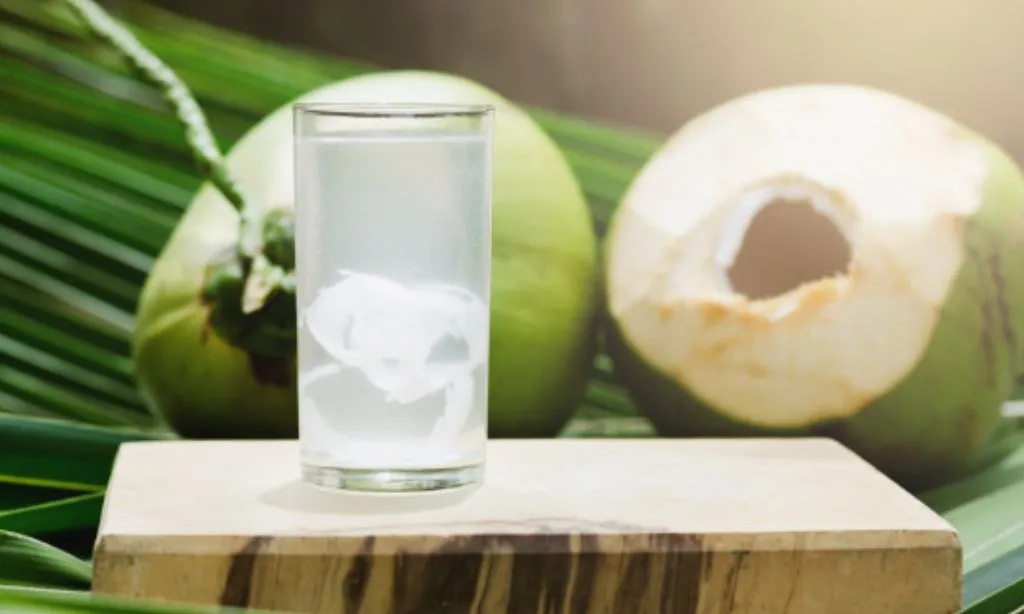
A green drinking coconut may be opened for its water and soft flesh, while a mature coconut can be grated, squeezed into coconut milk or cream, dried into copra, or processed into oil. The husk, shell, leaves, and trunk may also be used for practical household or material purposes.
Its importance is not the same everywhere. Coconut has a stronger presence in many coastal and island areas than in the Highlands, where coconuts may be brought in through local trade. This guide explains the palm, the fruit, traditional food uses, copra processing, whole-palm uses, regional differences, and the wider coconut industry in Papua New Guinea.
What Is a Papua New Guinea Coconut?
A Papua New Guinea coconut is not a separate botanical species from coconuts grown elsewhere in the tropics. It refers to the coconut palm and fruit as they are grown, harvested, prepared, traded, and understood within Papua New Guinea’s local environments and communities.
In this context, coconut can mean several different things at once. It may refer to the living palm near a house, the green drinking fruit sold at a market, the mature nut used for cooking, the grated flesh squeezed into coconut cream, or the dried kernel prepared as copra. Because Papua New Guinea is highly diverse in geography, language, and food traditions, coconut use also varies from one province, island, village, and household to another.
The Coconut Palm, Cocos nucifera
The coconut palm is known scientifically as Cocos nucifera. It belongs to the palm family, Arecaceae, and grows best in warm tropical environments. In Papua New Guinea, it is strongly associated with coastal areas, islands, and lowland communities, although coconuts may also be transported and consumed in inland towns and markets.
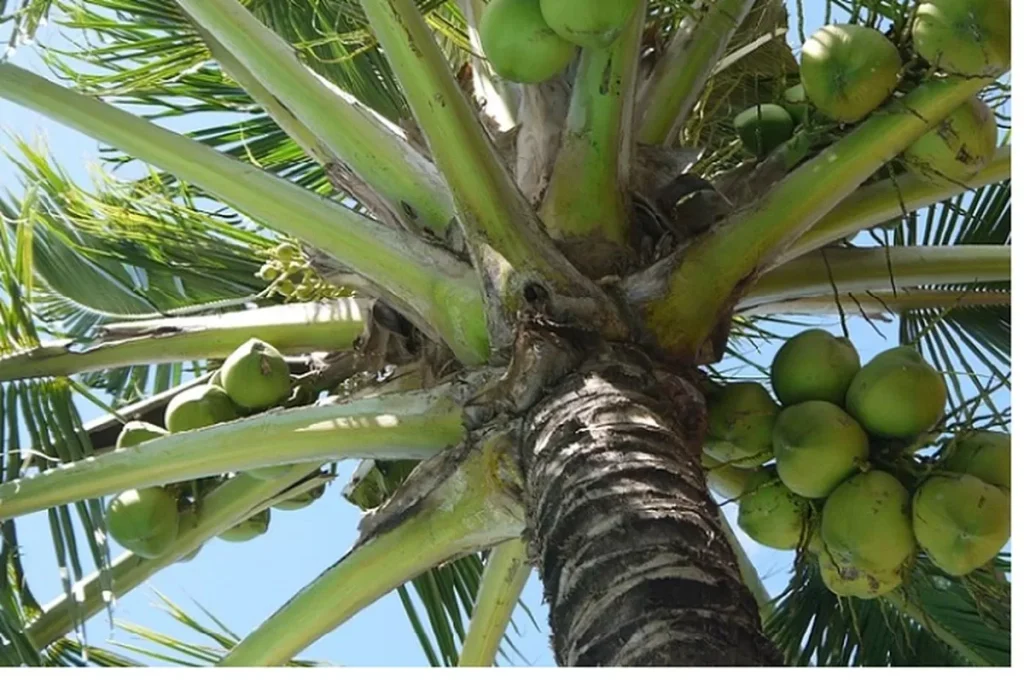
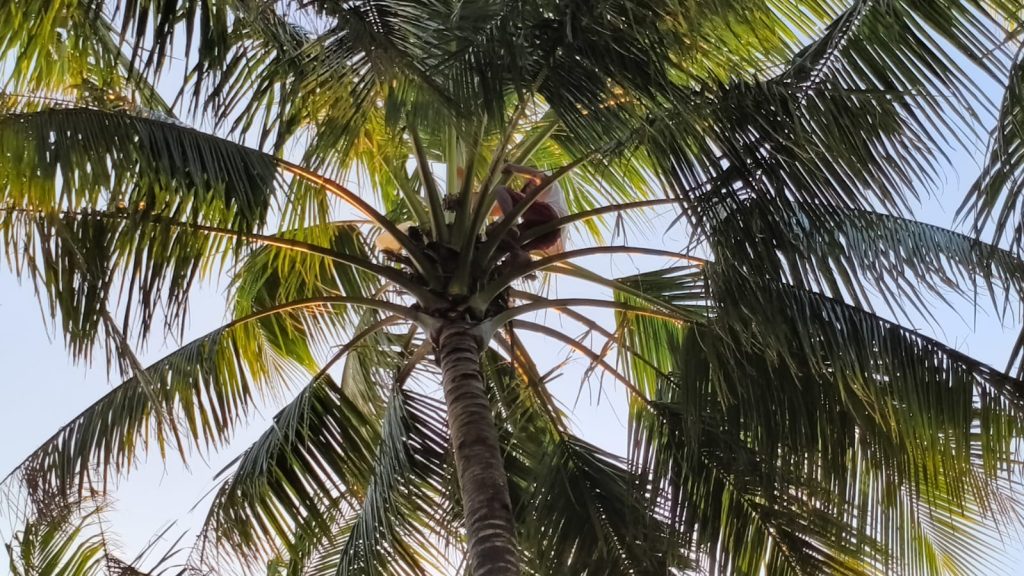
A coconut palm usually has a single upright trunk, large feather-shaped leaves, flowering structures, and fruit clusters that develop beneath the crown. Some palms grow around homes and village gardens. Others stand in groves, mixed farms, older plantation areas, or coastal landscapes where coconut has long been part of household and smallholder life.
Although people often call the coconut a “nut” in everyday language, botanically it is usually described as a fibrous, one-seeded drupe. This means the fruit has layers: an outer skin, a thick fibrous husk, a hard shell, and the seed tissue inside. The white coconut meat and the coconut water are both connected to the fruit’s endosperm, which supports the developing embryo.
The coconut water inside the fruit changes as the fruit matures. In a younger drinking coconut, the liquid is often the main part people want. As the coconut becomes mature, the white meat becomes firmer and thicker, making it more useful for grating, squeezing, drying, and processing. The exact development of a coconut can vary depending on variety, soil, rainfall, palm age, and how the palm is managed.
Parts of the Coconut Fruit
A coconut fruit has several parts, and each part can have a different use.
The exocarp is the thin outer skin. This is the surface layer that may appear green, yellow, orange, brown, or another shade depending on the variety and stage of development.
The mesocarp is the thick fibrous husk beneath the outer skin. This husk contains coir fibre, which may be used in practical household or craft contexts, depending on local practice.
The endocarp is the hard shell inside the husk. This is the familiar brown shell that protects the white kernel and the coconut water. Coconut shells may be used as fuel, bowls, utensils, scoops, or craft material in some communities.
The solid endosperm is the white coconut meat, also called coconut flesh or kernel. In younger coconuts, it may be soft and delicate. In mature coconuts, it becomes thicker and firmer, making it suitable for grating, squeezing into milk or cream, drying into copra, or processing into oil.
The liquid endosperm is coconut water. This is the clear liquid naturally found inside the fruit. It should not be confused with coconut milk, which is made later by squeezing grated coconut meat.
The embryo is found near one of the small pores, often called coconut “eyes,” on the shell. When conditions allow the coconut to germinate, this part begins the growth of a new coconut seedling.
For a published article, this section would benefit from an annotated cross-section diagram of a coconut. Useful labels would include: outer skin, husk, coir, shell, coconut meat, coconut water, embryo, and germination pore.
Green Coconut and Mature Coconut
A green coconut and a mature coconut are used differently, although the outer colour alone does not always tell the full story. Some coconuts remain green-looking for much of their development, while others may appear yellow, orange, or brown because of variety, age, or local type.
A green coconut is commonly harvested before full maturity. In Papua New Guinea, a green or drinking coconut is often called kulau in Tok Pisin. It is valued mainly for the liquid inside, and the soft developing flesh may also be eaten after the fruit is opened. Kulau is often associated with freshness, markets, travel stops, and everyday refreshment in warm coastal or island settings.
A mature coconut has firmer, thicker white meat and a more developed husk and shell. It is the stage most often used for grating and squeezing into coconut milk or coconut cream. Mature coconut meat can also be dried into copra or processed into coconut oil.
This distinction is important because many coconut products begin with different stages of the same fruit. Coconut water comes naturally from inside the coconut. Coconut milk and coconut cream come from grated mature coconut meat. Copra comes from dried mature kernel. Coconut oil may come from coconut kernel or coconut milk, depending on the process used.
What Does Kulau Mean in Papua New Guinea?
In Papua New Guinea, kulau commonly refers to a green or drinking coconut. It is the kind of coconut people usually open for the clear liquid inside and, when the fruit is young enough, the soft flesh along the inner shell. In everyday English, it may be described as a young coconut, green coconut, or drinking coconut.
Another important word is kokonas, a Tok Pisin term for coconut. Tok Pisin is widely used across Papua New Guinea, but it should not be treated as replacing the country’s many local languages. Papua New Guinea has hundreds of languages, and coconut names can vary by province, island, community, and household tradition. Some local languages may have more detailed terms for coconut stages, colours, uses, or varieties.
The phrase wara bilong kokonas can be understood as coconut water. This refers to the liquid naturally found inside the fruit. It is not the same as coconut milk or coconut cream, which are made by grating mature coconut meat and squeezing out a white liquid.
A kulau is usually opened by cutting away part of the upper husk until the shell can be pierced or opened. The coconut water may be drunk directly from the fruit or poured into a cup or container. After the water is finished, the coconut may be split open so the soft inner flesh can be scraped out with a small piece of shell, a spoon, or another simple utensil.
Kulau is part of everyday food culture in many warm coastal, island, and lowland settings. It may be found around homes, at roadside stalls, in local markets, near beaches, or in places where people gather, travel, work, and trade. Its meaning is simple, but it connects to a wider coconut culture: fresh fruit, local language, market life, and the practical use of the coconut palm.
Where Coconut Palms Grow in Papua New Guinea
Coconut palms in Papua New Guinea are most strongly associated with warm coastal, island, and lowland environments. The palm is well suited to many tropical settings where people live near the sea, rivers, village gardens, and transport routes. In these places, coconut can be part of everyday household life as well as smallholder farming and local trade.
This does not mean coconut has the same importance in every province. Papua New Guinea has high mountains, inland valleys, coastal plains, volcanic islands, coral islands, river deltas, and many different local food systems. Coconut is especially visible in many coastal and island communities, while people in some inland and Highlands areas may encounter coconuts mainly through markets and trade.
Coastal, Island, and Lowland Environments
Coconut palms are common in many coastal and island parts of Papua New Guinea because these areas often provide the warm conditions where the palm grows well. They may be found near villages, along shorelines, around gardens, beside houses, in mixed farms, and in older plantation landscapes.
Representative coconut-growing or coconut-using areas include East New Britain, West New Britain, New Ireland, Manus, Madang, Milne Bay, the Autonomous Region of Bougainville, Gulf, Central Province, and Morobe. These regions are not identical. Some have stronger links to copra production, some are better known for island household use, and some connect coconut with local markets, cocoa farming, fishing, or regional food traditions.
In many island and coastal places, coconut is practical because the fruit, leaves, husk, shell, and trunk can all be useful close to home. Fresh coconuts may be consumed locally, sold in village markets, or moved by road, boat, or inter-island transport. In other places, mature nuts may enter copra channels or small-scale processing.
Highlands communities may also consume coconuts, but the fruit is often transported from coastal or lowland producing areas. This movement from coast to inland market is part of the wider story of coconut in Papua New Guinea. Coconut should therefore be understood not only as a crop in the place where it grows, but also as a food and trade item that can travel between regions.
Coconut in Village Gardens and Mixed Farms
In many communities, coconut palms are not only planted in formal plantations. They may grow around homes, beside paths, near shorelines, in food gardens, and in family-managed groves. A household may use the same palms for drinking coconuts, cooking coconuts, market sales, leaves, husks, shells, and occasional copra.
Coconut can also be part of mixed farming systems. In some producing regions, it is found alongside cocoa, food gardens, bananas, root crops, fruit trees, and other useful plants. This mixed landscape reflects the way many rural households combine food production, cash income, local exchange, and practical household needs.
A single farm or village area may supply several coconut products at once. Younger coconuts may be used as kulau for drinking. Mature coconuts may be grated for coconut milk or coconut cream. Some mature nuts may be sold fresh. Others may be dried into copra. Leaves may be used for weaving or covering food. Shells and husks may be used as fuel, craft material, or garden material, depending on local practice.
Because coconut has both household and commercial roles, its value cannot be explained only through exports or industry data. A coconut palm may support a meal, a market sale, a community gathering, a small cash need, or a practical household task. These uses often overlap.
Tall and Dwarf Coconut Types
Coconut palms are often described broadly as tall or dwarf types, although real coconut diversity is more complex than these simple labels.
Tall coconut populations usually grow larger and may cross-pollinate more freely. They are often associated with long-lived palms in village areas, older groves, or established tree-crop landscapes. Dwarf coconut types are generally shorter and may begin bearing earlier, although performance depends on the particular planting material, environment, and care.
Farmers may also recognize coconut palms in more practical local ways. They may notice fruit colour, fruit size, drinking quality, kernel thickness, shell form, growth habit, bearing pattern, taste, or local origin. A community may value one palm for kulau, another for mature cooking nuts, and another for copra or household use.
Papua New Guinea contains locally maintained coconut diversity, but it is important not to assign national variety names without reliable documentation. A name used in one area may not apply elsewhere. The same is true for fruit colour. A green-looking coconut is not always the same variety as another green-looking coconut, and a brown coconut is not automatically mature only because of its colour. Variety, maturity, local terminology, and use all need to be understood together.
How Coconut Is Used in Papua New Guinea Food
Coconut use is especially visible in many coastal and island cuisines of Papua New Guinea. There is no single national coconut recipe, and it would be misleading to describe every province, language group, or household as cooking with coconut in the same way. In some places, coconut is part of daily meals. In others, it appears more often through markets, gatherings, or foods brought from coastal areas.
In Papua New Guinea cooking, coconut may function as a drink, fresh snack, grated ingredient, cooking liquid, sauce, flavouring, or feast food. A green coconut may be opened for its water. A mature coconut may be grated and squeezed into coconut milk or coconut cream. The same fruit can also be used with root crops, greens, fish, seafood, sago, bananas, and foods cooked in leaves, pots, or earth ovens.
Coconut Water
Coconut water is the clear liquid naturally present inside the fruit. It is most closely associated with younger drinking coconuts, often called kulau in Tok Pisin. When a kulau is opened, the water may be drunk directly from the coconut or poured into a cup.
Coconut water is different from coconut milk. It is already inside the fruit before the coconut is opened. Coconut milk, by contrast, is made later by grating mature coconut meat and squeezing it with or without added water. This difference matters because the two liquids have different textures, uses, and meanings in cooking.
In food writing, coconut water should be described simply as a drink or ingredient. It does not need to be presented with health, sports, or treatment claims. Its role in this article is cultural and culinary, not medical.
Fresh Coconut Meat
Fresh coconut meat is the white flesh inside the shell. In a younger coconut, the flesh is usually soft and can be scooped out after the water is finished. In a mature coconut, the flesh becomes firmer and thicker. This mature meat is the part most often grated for cooking.
Fresh coconut meat may be eaten directly, grated into food, or combined with sago, banana, root crops, fish, and desserts. It is also the starting point for several important coconut products. When grated and squeezed, it becomes coconut milk or coconut cream. When dried, it becomes copra. When processed further, it can become coconut oil.
This makes mature coconut meat one of the most versatile parts of the fruit in Papua New Guinea food systems. It can remain a household ingredient, enter a local market, or become part of a wider processing chain.
How Coconut Milk and Coconut Cream Are Made
Traditional coconut milk or cream begins with a mature coconut. The coconut is split, and the white meat is removed or grated. The grated coconut may be mixed with a little water when needed, then squeezed or pressed so the white liquid runs out. The first extraction is usually richer because it contains more coconut solids. Later squeezing may produce a thinner liquid.
Coconut milk and coconut cream are closely related, but they are not always identical in household use. Coconut cream is usually thicker and richer, while coconut milk is more pourable and may be used as a cooking liquid. However, exact thickness and naming can vary between households, markets, and regions.
The important distinction is that both coconut milk and coconut cream come from mature coconut meat. They are not the same as coconut water, which occurs naturally inside the fruit.
Coconut with Root Crops and Greens
Coconut milk or cream is often used to bring richness to starchy or leafy foods. It may be cooked with taro, sweet potato or kaukau, cassava, yam, banana, pumpkin, aibika, and other greens. In some preparations, coconut liquid coats the ingredients. In others, it becomes a broth that thickens as the food cooks.
These dishes are usually best described by their ingredients and local context rather than forced into one national recipe name. A family might prepare greens with coconut cream one way, while another household in a different province may use a different leaf, root crop, cooking vessel, or seasoning. The shared idea is simple: mature coconut is grated, squeezed, and used to cook or enrich local foods.
Coconut also pairs naturally with foods that are common in lowland and island areas, including sago and banana. The texture can range from soft and spoonable to firm, wrapped, steamed, or cooked over heat, depending on the local method.
Coconut with Fish and Seafood
In many coastal communities, coconut is used with fish and seafood. Fish may be cooked in coconut milk or coconut cream, sometimes with greens, lime, banana, root crops, or other local ingredients. Shellfish and reef foods may also be combined with coconut in places where they are part of the local diet.
It is important not to label every coconut-and-fish dish with a famous Pacific name from another country. For example, not every preparation involving fish and coconut should be called kokoda, which is more strongly associated with Fiji. Papua New Guinea has its own diverse coastal foodways, and dish names should be used only when they are accurately linked to the right community and source.
A safer approach is to describe the preparation clearly: fish cooked in coconut cream, seafood with coconut milk, or local fish served with coconut-based sauce. This keeps the article accurate without borrowing names from other Pacific traditions.
Coconut in Sago and Banana Dishes
Sago and coconut are an important combination in several lowland and coastal food contexts. Grated coconut may be mixed into sago preparations, while coconut cream may be poured over or cooked with sago-based foods. Banana can also be combined with coconut in steamed, wrapped, or heated preparations.
Some communities prepare leaf-wrapped mixtures of sago, banana, coconut, and other ingredients. Others may cook coconut-rich foods with hot stones, in pots, or over fire. Names, textures, and ingredients vary by place, so local terms should be checked carefully before publication.
Rather than presenting one “Papua New Guinea coconut pudding” as universal, it is better to explain that coconut can appear in sweet, starchy, soft, or wrapped foods depending on the region and household.
Coconut in Mumu Cooking
Mumu broadly refers to food cooked with heated stones or in an earth oven, although methods vary across Papua New Guinea. A mumu may include root crops, banana, greens, meat, fish, or other ingredients. Coconut milk or coconut cream may be included in some versions, but coconut is not required in every mumu.
Mumu can be prepared for household meals, community gatherings, ceremonies, or larger events. The layering, ingredients, leaves, stones, and cooking time may differ by region. Because of this, it is better to avoid calling one modern recipe the definitive national version.
When coconut is used in mumu-style cooking, it may help moisten the ingredients, coat root crops or greens, and become part of the cooking liquid. Its role depends on the food being prepared and the community tradition behind it.
Tolai Aigir Cooking
Aigir is a useful regional example because it is associated with Tolai food traditions in East New Britain Province. It is commonly described as a cooking method where hot stones heat coconut liquid and cook the ingredients. Coconut cream functions as the cooking medium, and the dish may include greens, vegetables, root crops, fish, or meat. A Papua New Guinea cooking source describes aigir as a Tolai method from East New Britain, often connected with special occasions or family gatherings.
This example should be presented carefully. Aigir should not be described as a method shared identically across all of Papua New Guinea. It belongs in the article as a regional case study showing how coconut can become central to a local cooking tradition.
As with other community-specific foods, spelling, ingredients, and preparation details should be verified with reliable local sources or knowledgeable community members before publication.
How Papua New Guinea Coconut Becomes Copra
Copra is one of the most important commercial forms of coconut in Papua New Guinea, especially in areas where mature coconuts are collected, dried, sold, and moved through local or regional buying networks. While fresh coconut is used for drinking and cooking, copra belongs more clearly to the processing and trade side of coconut life.
At the village or smallholder level, copra making is usually a practical way to turn mature coconut meat into a dried product that can be stored, carried, sold, and later processed into coconut oil. The process begins with mature coconuts, not green drinking coconuts. It also uses the white kernel, not the husk or shell.
What Is Copra?
Copra is dried mature coconut kernel. It is made from the white meat inside a mature coconut after the coconut has developed firm flesh. Once dried, the kernel becomes lighter, less perishable, and easier to transport than fresh coconut meat.
Copra is different from fresh coconut meat. Fresh meat is eaten, grated, squeezed, or cooked soon after the coconut is opened. Copra is intentionally dried for storage, sale, transport, or oil extraction.
Copra is also different from desiccated coconut. Desiccated coconut is usually prepared as a more refined food ingredient, often shredded or flaked for culinary use. Copra is mainly an industrial or trade product used to produce coconut oil and related by-products.
Definition box:
Copra is the dried white kernel of a mature coconut, prepared for storage, sale, transport, or oil extraction.
Harvesting Mature Coconuts
Copra making starts with mature coconuts. These may be collected after falling naturally, or they may be cut from the palm, depending on local practice, labour, palm height, safety, and the condition of the farm or grove.
In some household settings, family members gather coconuts from palms near homes or gardens. In smallholder production, coconuts may be collected from village groves, mixed farms, or older plantation areas. The nuts are then moved to a place where they can be husked, split, and dried.
Harvesting methods vary. A tall old palm, a shorter younger palm, a coconut near a house, and a coconut in a large grove may all require different handling. Because climbing and cutting can be dangerous, a general article should describe harvesting at a broad level rather than giving step-by-step climbing instructions.
Husking and Splitting the Coconut
After mature coconuts are gathered, the fibrous husk is removed to expose the hard shell. The coconut is then split so the white kernel can be dried. The coconut water inside mature nuts may be drained away during this process.
The split coconut halves are arranged so the kernel can dry. After drying, the kernel can be separated from the shell. In some settings, shell pieces may also be used as fuel or for other practical purposes, but they are not copra. Copra refers only to the dried white coconut meat.
For a published article, this stage is better shown through process photographs or simple illustrations rather than detailed tool instructions. Useful images might include mature coconuts, husked coconuts, split halves, drying racks, and dried kernel pieces ready for sale.
Copra Drying Methods
Copra can be dried in several ways. The method used depends on the weather, available materials, household practice, local infrastructure, and the quality requirements of buyers.
Sun drying uses direct sunlight and open air. It is simple and may be suitable in dry weather, but it depends heavily on reliable sun and careful handling.
Smoke drying uses heat and smoke from a fire. It can be useful where sunlight is inconsistent, but uneven heat or heavy smoke may affect the colour, smell, and overall quality of the copra.
Kiln or hot-air drying uses a more controlled drying structure. This may give more consistent drying when properly managed, although access to equipment and fuel can vary by location.
Some producers may use combined methods, especially when the weather changes. The main purpose is to reduce moisture so the dried kernel can be stored, transported, and processed. Because technical moisture targets and grading rules can depend on current buyer or industry standards, they should only be included in a final publication when supported by a dated, reliable source.
From Copra to Coconut Oil and Meal
Once dried, copra may be sold to a local buyer, trader, or mill. It may move by road, boat, inter-island shipping, or other transport depending on the producing area. This movement is a major part of the coconut value chain, especially in island and remote coastal settings where distance and freight costs can shape market access.
At a mill or processing facility, the dried coconut kernel is crushed, pressed, or otherwise processed to separate coconut oil. The remaining solid material is commonly known as coconut meal. Coconut oil may be used in cooking, soap, industrial products, fuel projects, or other commercial uses, depending on the processor and market.
It is important not to describe all coconut oil from Papua New Guinea as virgin coconut oil. Copra-based coconut oil and virgin coconut oil come from different processing pathways. Copra oil begins with dried kernel. Virgin coconut oil is generally made from fresh coconut kernel or fresh coconut milk without first producing conventional copra.
Copra therefore sits between household coconut use and commercial coconut processing. It begins with mature fruit collected by households or smallholders, but it can end in mills, domestic trade, export channels, or value-added products.
Copra Oil Versus Virgin Coconut Oil
Copra-based coconut oil and virgin coconut oil both come from the coconut palm, but they are not the same product. The main difference is the raw material and the processing path used before the oil is separated.
A simple way to understand the difference is this: copra oil begins with dried coconut kernel, while virgin coconut oil begins with fresh coconut kernel or fresh coconut milk. Both may be part of the wider coconut industry, but they should not be described as identical.
Copra-Based Coconut Oil
Copra-based coconut oil is made from dried mature coconut meat. The coconut kernel is first dried into copra, then transported, crushed, pressed, or processed to separate the oil. Depending on the processor and market, the oil may be filtered, refined, or further prepared for different commercial uses.
This pathway is often connected with copra buyers, traders, mills, shipping routes, and larger coconut value chains. In Papua New Guinea, copra has historically been important in several coastal and island areas because it gives smallholders a way to turn mature coconuts into a saleable dried product.
Copra-based coconut oil should be understood mainly as a processing and trade product. It may be used in cooking, soap making, industrial uses, or other material applications, depending on the market. In this article, it should not be positioned with medical, beauty, or therapeutic claims.
Virgin Coconut Oil
Virgin coconut oil is usually made from fresh coconut kernel or fresh coconut milk rather than conventional copra. The exact method may vary by producer, but the process is generally designed to extract oil from fresh coconut material without first drying the meat into standard copra.
Virgin coconut oil may be produced by small-scale processors, community enterprises, or commercial operations. In Papua New Guinea, it belongs more naturally in a discussion of value-added coconut products rather than the older copra trade alone.
It is important not to describe virgin coconut oil as simply “better” or “healthier” than copra oil. For a general educational article, the focus should stay on how the products are made, how they differ in raw material, and where they fit in the coconut value chain.
Simple Comparison
| Product | Starting material | General process | Common context |
| Copra-based coconut oil | Dried mature coconut kernel | Mature coconut meat is dried into copra, then pressed or processed for oil | Copra trade, mills, commercial processing |
| Virgin coconut oil | Fresh coconut kernel or fresh coconut milk | Oil is extracted from fresh coconut material without first making conventional copra | Value-added products, small-scale or commercial processing |
The distinction matters because coconut articles often mix these terms together. In Papua New Guinea, a farmer selling copra, a household grating coconut for cream, and a processor making virgin coconut oil may all be working with the same plant, but they are not doing the same activity. Clear wording helps readers understand the coconut industry without confusing household food use, copra production, and value-added oil processing.
The Role of Coconut in Papua New Guinea Livelihoods
Coconut supports many kinds of livelihood activity in Papua New Guinea, especially in coastal, island, and lowland communities. Its role may be small and household-based in one place, more market-oriented in another, and linked to copra or oil processing elsewhere. For this reason, coconut should not be described only as an export crop or only as a village food. It can be both, depending on the location and household.
A family may harvest coconut for a meal, open kulau for drinking, grate mature coconut for cream, sell fresh nuts at a market, dry kernel into copra, or use leaves and shells for practical household needs. These uses often sit alongside gardening, fishing, cocoa farming, wage work, trade, and other income activities.
Household Food and Drink
At the household level, coconut is often valued because it is useful in several stages. A younger coconut can be opened as kulau. A mature coconut can be split, grated, and squeezed for coconut milk or coconut cream. The firm meat can be eaten, cooked, dried, or processed.
In many coastal and island settings, coconut is part of the everyday food landscape. It may be used with fish, root crops, greens, sago, banana, or other local foods. It may also be prepared in larger quantities for family gatherings, church events, ceremonies, or community meals, depending on local custom.
Households may keep some coconuts for their own use and sell the surplus. Fresh drinking coconuts can move through roadside sales, village markets, town markets, or informal trade networks. Mature coconuts may also be sold for cooking or processing.
Smallholder Income
Copra has historically provided cash income for smallholders in several coastal and island parts of Papua New Guinea. Unlike fresh coconut, which can be bulky and perishable, copra is dried and can be stored and transported more easily. This has made it an important link between village production and commercial processing.
Smallholders may sell whole coconuts, kulau, mature nuts, copra, coconut oil, or other coconut products. The importance of this income varies widely. It depends on the number and age of palms, access to buyers, transport costs, prices, household labour, local demand, and other income options such as cocoa, fishing, food gardens, or paid work.
It is important to avoid universal statements such as “all coconut farmers depend on copra” or “coconut is the main income source for every coastal household.” In reality, coconut may be central for one family, secondary for another, and occasional for another.
Transport from Coastal Areas to Inland Markets
Coconut trade in Papua New Guinea is shaped by geography. The country includes mainland coastlines, offshore islands, mountain ranges, river systems, and remote settlements. Moving coconuts from producing areas to towns or inland markets can involve road transport, small boats, inter-island shipping, wholesale markets, roadside sales, and local carriers.
Fresh coconuts may travel from coastal and lowland regions to urban centres or Highlands markets. In these inland areas, consumers may know coconut mainly as a purchased food or drink rather than a crop grown nearby. This movement connects coconut-growing communities with wider domestic demand.
Transport can also be a challenge. Coconuts are bulky, and remote locations may face irregular shipping, poor road access, fuel costs, or long distances to buyers. These factors can influence whether a household sells fresh nuts, makes copra, processes coconut locally, or uses most of the harvest at home.
Domestic coconut movement should not be overlooked. Export figures and industry reports may show one part of the story, but local food use and internal trade also matter.
Coconut and Cocoa Farming
In some Papua New Guinea producing regions, coconut and cocoa are found together in the same rural landscape. A household may manage coconut palms, cocoa trees, food gardens, fruit trees, and other useful plants on customary or family land. Labour may shift between these activities depending on season, prices, family needs, and available buyers.
Coconut and cocoa can both contribute to smallholder income, but their roles are not identical. Cocoa may provide one kind of cash crop opportunity, while coconut may provide household food, copra, fresh nut sales, leaves, husks, shells, and other materials. Together, they can form part of a mixed livelihood system.
It is best not to claim that coconut is always planted as shade for cocoa unless a reliable source confirms that practice in a specific place. In some farms, the two crops may simply exist together as part of a mixed tree-crop environment. In other areas, planting patterns may reflect plantation history, household choices, or local land-use traditions.
Traditional Uses of the Whole Coconut Palm
In Papua New Guinea, coconut is often valued as a multipurpose palm. The fruit is the most obvious part, but the leaves, midribs, husk, shell, trunk, and oil may also be useful in household, craft, cooking, and material settings. These uses differ from place to place, so it is better to say that coconut parts may be used in certain ways rather than claiming every community uses them identically.
This whole-palm usefulness helps explain why coconut remains important beyond food. A coconut palm near a house, garden, beach, or village path can provide materials for everyday tasks as well as fruit for drinking, cooking, and trade.
Coconut Leaves and Fronds
Coconut leaves and fronds may be used for thatching, temporary shelters, food coverings, woven baskets, mats, decorative items, and other practical objects. The long leaflets can be folded, plaited, or arranged depending on the intended use and local skill.
The midribs of coconut leaves may be collected and tied into simple brooms. Leaves may also be used in cooking contexts, such as covering food, lining surfaces, or helping organize food during preparation. In some gatherings, woven or arranged coconut leaves may have decorative or practical roles.
These practices should be described with care. Weaving styles, household uses, and ceremonial meanings can differ between communities, islands, and language groups. A technique known in one coastal area should not automatically be presented as a national practice.
Coconut Shells
Coconut shells are hard, durable, and useful after the white meat has been removed. In household settings, shells may be used as bowls, drinking vessels, ladles, scoops, small containers, or decorative items. They may also be used as fuel or made into charcoal.
A shell bowl or scoop can be simple and practical, while carved or polished shell items may become craft objects. In some places, coconut shell material may appear in local markets or tourist craft settings. In others, it remains mainly a household material.
It is important to distinguish the shell from the husk. The shell is the hard inner layer around the coconut meat and water. The husk is the thick fibrous layer outside the shell. They are different parts of the fruit and have different uses.
Coconut Husks and Coir
The coconut husk is the thick fibrous layer between the outer skin and the hard shell. Its fibres are often called coir. In small-scale settings, husks may be used as fuel, garden material, mulch, protective packing, brushes, or simple fibre products. Coir may also be used for rope, mats, and craft items where the skills and market demand exist.
However, industrial coir production should not be assumed in every coconut-growing region. A household using husks near the garden is different from a commercial coir enterprise. The same material can have different value depending on processing, transport, buyers, and local needs.
Husks may also remain as organic residue around homes, drying sites, or farms. In these cases, they are part of the everyday material landscape of coconut use.
Coconut Trunks
Coconut trunks may be used for posts, small structures, bridges or walkways, fencing, furniture, or fuelwood in some settings. Their use depends on the age of the palm, the condition of the trunk, available tools, local building knowledge, and the purpose of the structure.
A coconut trunk is not uniform from top to bottom. Quality can differ by age and by position within the trunk. For this reason, a general article should avoid structural claims or construction advice. It is enough to say that coconut trunks may be used as local material where appropriate knowledge and conditions are present.
When old palms are removed during replanting or clearing, the trunk may become a useful resource rather than being treated only as waste.
Coconut Oil in Household and Material Culture
Coconut oil can have household, cooking, and material uses. It may be used in cooking, soap making, lighting, body decoration in specific cultural settings, ceremonial preparation where accurately documented, or modern fuel and machinery experiments.
This section should avoid medical or cosmetic treatment claims. It is better to describe coconut oil as a practical material rather than saying it heals skin, grows hair, prevents illness, or works as a treatment. In a culturally focused article, coconut oil can be discussed as part of cooking, craft, household work, body presentation, and local processing without entering health advice.
In modern contexts, coconut oil has also been explored in some places as a fuel or machinery input. Those examples should be dated, located, and described carefully so readers do not assume they represent nationwide adoption.
Coconut in Papua New Guinea Culture
Coconut in Papua New Guinea is not only an ingredient or crop. In many coastal, island, and lowland communities, it is also part of daily routines, shared work, food preparation, local language, market activity, and community gatherings. Its cultural role depends on place. A practice from East New Britain, Manus, Milne Bay, Bougainville, or another province should not be presented as if it belongs equally to all Papua New Guineans.
Because the country is highly diverse, the safest way to describe coconut culture is through patterns rather than universal claims. Coconut may be part of cooking, feasting, household labour, craft making, or local trade, but the details vary by family, community, language group, and region.
Preparing coconut often involves several steps: collecting the fruit, removing the husk, splitting the shell, grating the white meat, and squeezing the grated coconut into milk or cream. In households where coconut is used often, these tasks may be familiar parts of everyday cooking.
The work may be shared among family members or neighbours, especially when large amounts of food are prepared. For a community gathering or feast, people may help collect coconuts, grate mature meat, squeeze coconut cream, clean greens, prepare root crops, wrap food, or arrange cooking materials.
It is important not to assign universal gender roles to these tasks. Labour arrangements differ between households and communities. In one place, certain people may be known for grating or cooking. In another, responsibilities may shift depending on age, skill, availability, occasion, or family custom.
Coconut preparation also carries practical knowledge. People learn how to choose a drinking coconut, identify a mature cooking coconut, grate the meat efficiently, judge the thickness of coconut cream, and match coconut liquid with certain foods. These skills are often learned by watching and helping others.
Feasts, Ceremonies, and Community Gatherings
Coconut-rich dishes may be prepared for gatherings, church events, ceremonies, market days, family visits, or communal meals. In some settings, a large quantity of coconut cream may be needed to cook root crops, greens, fish, meat, or sago-based foods. Coconut leaves, shells, husks, or oil may also have practical or decorative roles, depending on the event and local custom.
These examples should be described with care. A Tolai aigir gathering in East New Britain, an island feast in Milne Bay, a coastal household meal in Central Province, and a community preparation in Bougainville may all involve coconut, but they are not the same event. Each has its own place, language, food combinations, and social meaning.
For a respectful article, community-specific practices should be identified by location when possible. If a source describes a practice from one province or language group, the article should say so. Coconut is widely used, but the cultural details are not nationally identical.
Language and Local Knowledge
Tok Pisin terms such as kokonas and kulau are widely recognized in Papua New Guinea. Kokonas refers to coconut, while kulau commonly refers to a green drinking coconut. These terms are useful for readers, especially those trying to understand markets, everyday conversation, or Papua New Guinea food writing.
However, Tok Pisin is only one part of the country’s language landscape. Local languages may have their own names for coconut stages, palm parts, fruit colours, varieties, and preparations. A community may use distinct words for young coconut, mature coconut, sprouted coconut, coconut water, coconut flesh, or coconut cream.
Local names can carry practical knowledge. They may help people identify which coconut is best for drinking, which one is ready for grating, which palm produces thicker kernel, or which fruit comes from a known local type. These words can reflect observation, farming experience, cooking practice, and intergenerational knowledge.
For publication, language-specific examples should be confirmed with speakers, dictionaries, local institutions, or reliable records. This avoids flattening Papua New Guinea’s cultural diversity into a single coconut vocabulary.
Important Coconut Producing Regions
Coconut is present in many parts of Papua New Guinea, but its role differs by province, island, and community. Some regions are known for coastal household use, some for copra and tree-crop farming, and some for local markets where coconuts move between rural producers and urban consumers.
The table below gives representative examples. It should not be read as a complete ranking of production, and it does not mean coconut has the same importance in every listed area.
| Province or region | Coconut environment | Common livelihood context | Potential article example | Qualification |
| East New Britain | Coastal and volcanic environments, including areas around the Gazelle Peninsula and nearby islands | Coconut and cocoa farms, village food use, local markets | Tolai aigir as a regional coconut-based cooking example | Tolai traditions should not be described as nationally universal |
| West New Britain | Coastal lowlands and island environments | Smallholder tree crops, household coconut use, copra, local trade | Coconut as part of mixed rural livelihoods | Avoid assuming all communities share the same farming pattern |
| New Ireland | Island and coastal production areas | Fresh coconut use, copra, local markets, household cooking | Island coconut foodways and local trade | Include local examples only when verified |
| Manus | Island household and coastal use | Food, drink, household materials, fresh coconut movement | Kulau, cooking coconuts, and whole-palm uses in island settings | Use community-specific sources for cultural details |
| Autonomous Region of Bougainville | Coastal and island smallholder landscapes | Coconut and copra history, mixed rural livelihoods, local food use | Coconut in household cooking and smallholder trade | Separate historical copra information from current conditions |
| Madang and Karkar Island | Coastal areas, island farms, and plantation history | Copra, oil, coconut-based projects, mixed tree crops | Karkar Island as a dated case study for coconut oil fuel exploration | Date all industrial and fuel examples clearly |
| Milne Bay | Island and coastal food systems | Household coconut use, local markets, fishing, village food preparation | Coconut with fish, root crops, sago, and island foods | Avoid borrowing examples from nearby Pacific countries |
| Gulf and Central Province | Coastal settlements, lowlands, and market connections | Household cooking, fresh coconut sales, coastal-to-urban trade | Coconut in local cooking and town markets | Do not imply uniform production levels |
| Morobe | Coastal and lowland areas with market links | Fresh coconut trade, household use, transport to towns and inland areas | Coconut movement from coastal areas into wider markets | Distinguish coastal production from inland consumption |
These regions show why Papua New Guinea coconut cannot be explained through one province or one recipe. East New Britain may be useful for discussing Tolai aigir and coconut-cocoa landscapes. Madang and Karkar Island may be useful for dated coconut oil or fuel examples. Milne Bay, Manus, and New Ireland may help illustrate island food systems. Gulf, Central Province, and Morobe may show how coastal coconut use connects with domestic markets.
For a final publication, each regional example should be checked against reliable local or institutional sources. Photos should be captioned with the real location, and images from Indonesian Papua, Fiji, Solomon Islands, or other Pacific places should not be used as evidence for Papua New Guinea unless the comparison is clearly labelled.
The Papua New Guinea Coconut Industry
The Papua New Guinea coconut industry includes several connected but distinct activities. It is not only about coconut oil, and it is not only about exports. It includes fresh drinking coconuts, mature cooking coconuts, domestic markets, copra, coconut oil, coconut meal, virgin coconut oil, desiccated coconut, crafts, fibre products, and local experiments with coconut-based fuel.
Some of these activities happen at the household or village level. Others involve buyers, mills, transport companies, processors, exporters, government agencies, research institutions, and development partners. The industry is therefore best understood as a chain that begins with palms on family or customary land and may continue into markets, processing facilities, and wider trade.
Fresh Coconut, Copra, and Oil Subsections
Fresh coconuts and processed coconut products serve different markets. A kulau sold for drinking in a town market is not the same as mature coconut meat dried into copra. A household coconut grated for cream is not the same as coconut oil produced at a mill.
Fresh drinking coconuts are usually sold for immediate consumption. Mature coconuts may be sold for cooking, household processing, or drying. Copra is dried mature kernel that can be stored and transported to buyers or mills. Coconut oil is extracted from coconut kernel or coconut milk, depending on the process used. Coconut meal is the solid material that remains after oil extraction from copra or dried kernel.
Virgin coconut oil and desiccated coconut belong to the value-added side of the industry. They may require different processing standards, equipment, packaging, and markets than village-level copra. Coconut shells, husks, and fibres may also support small-scale craft, fuel, garden, or material uses, though these should not be confused with large-scale industrial coir production unless that is clearly documented.
The Role of Smallholders
Smallholders are central to many coconut activities in Papua New Guinea. Family-managed palms, village groves, and mixed farms often supply household food as well as market products. A smallholder household may use some coconuts at home, sell fresh nuts locally, and dry part of the harvest into copra when the price and transport situation make it worthwhile.
Smallholder production can be geographically dispersed. Some coconut-producing communities are located on islands, along remote coastlines, or away from reliable roads. This affects how easily farmers can reach buyers, mills, or town markets. In some places, coconut production depends heavily on family labour and local collection systems rather than large mechanized operations.
Market access is not equal everywhere. A farmer near a road, wharf, buyer, or town market may have more options than a producer in a remote island village. This is one reason coconut can be an everyday household resource in one place, a cash crop in another, and a difficult-to-sell product somewhere else.
Industry Institutions
Several types of institutions may be relevant to the coconut industry in Papua New Guinea. These can include national government bodies, research organizations, commodity institutions, development partners, processors, and exporters.
Kokonas Indastri Koporesen is commonly associated with Papua New Guinea’s coconut sector and is a key name to verify when discussing industry roles, farmer support, product development, or coconut policies. Any description of its current responsibilities should be checked against up-to-date official information before publication.
The National Agricultural Research Institute, the Cocoa and Coconut Institute, the Department of Agriculture and Livestock, the Pacific Community, FAO, and ACIAR may also appear in discussions of agricultural research, crop development, biosecurity, market systems, or rural livelihoods. Their roles should be described carefully and only in relation to verified programs, reports, or current responsibilities.
Industry processors and exporters may also shape the coconut value chain. They can influence buying systems, quality requirements, transport demand, processing capacity, and product development. However, an educational article should avoid comparing brands or claiming that one processor is superior to another.
Coconut Replanting
Coconut replanting is an important long-term issue in many coconut-producing areas. Some farms and village groves contain older palms, and older or poorly maintained palms may produce less or become harder to harvest. Replacing palms is not a quick decision because a coconut seedling takes time to establish before it becomes useful for household harvest or market production.
Farmers considering replanting must balance several needs. They may need coconuts for household food, cash income, shade, land boundaries, mixed farming, or future copra production. They also need access to suitable seednuts or seedlings, land, labour, and time. Removing old palms too quickly may reduce short-term household supply, while delaying replanting may reduce future productivity.
Replanting programs may target selected coconut-growing provinces, but details should always be dated and sourced. It is better to avoid broad claims such as “most palms are old” or “the whole industry is declining” unless supported by current evidence. A careful article can explain the issue without relying on unsourced national percentages.
Challenges Facing Coconut Production
Coconut production in Papua New Guinea faces several practical challenges. These challenges are not the same in every province, and they do not affect all households equally. A family with palms near a town market may face different problems from a smallholder on a remote island or a coastal farmer far from regular transport.
The main issues are often linked to ageing palms, labour, market access, pests and diseases, weather pressure, and the cost of moving bulky products. These challenges can influence whether coconuts are used mainly at home, sold fresh, dried into copra, processed locally, or left unharvested.
Ageing Palms and Low Productivity
In some coconut-growing areas, older palms remain part of village groves, mixed farms, and former plantation landscapes. Older palms may still produce fruit, but they can become less convenient for household and commercial use. Very tall palms can be difficult to harvest, and poorly maintained areas may produce less consistently than farmers would like.
Low productivity can also be connected with old planting material, limited replanting, variable management, labour demands, and competition from other crops or income activities. A household may choose to spend time on cocoa, fishing, food gardens, market sales, wage work, or family obligations instead of collecting and drying coconuts.
Copra prices can also influence motivation. When prices are low or irregular, the work of gathering, husking, splitting, drying, bagging, and transporting copra may feel less worthwhile. When prices improve, households may return more attention to coconut collection and drying. This makes coconut production partly a farming issue and partly a market issue.
Transport and Market Access
Papua New Guinea’s geography creates real transport challenges. Coconut-producing communities may be spread across islands, remote coastlines, river areas, and places with limited road access. Moving coconuts or copra from a village to a buyer can involve walking, carrying, small boats, trucks, inter-island shipping, or several stages of local trade.
Fresh coconuts are bulky. Copra is easier to transport than fresh kernel, but it still depends on sacks, storage, buyers, and freight. Remote areas may face irregular shipping, high fuel costs, limited storage, or long travel times to market. Bad weather can also disrupt boats, roads, and buying schedules.
These challenges help explain why some coconuts are used locally rather than sold. In a place where transport is costly, the household value of coconut for food, drink, fuel, leaves, and local exchange may be just as important as commercial sale.
Pests, Diseases, and Biosecurity
Coconut palms can be affected by pests, diseases, and broader biosecurity concerns. In Papua New Guinea discussions, coconut rhinoceros beetle and Bogia coconut syndrome are examples of threats that may be mentioned at a high level. Other local pest and disease issues may also affect palms depending on the area.
A general article should not try to teach readers how to identify diseases, apply pesticides, or move planting material. Those topics require technical guidance from agricultural authorities, researchers, or trained extension workers. Instead, it is safer to explain that monitoring, research, and careful movement of planting material are important parts of coconut protection.
Biosecurity matters because coconut palms can be part of long-lived farming systems. A disease or pest problem may affect household food, future planting, copra production, and local income. For practical advice, readers should be directed to relevant Papua New Guinea agricultural agencies, extension services, or research institutions.
Weather and Environmental Pressures
Coconut palms grow in tropical environments, but they are still exposed to weather and environmental pressure. Strong winds, cyclones, drought, coastal exposure, changing rainfall, and saltwater intrusion can affect palms, gardens, transport routes, and processing sites.
In island and coastal areas, a storm can damage palms, knock down fruit, interrupt drying, delay shipping, or reduce access to markets. Dry periods can affect young seedlings and mixed gardens. Coastal change may also influence where households plant or maintain palms.
It is important not to treat one event as proof of national conditions. Papua New Guinea has many environments, and weather pressure differs by location and season. A careful article can describe the types of pressures coconut farmers may face without making broad claims about every region.
New and Expanding Coconut Uses
Beyond fresh coconut, household cooking, copra, and conventional coconut oil, Papua New Guinea coconut may also appear in newer or expanding product categories. These uses should be treated as secondary to the broader story of coconut in food, culture, farming, and local livelihoods. They are part of the coconut value chain, but they do not represent every coconut-growing community.
Some value-added coconut products may include virgin coconut oil, packaged coconut water, coconut flour, desiccated coconut, coir products, shell charcoal, soap, local cosmetics, coconut meal, and coconut-based fuel experiments. Each product requires different levels of processing, equipment, market access, packaging, quality control, and transport.
Virgin coconut oil is one example of value-added processing. Unlike copra-based oil, it is generally made from fresh coconut kernel or fresh coconut milk rather than dried copra. It may be produced by small enterprises or commercial processors, depending on the location and available facilities.
Packaged coconut water is another possible product, but it should not be confused with kulau sold fresh in a market or opened at home. The two may come from the same fruit stage, but packaging, shelf life, transport, and commercial standards make them different market categories.
Coconut flour and desiccated coconut come from processed coconut meat. Coconut meal is usually connected to oil extraction and may be used in agricultural or feed-related contexts depending on local systems and buyers. Shell charcoal and coir products come from parts of the fruit that might otherwise remain as household fuel, garden material, or residue.
Soap and local cosmetic products may use coconut oil as an ingredient, but an educational article should describe them as craft or material products rather than making claims about skin, hair, healing, or beauty results.
Coconut-Based Fuel in Papua New Guinea
Coconut or copra oil has also been explored in Papua New Guinea as a possible local fuel source in specific projects. Karkar Island in Madang Province is often mentioned as a useful case study because coconut oil has been discussed there in relation to local energy and machinery use.
This kind of example should always be dated and located. A local coconut-based fuel project does not mean that coconut oil is used nationwide as a standard fuel. It also does not mean readers should put coconut oil into engines or machinery. Fuel use requires technical design, testing, and local expertise.
For an article, the safest explanation is conceptual: in some places, coconut oil has been explored as a local resource for energy or machinery, especially where coconuts are available and imported fuel may be costly or difficult to access. The details belong to engineering, energy policy, and project reports, not household advice.
This section should also avoid broad environmental claims unless supported by reliable, current data. Coconut-based fuel may be interesting as a local innovation, but it should not be presented as a simple nationwide solution.
Papua New Guinea Coconut Versus Indonesian Papua Coconut
Papua New Guinea and Indonesian Papua are often confused because they share the island of New Guinea. However, they are not the same political, cultural, or administrative region. Papua New Guinea is an independent country on the eastern side of the island. Indonesian Papua refers to provinces on the western side of the island that are part of Indonesia.
Both regions have tropical environments where coconut can grow. Both may have coastal communities, island communities, local food traditions, markets, and coconut-based household uses. The coconut species may be the same, Cocos nucifera, but this does not mean the languages, dishes, farming systems, industry structures, or cultural meanings are identical.
This distinction matters for readers and publishers. A photo from Jayapura, Biak, Merauke, or another location in Indonesian Papua should not be captioned as Papua New Guinea. A Papua New Guinea food example should not be supported with Indonesian government statistics unless the article is clearly making a comparison. Likewise, an Indonesian Papua coconut product claim should not be used as evidence about Papua New Guinea’s coconut industry.
The same caution applies in the opposite direction. Papua New Guinea examples should not be used to describe Indonesian Papua without a clear label. Even where there are shared Melanesian, coastal, or island contexts, each community has its own history, language, economy, and food knowledge.
Editorial note:
Do not use Indonesian government statistics, West Papua community examples, or Indonesian product claims as evidence about Papua New Guinea without a clear comparison label.
For this article, “Papua New Guinea coconut” should mean coconut as grown, eaten, processed, and traded within Papua New Guinea. If Indonesian Papua is mentioned, it should be discussed only as a neighbouring comparison, not as interchangeable evidence.
Coconut Water, Milk, Cream, Oil, and Copra Compared
Coconut terms are easy to confuse because many products come from the same fruit. A green coconut, mature coconut, coconut water, coconut milk, coconut cream, copra, coconut oil, and palm oil are not the same thing. Understanding the differences helps readers follow Papua New Guinea coconut food, household use, and industry discussions more clearly.
| Coconut product or term | Source | Typical fruit stage or form | Texture or form | Main use |
| Coconut water | Naturally inside the coconut fruit | Most associated with younger or drinking coconuts, including kulau | Clear liquid | Beverage and occasional cooking ingredient |
| Coconut milk | Liquid squeezed from grated mature coconut meat | Mature coconut | Pourable white liquid | Cooking liquid for root crops, greens, fish, sago, banana, and other foods |
| Coconut cream | Richer extraction from grated mature coconut meat | Mature coconut | Thicker white liquid | Sauce, rich cooking medium, feast food preparation |
| Fresh coconut meat | Solid white endosperm inside the shell | Soft in younger coconuts, firmer in mature coconuts | Soft or firm flesh | Eaten fresh, grated, squeezed, cooked, dried, or processed |
| Copra | Dried mature coconut meat or kernel | Mature coconut after drying | Dry kernel pieces | Oil extraction, storage, sale, transport, and trade |
| Coconut oil | Coconut kernel or coconut milk, depending on process | Fresh or dried coconut material | Extracted oil | Cooking, soap, industrial products, fuel projects, and other material uses |
| Palm oil | Fruit of the oil palm, not the coconut palm | Oil palm fruit | Extracted oil | Separate oil crop and industry |
The most important distinction is between liquids that occur naturally and liquids made by processing. Coconut water already exists inside the fruit. Coconut milk and coconut cream are made by grating mature coconut meat and squeezing it.
Another important distinction is between fresh and dried coconut. Fresh coconut meat can be eaten, grated, or cooked soon after opening. Copra is the same general part of the fruit after it has been dried for storage, sale, or oil extraction.
Coconut oil should also not be confused with palm oil. Coconut oil comes from coconut kernel or coconut milk. Palm oil comes from the fruit of the oil palm. They are different oils from different palms, with different production systems and industries.
Frequently Asked Questions About Papua New Guinea Coconut
What is coconut called in Papua New Guinea?
In Tok Pisin, coconut is commonly called kokonas. A green or drinking coconut is commonly called kulau. Papua New Guinea also has many local languages, so coconut may have different names depending on the community, province, or island.
Where are coconuts grown in Papua New Guinea?
Coconuts are grown mainly in warm coastal, island, and lowland regions. They are especially associated with places where the climate, soils, settlement patterns, and transport links support coconut palms. Their importance differs by province. Fresh coconuts may also be transported to towns, inland areas, and Highlands markets.
What is kulau?
Kulau generally means a green or immature drinking coconut. It is usually opened for the coconut water inside, and the soft inner flesh may also be eaten. Kulau is different from a mature coconut used for grating, coconut cream, copra, or oil.
Is coconut water the same as coconut milk?
No. Coconut water occurs naturally inside the coconut fruit. Coconut milk is made by grating mature coconut meat and squeezing it, sometimes with added water. Coconut cream is a thicker, richer extraction from grated mature coconut meat.
What is copra?
Copra is dried mature coconut kernel. It is made from the white meat of a mature coconut, not from the husk or shell. Copra is mainly prepared for storage, sale, transport, and coconut oil extraction.
How is coconut milk made traditionally?
Mature coconut meat is grated, mixed with water when needed, and squeezed to extract a white liquid. The first squeezing is usually richer, while later squeezing may be thinner. Exact methods and terms can vary between households and regions.
How is coconut used in Papua New Guinea cooking?
Coconut may be consumed as water or fresh flesh, grated into food, squeezed into coconut milk or cream, or cooked with root crops, greens, sago, banana, fish, seafood, and other ingredients. Its use is especially visible in many coastal and island cuisines, but there is no single national coconut recipe.
What parts of the coconut palm are used?
Depending on the community, the fruit, husk, shell, leaves, midribs, trunk, and oil may all be used. Coconut can provide food, cooking liquid, drink, bowls, fuel, thatching, weaving material, brooms, garden material, craft items, and other household resources.
Is coconut important in the Papua New Guinea economy?
Coconut supports household consumption, domestic trade, copra production, oil processing, local markets, and smallholder income in several coastal and island areas. Its economic importance differs by region and changes with prices, transport access, palm age, processing options, and alternative crops. Current production or export statistics should always be dated and sourced.
Is Papua New Guinea coconut the same as Papua coconut?
The coconut species may be the same, Cocos nucifera, but Papua New Guinea and Indonesian Papua are different political and cultural regions. Papua New Guinea is an independent country on the eastern side of New Guinea, while Indonesian Papua refers to provinces on the western side of the island. Their communities, languages, food traditions, industries, and statistics should not be mixed without clear labels.
Is coconut oil the same as palm oil?
No. Coconut oil comes from coconut kernel or coconut milk. Palm oil comes from the fruit of the oil palm. They are different oils from different palms and belong to different production systems.
Conclusion
Coconut in Papua New Guinea is a food, drink, household material, smallholder crop, and commercial product. It is especially important in many coastal, island, and lowland communities, where the palm may support cooking, local markets, family labour, village gatherings, copra production, and practical household needs.
Green coconut, mature coconut, coconut water, coconut milk, coconut cream, copra, and coconut oil are related, but they are not the same thing. A kulau is commonly opened for drinking. A mature coconut may be grated for cream, dried into copra, or processed into oil. The husk, shell, leaves, and trunk may also be used in everyday material culture.
The role of coconut varies across Papua New Guinea. East New Britain, New Ireland, Manus, Milne Bay, Bougainville, Madang, Gulf, Central Province, Morobe, and other areas each have their own farming settings, food traditions, market links, and community knowledge. These differences should be respected rather than reduced to one national recipe or one industry story.
Papua New Guinea coconut should also be distinguished from coconut in Indonesian Papua and other Pacific countries. Shared tropical environments do not make all languages, dishes, statistics, or traditions interchangeable.
For readers interested in the wider New Guinea region, coconut is a useful doorway into broader stories about traditional foods, coastal livelihoods, tropical plants, island communities, and the everyday knowledge that connects people with their local landscapes.