Eucalyptus Papua generally refers to eucalyptus and related eucalypt trees native to the New Guinea region. It is not an accepted botanical species name. In most searches, the phrase points first to Eucalyptus deglupta, widely known as rainbow eucalyptus, a tropical tree famous for its naturally multicolored peeling bark. Major botanical records list Eucalyptus deglupta as an accepted species native from the Philippines to Papuasia, including New Guinea, and growing mainly in the wet tropical biome.
The topic is broader than one colorful tree. Several eucalypts occur across New Guinea, including species of Eucalyptus and related species now placed in Corymbia. This distinction matters because older books and nursery references may still use names that have changed. For example, Eucalyptus papuana is now treated as a synonym of Corymbia papuana, an accepted species native from southern New Guinea to northern Queensland.
In this guide, “Papua” will be used carefully. It may refer to Indonesian Papua, Papua New Guinea, or the whole island of New Guinea, depending on context. The sections below explain the meaning of the keyword, important species, habitats, identification features, forestry history, and conservation issues without treating every Papuan eucalyptus as the same tree.
What Does Eucalyptus Papua Mean
It Is a Search Phrase, Not a Scientific Name
“Eucalyptus Papua” is best understood as a general search phrase, not as a formal botanical name. A scientific plant name normally includes a genus and a species, such as Eucalyptus deglupta. The genus name is capitalized, the species name is lowercase, and both are usually written in italics.
There is no need to treat “eucalyptus Papua” as one exact tree. The phrase may be used by readers who are looking for a eucalyptus tree from Papua, a group of native eucalypts from New Guinea, or the colorful rainbow eucalyptus often seen in photographs. In botanical writing, common names are helpful, but they should not replace verified scientific names, especially in a region where older names and local names can overlap.
The Three Most Likely Meanings
The first and most common meaning is Eucalyptus deglupta, the rainbow eucalyptus. This is the species most strongly connected with international image searches because of its smooth, peeling, multicolored bark. Plants of the World Online lists Eucalyptus deglupta as an accepted species with a native range from the Philippines to Papuasia, including New Guinea and the Bismarck Archipelago. It grows mainly in wet tropical environments.
The second meaning is broader: native eucalypts that occur in Papua, Papua New Guinea, or the wider island of New Guinea. These include several Eucalyptus species and closely related Corymbia species. Some grow in wet forest and river-flat environments, while others belong more naturally to open woodland, savanna, or seasonally dry landscapes.
The third meaning comes from taxonomy. A reader may be searching for Eucalyptus papuana, an older botanical name. Current botanical databases treat Eucalyptus papuana as a synonym of Corymbia papuana, meaning the accepted name has changed while the older name remains useful for reading historical records.
| Term | Meaning |
| Eucalyptus Papua | General search phrase |
| Eucalyptus deglupta | Accepted species name for rainbow eucalyptus |
| Eucalyptus papuana | Historical botanical name |
| Corymbia papuana | Current accepted name for the species formerly called Eucalyptus papuana |
Papua, Papua New Guinea, and New Guinea
Geography is just as important as taxonomy. New Guinea is the large island. Papua New Guinea occupies the eastern part of the island and includes additional islands. Indonesian Papua refers to the western Indonesian side of New Guinea, now divided into several Indonesian provinces. The Embassy of Papua New Guinea describes Papua New Guinea as being on the eastern half of New Guinea, while the western half belongs to Indonesia.
For plant distribution, these labels should not be used as if they mean the same thing. A species recorded from the entire New Guinea island is not automatically confirmed from every province, district, or country-level area. Likewise, a species recorded in Papua New Guinea should not be casually described as occurring in Indonesian Papua unless there is a separate record for that area.
Older botanical literature may also use historical political names or broad regional terms. For this reason, each species should be discussed with a clear distribution scope, such as Indonesian Papua, Papua New Guinea, entire New Guinea island, New Guinea and northern Australia, or the wider Malesian region.
What Is a Eucalypt
The Eucalyptus Genus
A eucalypt is a tree or shrub from a group of closely related plants in the myrtle family, Myrtaceae. In everyday language, many people use “eucalyptus” for almost any gum tree, but in botany the word Eucalyptus refers to a specific genus. Plants in this group are known for features such as aromatic leaves, flower buds with a cap-like cover, many visible stamens, and woody seed capsules.
Most Eucalyptus species are associated with Australia, but it is not accurate to say that every eucalyptus is Australian. A smaller number occur naturally beyond Australia, including in New Guinea and nearby tropical regions. This is why New Guinea is important in any careful discussion of “Papua eucalyptus.” It sits at a meeting point of tropical rainforest, monsoon forest, woodland, savanna, and planted forest landscapes.
In Papua and the wider New Guinea region, eucalypts should not be imagined as one type of tree growing in one type of habitat. Eucalyptus deglupta belongs to wet tropical and river-flat environments, while other species are more closely linked with seasonal woodland and savanna. Plantation trees add another layer, because some Eucalyptus species may be planted outside their natural range for timber, pulpwood, shade, or forestry trials.
Eucalyptus, Corymbia, and Angophora
The word “eucalypt” can be used broadly for several related genera, especially Eucalyptus, Corymbia, and Angophora. These plants are close relatives, but modern botanical treatment does not place all of them in one genus.
Eucalyptus and Corymbia are especially important for Papua and New Guinea. Some trees now placed in Corymbia were historically included within Eucalyptus, which is why older field guides, forestry documents, herbarium records, and nursery catalogues may use older names. This can confuse readers who are trying to match a common name, a timber name, or an old scientific name with a current accepted botanical name.
At a high level, botanists separate these genera by studying patterns in the flowers, fruit, inflorescence arrangement, bark, seedlings, and evolutionary history. However, a tree should not be identified only by whether someone calls it eucalyptus, gum, ghost gum, bloodwood, or kamarere. The actual identification depends on the full set of field characters: bark, leaves, buds, flowers, fruit, habitat, and location.
Angophora is another related eucalypt genus, but it is mainly associated with Australia and is less central to the Papua topic than Eucalyptus and Corymbia. It is useful to mention because it shows that “eucalypt” is a broader botanical idea, not always a direct synonym for Eucalyptus.
Why Eucalyptus papuana Became Corymbia papuana
Corymbia papuana, formerly known as Eucalyptus papuana, is a good example of how plant names can change as botanical understanding improves. The species was originally described under Eucalyptus. Later taxonomic work separated the bloodwood group into the genus Corymbia, and modern botanical databases now treat Corymbia papuana as the accepted name.
This does not mean the older name is useless. Eucalyptus papuana remains important when reading historical literature, older forestry reports, specimen labels, and websites that have not updated their taxonomy. A reader searching for Eucalyptus papuana may still be looking for the same tree, but the current accepted name should be given as Corymbia papuana.
This is why good botanical writing often includes both names once: Corymbia papuana, formerly known as Eucalyptus papuana. After the clarification is made, the current accepted name should be used consistently.
Eucalyptopsis papuana Is a Different Tree
Another source of confusion is Eucalyptopsis papuana. The name looks similar, and it also belongs to the myrtle family, Myrtaceae, but it is not a species of Eucalyptus. It belongs to a different genus, Eucalyptopsis.
This distinction matters because botanical genus names are not interchangeable. Eucalyptus papuana, Corymbia papuana, and Eucalyptopsis papuana may all contain the word “papuana,” but they do not mean the same plant. The species epithet “papuana” simply points to an association with Papua or New Guinea in the naming history. It should not be used as proof that two plants are the same tree.
For readers, the safest approach is simple: check the full scientific name, check whether it is accepted or historical, and avoid shortening similar names unless the genus is already clear.
Rainbow Eucalyptus, Eucalyptus deglupta
Why It Is the Main Species Behind the Keyword
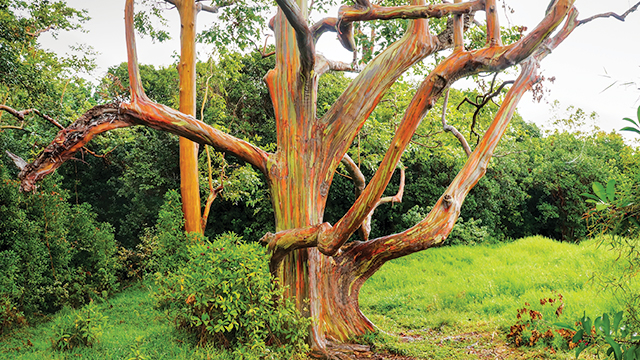
Eucalyptus deglupta is usually the main tree people mean when they search for eucalyptus Papua. It is the most visually recognizable eucalypt connected with New Guinea because its trunk can show bands of green, blue-grey, orange, red, purple, and brown. Plants of the World Online treats Eucalyptus deglupta as an accepted species native from the Philippines to Papuasia, including New Guinea and the Bismarck Archipelago, and describes it as a tree of the wet tropical biome.
This range needs careful wording. A rainbow eucalyptus photograph may come from New Guinea, but it may also come from the Philippines, Sulawesi, Maluku, New Britain, Hawaii, Singapore, a botanical garden, or another tropical planting site. POWO lists the species as introduced in several places outside its native range, including Hawaii and parts of Central America and the Caribbean.
Common and Local Names
Common names for Eucalyptus deglupta include rainbow eucalyptus, rainbow gum, and Mindanao gum. In Papua New Guinea forestry sources, kamarere is also used as a trade name. PNGTreesKey, a tree identification resource connected with Papua New Guinea botanical work, lists Eucalyptus deglupta with the trade name “Kamarere.”
These names should be used with care. Mindanao gum does not mean the tree is native only to Mindanao. Kamarere should not be presented as a name used by every community in Papua or Papua New Guinea. Local names vary by language, place, and use.
Appearance and Field Characteristics
Rainbow eucalyptus is a large evergreen tree. In Papua New Guinea tree descriptions, it is described as an emergent tree or large canopy tree, sometimes reaching around 60 meters in height, with a cylindrical to slightly fluted bole and bark that may show yellow, green, pale brown, orange, or purple tones.
Mature trees can have a straight trunk, a high crown, and sometimes buttressed roots. The bark is smooth and peeling, but the flowers are not usually the first feature people notice. The small pale flowers and woody seed capsules are botanically important, while the trunk is what attracts photographers. Juvenile and adult foliage may also differ, so identification should not rely on one fallen leaf or one colorful patch of bark.
Why Rainbow Eucalyptus Bark Changes Color
The rainbow effect comes from bark shedding. The outer bark peels away in strips or patches, exposing fresh inner bark that first looks green. As that exposed surface ages, it changes through different tones. Because different parts of the trunk shed at different times, the tree can show many colors at once.
The colors are natural, but their appearance varies. Moisture, age, light direction, shade, camera settings, and photo editing can all affect how intense the bark looks. The tree does not produce rainbow-colored sap, and the colors should not be described as paint-like decoration. They are part of a natural bark-renewal process.
Are Rainbow Eucalyptus Photos Real
Rainbow eucalyptus photos can be real, but not every viral image is a reliable botanical record. The multicolored bark exists naturally. However, some online photographs are taken in cultivated landscapes, and some are edited with stronger saturation or contrast.
For educational use, the best captions should state where the tree was photographed and whether it was wild, planted, or cultivated. A rainbow eucalyptus growing in Hawaii, Singapore, or a botanical garden should not be labeled as a wild Papua tree unless the location is verified.
Natural Habitat
Unlike many familiar Australian eucalypts, Eucalyptus deglupta is strongly associated with humid tropical environments. Its natural habitat includes wet lowlands, river flats, alluvial soils, rainforest edges, and disturbed riverine forest. This makes it unusual among eucalypts because it is linked with tropical rainforest conditions rather than only dry woodland or savanna.
Natural stands may occur along waterways, where floods, sediment movement, and open light create places for young trees to establish. In these landscapes, rainbow eucalyptus should be understood as a tropical rainforest and river-flat species, not as a symbol of all eucalyptus ecology.
Rainforest Growth Strategy
Rainbow eucalyptus grows well where light is available. In favorable river environments, young trees can rise quickly, forming straight trunks and competing for space above surrounding vegetation. Seed production and wind movement help new seedlings reach open ground, although establishment still depends on suitable soil, moisture, and light.
This growth pattern helps explain why the species has attracted forestry interest in tropical regions. Still, fast growth should not be confused with universal ecological suitability. A tree that belongs naturally in one wet river-flat environment may not belong in every forest, farm, roadside, or restoration project.
Other Native Eucalyptus Species of Papua and New Guinea
Rainbow eucalyptus is the best-known Papuan eucalypt, but it is not the only one. Southern New Guinea also has woodland and savanna species that look quite different from Eucalyptus deglupta. Some belong to Eucalyptus, while others are now placed in Corymbia. This section separates native species from introduced or plantation species so natural distribution is not confused with forestry history.
Eucalyptus alba
Eucalyptus alba is often called white gum in English-language references. Plants of the World Online lists its native range as extending from the Lesser Sunda Islands to northern Australia and New Guinea.
In New Guinea discussions, this species belongs more naturally with seasonally dry tropical woodland and savanna than with the wet river-flat habitat of rainbow eucalyptus. It may have pale, smooth bark, sometimes with a lighter upper trunk and a rougher or more irregular lower section. Because common names can travel from Australia into other references, “white gum” should be treated as a general English common name, not automatically as a local Papuan name.
Eucalyptus tereticornis
Eucalyptus tereticornis is another accepted Eucalyptus species with a broad natural range. Plants of the World Online gives its native range as New Guinea to eastern and southeastern Australia and describes it as a tree of the seasonally dry tropical biome.
In the New Guinea context, it should be discussed carefully at country or regional level rather than assumed to occur everywhere in Papua. It is usually associated with open forest, woodland, seasonal landscapes, and places influenced by watercourses. Its adult leaves are often elongated, and like other eucalypts it produces woody capsules. Those capsules may help with identification, but they should be examined together with bark, buds, leaves, habitat, and location.
Eucalyptus brassiana
Eucalyptus brassiana is linked with southern Papua New Guinea and Cape York Peninsula in northern Australia. EUCLID describes it as a small to medium-sized tree from Cape York Peninsula and notes that it belongs to a red gum group distinguished by rough bark and diagnostic bud and fruit characters.
Some Papua New Guinea sources associate this species with the name karo. The name should be used cautiously because local names can vary by language and area. In the field, Eucalyptus brassiana differs from rainbow eucalyptus by having rougher bark on the lower trunk, with smoother and paler bark above. It is more closely connected with woodland, seasonally flooded flats, slopes, plains, and open forest than with humid rainforest riverbanks.
Corymbia papuana
Corymbia papuana is important because it explains much of the confusion around “Eucalyptus papuana.” Plants of the World Online treats Corymbia papuana as an accepted species native from southern New Guinea to northern Queensland, while Eucalyptus papuana is listed separately as a synonym of Corymbia papuana.
This tree is commonly known in English as ghost gum. It is not currently classified within Eucalyptus, although older references may still call it Eucalyptus papuana. Its smooth pale or whitish bark makes it visually different from the multicolored trunk of Eucalyptus deglupta. It is associated with grassy woodland, flats, drainage lines, and some rocky or open terrain.
Corymbia novoguinensis
Corymbia novoguinensis is another related species that helps show the diversity of New Guinea eucalypt relatives. Plants of the World Online lists its native range as southern New Guinea to northern Queensland.
Because it belongs to Corymbia, it should not be described as a current Eucalyptus species. Older literature may place related bloodwoods under Eucalyptus, but modern writing should use the accepted genus unless discussing historical names. Its inclusion is useful for readers who want to understand why southern New Guinea shares some botanical links with northern Australia.
Introduced Eucalyptus Species
Not every eucalyptus tree seen in Papua New Guinea is native. Some species have been planted or tested for forestry. A FAO forestry paper on eucalypts in Papua New Guinea notes that several exotic Eucalyptus species were screened for reforestation and afforestation in places such as East Sepik, Open Bay, Western Highlands, and Bulolo. It also identifies Eucalyptus robusta and Eucalyptus grandis as successful species in swampy areas of the PNG Highlands, especially around the Waghi swamps.
These plantation records should be kept separate from natural distribution. Plants of the World Online lists Eucalyptus robusta as native to southeastern Queensland and eastern New South Wales, and Eucalyptus grandis as native to eastern Australia. Their presence in Papua New Guinea forestry contexts does not automatically make them native Papuan trees.
Comparison of Important Papua Eucalypts
The table below gives a simplified comparison of important eucalypts and related trees connected with Papua, Papua New Guinea, and the wider New Guinea region. It is meant as a general guide, not a replacement for a botanical key, herbarium record, or field identification by a qualified botanist.
| Scientific name | Current genus | Common or local name | Native status | Geographic scope | Main habitat | Bark type | Distinctive feature |
| Eucalyptus deglupta | Eucalyptus | Rainbow eucalyptus, rainbow gum, kamarere | Native | Wider Malesian and Papuasian region, including New Guinea and the Bismarck Archipelago | Wet tropical rainforest, river flats, alluvial soils, disturbed riverine forest | Smooth, peeling, multicolored bark | Famous for green, orange, red, purple, and brown bark patches that appear as older bark sheds |
| Eucalyptus alba | Eucalyptus | White gum in some English references | Native | New Guinea and northern Australia, with records also in nearby island regions | Seasonally dry woodland, open forest, and savanna | Often pale or light-colored smooth bark, sometimes rougher near the base | Represents dry tropical woodland eucalypts rather than rainforest eucalypts |
| Eucalyptus tereticornis | Eucalyptus | Common names vary by region | Native | New Guinea to eastern and southeastern Australia | Open forest, woodland, seasonal environments, and areas near watercourses | Variable, often with smooth upper bark and rougher lower sections depending on form and site | Elongated adult leaves and typical woody eucalyptus capsules |
| Eucalyptus brassiana | Eucalyptus | Karo in some Papua New Guinea sources | Native | Southern Papua New Guinea and Cape York Peninsula | Woodland, flooded flats, slopes, plains, and seasonally dry open forest | Rougher lower bark with smoother, paler upper bark | Shows the ecological link between southern New Guinea and northern Australia |
| Corymbia papuana | Corymbia | Ghost gum; formerly Eucalyptus papuana | Native | Southern New Guinea and northern Australia | Grassy woodland, flats, drainage lines, and some open rocky terrain | Smooth white, cream, or pale bark | Important example of a tree once placed in Eucalyptus but now classified in Corymbia |
| Corymbia novoguinensis | Corymbia | New Guinea bloodwood relationship; older references may use Eucalyptus placement | Native | Southern New Guinea and northern Queensland | Southern New Guinea woodland and related seasonal habitats | Variable by age and site | Helps show the diversity of New Guinea bloodwoods and related eucalypt lineages |
| Eucalyptus robusta | Eucalyptus | Swamp mahogany in Australian references | Introduced or planted in Papua New Guinea forestry contexts | Native to eastern Australia; planted or tested elsewhere | Plantation sites, swampy areas, and forestry trial landscapes | Rough, fibrous bark | Should be discussed as a plantation or introduced forestry tree, not a naturally native Papuan eucalyptus |
| Eucalyptus grandis | Eucalyptus | Flooded gum or rose gum in some references | Introduced or planted in Papua New Guinea forestry contexts | Native to eastern Australia; planted or tested elsewhere | Plantation sites and forestry trial landscapes | Mostly smooth bark with rough bark near the base in many forms | Fast-growing plantation tree, but plantation presence is not the same as native distribution |
A few cautions make this table easier to use correctly. First, “New Guinea” is an island-wide botanical scope, while “Papua New Guinea” is a country and “Indonesian Papua” refers to the western Indonesian side of the island. A species recorded from southern New Guinea should not automatically be described as present in every part of Indonesian Papua or Papua New Guinea.
Second, Corymbia species are related to eucalyptus but are not currently classified in the genus Eucalyptus. This is why names such as ghost gum, bloodwood, and Eucalyptus papuana need careful explanation. Older names may still appear in books, nursery lists, timber records, or online articles, but current botanical writing should identify the accepted genus.
Third, bark is useful, but it is not enough by itself. Rainbow bark strongly suggests Eucalyptus deglupta, and pale ghost-gum bark may suggest Corymbia papuana, but confident identification should also compare leaves, buds, flowers, fruit capsules, habitat, and location.
Where Eucalyptus Grows in Papua
Eucalyptus distribution in Papua and New Guinea is not uniform. Some trees grow naturally in wet river-flat rainforest landscapes, while others are linked with open savanna, grassy woodland, seasonal floodplains, or planted forestry sites. For this reason, it is better to think in ecological zones rather than imagine one single “Papua eucalyptus habitat.”
Wet Rainforest and River Flats
The main example in wet tropical environments is Eucalyptus deglupta. This species is associated with humid lowlands, river flats, alluvial soils, and disturbed riverine forest. In New Guinea and nearby island regions, it can grow where river movement, flooding, sediment deposits, and open light create space for seedlings.
This habitat is very different from the dry eucalyptus woodland often associated with Australia. Around river flats, the surrounding landscape may include dense rainforest, forest edge, village land, gardens, and naturally disturbed riverbanks. The tree’s fast vertical growth helps it compete in bright openings, but young trees still need suitable moisture, soil, and light conditions.
Southern Savanna and Woodland
Southern New Guinea contains landscapes that are much more open and seasonal than the popular image of dense rainforest. Here, eucalypts and related Corymbia trees can grow in savanna, open woodland, grassy woodland, seasonally flooded flats, drainage lines, and slopes.
Important examples include Eucalyptus alba, Eucalyptus tereticornis, Eucalyptus brassiana, Corymbia papuana, and Corymbia novoguinensis. These trees are generally more connected with seasonal rainfall, dry periods, open tree spacing, grassy understory, and fire-influenced landscapes than with the wet rainforest habitat of rainbow eucalyptus.
Southern New Guinea also has a biogeographic relationship with northern Australia. Some plant lineages occur on both sides of the Torres Strait or show close ecological similarities across the region. This does not make New Guinea the same as Australia, but it helps explain why some southern New Guinea eucalypts look and behave more like northern Australian woodland trees than like tropical rainforest trees.
Coastal and Lowland Landscapes
In coastal and lowland areas, a eucalyptus or eucalypt-like tree may be found near rivers, plains, village landscapes, roadsides, forest edges, managed forests, or plantations. The setting can give useful clues, but location alone is not enough for identification.
A roadside tree may be native, planted, or naturalized. A tree near a village may have been retained from natural vegetation, planted for shade, or introduced through forestry or landscaping. A tree on a river flat may belong to a natural population, but it still needs identification through leaves, buds, flowers, fruit capsules, bark, and local records.
This is especially important for photographs. A colorful trunk does not prove the photo was taken in Papua, and a tree growing in Papua New Guinea does not automatically prove that the species is native to that exact site.
Highland Plantations
Some eucalyptus trees in Papua New Guinea highlands are part of forestry history rather than natural distribution. Exotic species have been tested or planted in certain highland and swampy areas for timber, pulpwood, fuelwood, reforestation, or afforestation purposes.
These trees should be discussed separately from native eucalypts. A planted Eucalyptus grandis or Eucalyptus robusta in a highland plantation does not mean the species naturally belongs to that highland ecosystem. Plantation records can show where people have planted eucalyptus, while native botanical records show where species occur naturally.
Keeping this distinction clear helps avoid one of the most common mistakes in writing about Papua trees: mixing natural flora with forestry introductions.
Recommended Distribution Map
A simple educational map of eucalyptus in Papua and New Guinea should show broad ecological zones rather than exact locations of sensitive natural stands. The map should mark the international boundary between Indonesian Papua and Papua New Guinea and clearly label both sides of New Guinea.
A simplified map could show three zones:
| Simplified zone | Main species examples | Notes |
| Wet tropical zone | Eucalyptus deglupta | River flats, wet lowlands, rainforest edges, and humid alluvial environments |
| Southern savanna and woodland zone | Eucalyptus alba, Eucalyptus tereticornis, Eucalyptus brassiana, Corymbia papuana, Corymbia novoguinensis | Open woodland, grassy savanna, seasonal floodplains, drainage lines, and slopes |
| Introduced plantation locations | Selected forestry trial species such as Eucalyptus robusta and Eucalyptus grandis | Plantation or trial records should be separated from natural species ranges |
The map should state that ranges are simplified. It should avoid precise coordinates for vulnerable populations and should not turn island-wide records into country-specific claims without supporting evidence.
How to Identify a Papua Eucalyptus
Identifying a Papua eucalyptus is not as simple as looking for colorful bark. Bark can be a strong clue, but eucalypt identification usually works best when several features are recorded together: bark, leaves, buds, flowers, fruit, habitat, and location. In Papua and New Guinea, this is especially important because native Eucalyptus, related Corymbia, introduced plantation species, and similar Myrtaceae trees may occur in the same broad region.
Start with Bark
Bark is the first feature many people notice. It can be smooth, rough, peeling, persistent, patchy, ribbon-like, flaky, fissured, or tessellated. It may appear white, grey, green, orange, brown, red, or multicolored depending on the species, tree age, moisture, and light.
For example, multicolored peeling bark is a key visual clue for Eucalyptus deglupta. Smooth pale or whitish bark may suggest Corymbia papuana. Rough lower bark with a smoother upper trunk may point toward species such as Eucalyptus brassiana or other woodland eucalypts.
Still, bark alone should not be treated as final identification. Young trees may look different from mature trees. Wet bark can appear darker or brighter. Photographs may alter color. Some species have variable bark across their range. A reliable identification needs more evidence.
Compare Juvenile and Adult Leaves
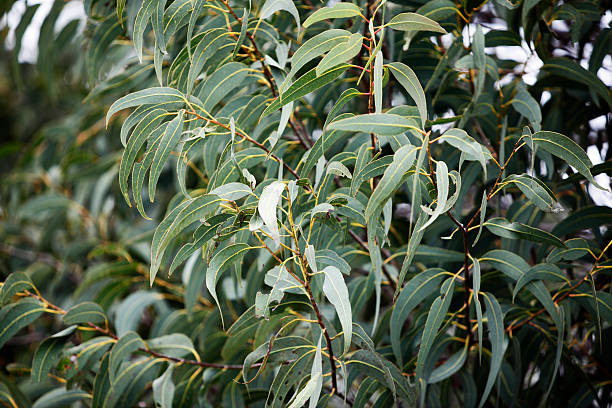
Many eucalypts change leaf shape as they grow. This change is called heterophylly, which simply means that one plant can produce different leaf forms at different life stages. Juvenile leaves may be broader, rounder, or arranged opposite each other on the stem. Adult leaves are often alternate, narrower, more lance-shaped, and held differently in the crown.
This matters because a young shoot near the base of a tree may not match leaves from the upper canopy. Fallen adult leaves may not show the juvenile form. A branch from a young sapling may look different from a branch on a mature tree of the same species.
When recording leaves, note their arrangement, shape, length, width, tip, base, surface color, petiole, and whether both sides look similar. Leaf details should then be compared with buds, flowers, fruit, bark, and habitat.
Examine Flower Buds and the Operculum
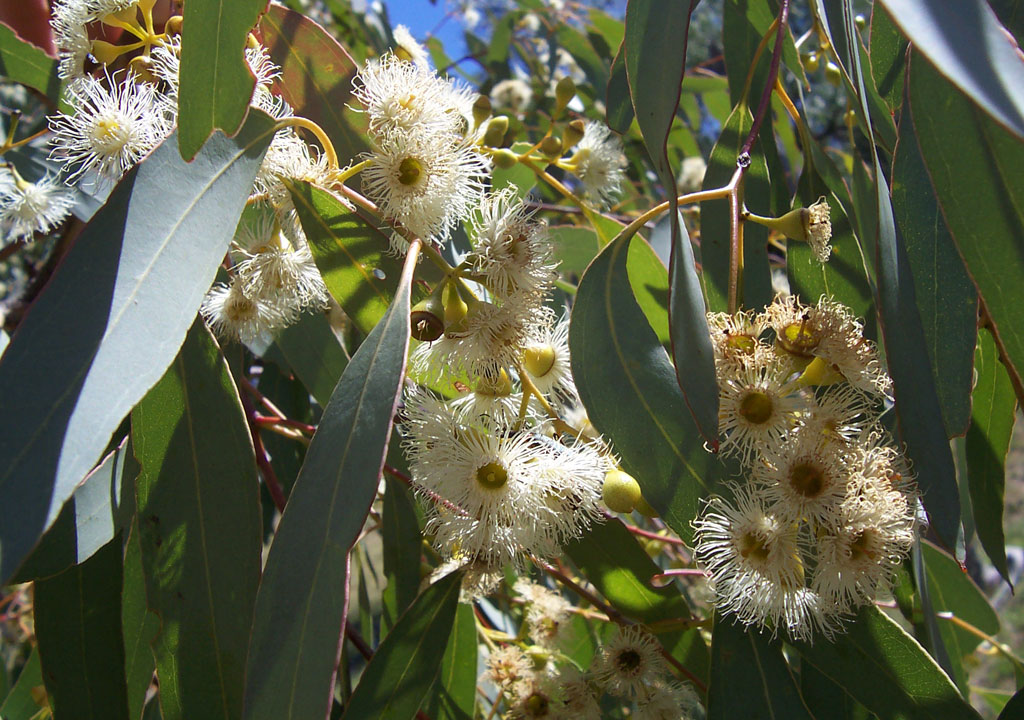
Eucalypt flowers develop from buds with a cap-like structure called an operculum. The operculum covers the developing flower and falls away when the flower opens. After it falls, the many stamens become the visible part of the flower.
Bud features are important for identification. The number of buds in a cluster, how the buds are arranged, and the shape of the operculum can all help separate species. Some buds may be narrow, rounded, beaked, ribbed, or differently shaped depending on the species.
Flower color alone is rarely enough. Many eucalypt flowers are pale, cream, or white, and several species can look similar when flowering. A good record should include the bud cluster before flowering, the open flower if available, and the fruit capsule after flowering.
Examine the Fruit
The fruit of a eucalyptus or related eucalypt is a woody capsule, often informally called a gumnut. Capsule shape can be cup-shaped, barrel-shaped, urn-shaped, hemispherical, or otherwise distinctive. The rim, disc, and valves are also useful. Valves may be enclosed below the rim, level with the rim, or protruding.
Fruit capsules are especially helpful because they often remain on the tree or fall beneath it after flowering. When photographing or collecting observational notes, include the capsule from several angles and place it near a scale reference, such as a ruler, coin, or hand for size context.
Fruit should be linked to the tree being identified. A capsule found on the ground may come from a nearby tree, but in mixed woodland or planted areas, it is safer to photograph attached fruit when possible.
Record Habitat and Location
Habitat and location can prevent many identification mistakes. A suspected Eucalyptus deglupta in wet river-flat forest fits a different ecological pattern from a pale-barked Corymbia in southern grassy woodland. A planted roadside tree may follow a different story again.
Useful field notes include the country, province, general locality, elevation, landform, and habitat type. Record whether the tree grows in rainforest, woodland, savanna, river flat, slope, plain, swamp margin, plantation, roadside, village landscape, or managed forest. Also note whether there are signs of planting, such as rows, uniform spacing, nursery origin, or association with a known forestry project.
For sensitive or uncommon natural populations, avoid publishing exact coordinates. A general locality and habitat description can be enough for educational discussion while still respecting conservation concerns and local land management.
Recommended Identification Photographs
A complete identification photo set is more useful than one dramatic trunk image. For a Papua eucalyptus or related eucalypt, photograph the entire tree, the base of the trunk, the middle trunk, upper bark, crown shape, juvenile leaves, adult leaves, both leaf surfaces, bud clusters, open flowers, fruit capsules, fallen bark, and the surrounding habitat.
A scale reference is also helpful. Close-up images should show size and shape clearly, while wider images should show the tree’s setting. When sharing images publicly, captions should state the general location and whether the tree is wild, planted, cultivated, or uncertain.
Good photographs do not guarantee identification, but they make careful identification possible. They also help avoid common errors, such as calling every colorful tree rainbow eucalyptus or treating every pale-barked tree as the same ghost gum.
Ecology of Papua Eucalypts
Papua eucalypts are not tied to one single ecological story. Some grow in wet tropical forest margins and river flats, while others belong to seasonal savanna and woodland systems. Understanding the ecology of these trees means looking at species, habitat, rainfall, soil, disturbance, and surrounding vegetation together.
Flowering and Pollination
Eucalypt flowers are usually recognized by their many visible stamens. The petals are not the showiest part of the flower. Instead, the flower opens when the operculum, or bud cap, falls away and exposes the stamens.
These flowers may attract insects, birds, and other nectar visitors, although the exact pollination pattern can vary by species and location. It is better to speak generally unless a particular species and place have been studied. A flowering observation from Australia, for example, should not automatically be applied to a tree in Papua New Guinea or Indonesian Papua.
Flowering time can also differ by climate, elevation, season, and local conditions. For field identification, flowers are useful, but they should be recorded alongside buds, fruit, leaves, bark, and habitat.
Seed and Regeneration
Eucalypt seeds develop inside woody capsules. As the capsules mature or dry, they open and release small seeds. These seeds are usually moved by gravity and wind, although the distance can vary with tree height, wind conditions, and the surrounding vegetation.
Regeneration often depends on open space and light. Bare soil, exposed sediment, disturbed ground, and gaps in vegetation can give seedlings a better chance to establish. The source of disturbance may differ by habitat. In river-flat environments, flooding and sediment movement can create new surfaces. In woodland and savanna, seasonal fire, windthrow, animal movement, or human land use may influence open patches.
This does not mean all disturbance is beneficial. Clearing, repeated burning, road construction, or soil disruption can also damage seedlings, fragment populations, or change the conditions that native trees need.
Fire Ecology Is Not the Same for Every Species
It is common to hear that eucalyptus trees are fire-adapted, but this statement is too broad for Papua and New Guinea. Some savanna and woodland eucalypts experience seasonal fire as part of their landscape. Certain species may resprout after damage through protected buds, stem shoots, or underground structures. In those landscapes, fire history can influence tree spacing, grass cover, seedling survival, and woodland structure.
However, Eucalyptus deglupta should not be described as a typical fire-adapted dryland eucalyptus. Its natural story is more closely linked with humid tropical rainforest, river flats, alluvial soils, and open light after river disturbance. The ecological pressures around a wet riverbank tree are different from those around a savanna woodland tree.
For this reason, fire response should be discussed species by species and landscape by landscape. Too-frequent fire may prevent young trees from reaching maturity in some places, while long fire exclusion can also change the balance of grasses, shrubs, and trees in certain woodland systems. Technical land management should be guided by local ecological authorities and customary landowners, not by general rules copied from another region.
River Disturbance and Rainbow Eucalyptus
Rainbow eucalyptus is closely associated with riverine and wet lowland environments. Flooding can open the canopy, move sediment, expose mineral soil, and create bright patches where seedlings can grow. In favorable conditions, young Eucalyptus deglupta trees can grow upward quickly and compete strongly for light.
River flats are also attractive places for people. They may be used for gardens, settlement, access routes, agriculture, or managed tree planting. This overlap can create pressure on natural stands, especially where mature trees are removed or riverbank vegetation is simplified.
The same river disturbance that helps create habitat can also make the landscape dynamic. A stand may change as channels shift, floods deposit new sediment, or surrounding forest closes over time. This is one reason why natural rainbow eucalyptus populations should not be confused with rows of planted trees.
Ecological Relationship with New Guinea and Australia
The New Guinea region contains more than one botanical influence. Wet tropical forests connect it with the broader Malesian rainforest world, while the southern lowlands share ecological and plant-lineage connections with northern Australia. Eucalypts help illustrate this contrast.
Eucalyptus deglupta represents the wet tropical side of the story. It is a rainforest and river-flat eucalypt, unusual when compared with many dry woodland species familiar from Australia. Species such as Eucalyptus alba, Eucalyptus brassiana, Eucalyptus tereticornis, Corymbia papuana, and Corymbia novoguinensis represent a different pattern, one linked with open woodland, grassy savanna, seasonal flooding, and dry periods.
This variety is part of what makes Papua and New Guinea botanically rich. The region should not be reduced to one image of dense rainforest, nor should every eucalyptus be treated as an Australian dryland tree. Papua eucalypts sit across a range of habitats, from wet tropical river systems to open seasonal landscapes.
Human Uses of Eucalyptus in Papua
Human use of eucalyptus in Papua and New Guinea is best discussed through forestry, timber, shade, ornament, local naming, and land history. This section stays focused on trees and landscapes rather than medicinal or essential-oil claims, because the main topic is botanical and ecological.
Timber and Kamarere
Kamarere is a name commonly associated with Eucalyptus deglupta, especially in Papua New Guinea forestry and timber contexts. The tree’s straight trunk, large size, and fast growth have made it attractive as a tropical hardwood in some places.
Timber use should be separated from natural history. A tree may be native to part of New Guinea, used in forestry, and also planted outside its natural range. These facts are connected, but they are not the same. Natural stands, planted stands, managed forests, and timber records each need their own context.
It is also helpful to avoid overgeneralizing local names. Kamarere may appear in forestry sources, trade discussions, or local use in some areas, but it should not be presented as a universal name across all Papuan communities. New Guinea has many languages and local naming systems, and one tree species may have several names.
Pulpwood and Plantation Forestry
Eucalyptus deglupta has also attracted attention as a pulpwood and plantation tree in tropical regions. Its fast growth, straight form, and ability to grow in humid climates have made it useful in selected forestry programs.
Other Eucalyptus species, including introduced Australian species, have been tested or planted in parts of Papua New Guinea. These plantings may have been connected with timber, pulpwood, fuelwood, reforestation, shade, or experimental forestry trials. A planted tree in a highland or swampy area should not automatically be counted as a native species record.
Plantation forestry differs from natural forest management. A plantation may focus on wood production, while a natural forest contains many species, habitat layers, soil relationships, wildlife interactions, and local land-use histories. Fast tree growth does not automatically mean a species is suitable for every landscape. Seed source, climate, soil, water, local biodiversity, and land ownership all matter.
Reforestation and Afforestation
Reforestation and afforestation are often used together, but they mean different things. Reforestation means restoring tree cover to land that was previously forested. Afforestation means establishing tree cover where forest was absent or limited.
Eucalyptus may appear in both kinds of projects, but it should not be treated as a universal answer for restoration. A single-species plantation is not the same as restoring native forest diversity. In some places, tree planting may support timber production or soil cover, while in others the better goal may be to protect or regenerate mixed native forest.
For Papua and New Guinea, the difference is important. A wet river-flat landscape, a southern savanna woodland, a highland plantation site, and a coastal village landscape do not have the same ecological needs. Local context should guide species choice.
Ornamental Use
Rainbow eucalyptus is often planted as an ornamental tree because of its colorful bark. Many widely shared photographs of rainbow eucalyptus come from cultivated trees outside Papua, such as botanical gardens, parks, resorts, and tropical roadside plantings.
The tree can become very large, so ornamental interest should not be confused with a simple garden recommendation. A species that looks striking in a photograph may need space, climate suitability, and ecological assessment before planting. In educational captions, a cultivated specimen should be labeled as cultivated, especially when it grows outside the species’ native range.
Local Names and Cultural Context
Local and trade names can help connect botanical writing with real places, but they must be handled respectfully. Kamarere is associated with Eucalyptus deglupta in Papua New Guinea forestry contexts. Karo is associated with Eucalyptus brassiana in some Papua New Guinea sources. These names should be presented as place-linked names, not as universal Papuan terms.
One local name can sometimes refer to more than one tree, and one species can have different names across language groups. Community knowledge should be credited to the relevant place and people when known. It is better to say “in some Papua New Guinea forestry sources” than to make broad claims about all Papuan communities.
This caution also protects accuracy. Without a specific source, it is not appropriate to invent traditional uses, describe ceremonies, or generalize one community’s knowledge across the whole island. Papua and New Guinea are culturally diverse, and plant knowledge belongs within that diversity.
Conservation Issues
Conservation of eucalyptus and related eucalypts in Papua and New Guinea is not only about individual trees. It also involves habitat, seed sources, customary land, river systems, savanna management, and the difference between natural stands and planted forests. Because these trees grow across very different landscapes, conservation questions should be discussed by species and habitat rather than through one general rule.
Loss of River Flat Habitat
River flats are important for Eucalyptus deglupta. These wet, open, alluvial environments can support natural regeneration when flooding creates bare soil and bright growing spaces. At the same time, river flats are often useful for people. They may be close to settlements, gardens, access routes, fertile soil, and river transport.
When natural river-flat forest is cleared or heavily simplified, rainbow eucalyptus populations may become more fragmented. Mature trees can be separated from younger regeneration areas, and changes in water flow or sediment movement may affect where seedlings can establish.
A natural stand should not be confused with a plantation. A row of planted rainbow eucalyptus trees may preserve the appearance of the species, but it does not automatically preserve the same genetic diversity, river ecology, or mixed native forest relationships found in wild populations.
Logging and Timber Extraction
Large, straight eucalyptus trees can be commercially attractive. This is especially relevant for Eucalyptus deglupta, which has a history as a tropical timber tree under the trade name kamarere. Selective removal of mature trees may reduce local seed sources, especially if the largest and healthiest trees are repeatedly taken.
Logging can also change more than tree numbers. Roads, skid trails, soil disturbance, and altered drainage may affect regeneration. In some landscapes, roads can also increase access for further clearing or change how fire moves through an area.
Historical timber information should always be dated and placed in context. It is not careful to make broad claims about current logging levels without current evidence. For a general educational article, the safer point is that timber extraction can affect native stands when it removes mature seed trees or changes the habitat structure around them.
Savanna Conversion
Southern New Guinea savannas and woodlands should not be described as empty, unused, or degraded land. They contain specialized grasses, trees, shrubs, seasonal wetlands, and wildlife relationships. Eucalypts such as Eucalyptus alba, Eucalyptus brassiana, Eucalyptus tereticornis, Corymbia papuana, and Corymbia novoguinensis belong to these open seasonal landscapes.
Conversion to agriculture, infrastructure, roads, settlements, or poorly planned plantations can change native woodland structure. It may reduce old trees, interrupt regeneration, compact soil, or simplify the grassy understory. Because savanna trees often depend on landscape-level processes, conservation has to consider both trees and the open habitat around them.
Open land should not automatically be treated as available land for planting. Some open landscapes are natural ecosystems with their own conservation value.
Fire Regime Change
Fire is part of many savanna and woodland landscapes, but its effects are not the same everywhere. Too-frequent fire may prevent young trees from growing tall enough to survive future burns. On the other hand, long fire exclusion can change grass cover, shrub density, and woodland structure in certain settings.
The response depends on species, age, soil, rainfall, season, and land-use history. A savanna eucalypt should not be managed with assumptions copied from wet rainforest, and Eucalyptus deglupta should not be described as if it were a typical dry woodland fire species.
This article does not provide burning instructions. Technical land management should involve local ecological authorities, customary landowners, and people with direct knowledge of the landscape.
Protecting Genetic Diversity
Genetic diversity is an important but often overlooked part of tree conservation. Populations from different rivers, plains, provinces, or islands may carry different traits. In forestry, the origin of seed is often called provenance. A seed source from one place may grow differently from a seed source from another place, even within the same species.
For conservation, this means that saving one planted stand is not the same as protecting the full native gene pool. Natural populations across several locations may hold more diversity than a single plantation. Locally adapted seed sources may also respond differently to soil, rainfall, flooding, drought, pests, or competition.
Careful seed collection, nursery work, and restoration planning should respect provenance. Moving seed casually across regions may blur local genetic patterns or create trees that are poorly matched to the site.
Community and Customary Land
Much of New Guinea is connected to customary land management. Local landowners and communities are central to long-term forest and savanna conservation. Botanical research, seed collection, photography, and conservation planning should involve local permission and respectful collaboration.
Local names and plant knowledge should be credited carefully when the source community is known. Sensitive locations, especially for uncommon natural stands, should not be publicized without consent. Conservation is stronger when it recognizes both botanical knowledge and the people who live with these landscapes.
In this context, protecting Papua eucalypts is not only a scientific task. It is also a matter of land relationships, local authority, careful documentation, and respect for the difference between public information and place-based knowledge.
Common Misconceptions About Eucalyptus Papua
All Eucalyptus Trees Come from Australia
Most Eucalyptus species are associated with Australia, but it is not accurate to say that all eucalyptus trees come from Australia. Several eucalypts and related trees occur naturally in New Guinea and nearby parts of Malesia. The best-known example is Eucalyptus deglupta, the rainbow eucalyptus, which is naturally connected with wet tropical regions rather than only dry Australian woodland.
This matters because Papua and New Guinea are not botanical blank spaces beside Australia. They have their own native trees, local names, habitats, and forest histories.
Eucalyptus Papua Is a Species Name
“Eucalyptus Papua” is not an accepted binomial species name. It is a search phrase. People may use it when looking for rainbow eucalyptus, native eucalypts of New Guinea, or older names such as Eucalyptus papuana.
A formal botanical name should include a genus and species, such as Eucalyptus deglupta or Corymbia papuana. Without that structure, the phrase should be treated as a broad topic rather than a confirmed species.
Eucalyptus papuana Is the Current Name
Eucalyptus papuana is an older name, not the current accepted name in modern botanical treatment. The species is generally treated as Corymbia papuana. This change reflects a broader taxonomic separation between Eucalyptus and Corymbia.
The older name still matters because it may appear in historical books, timber records, nursery catalogues, herbarium notes, or older websites. However, current writing should explain the synonym and then use Corymbia papuana.
Every Papua Eucalyptus Has Rainbow Bark
Rainbow bark is a feature of Eucalyptus deglupta, not of every eucalyptus or eucalypt in Papua and New Guinea. Other native species may have pale bark, white bark, grey bark, rough bark, brown bark, or fissured bark.
For example, Corymbia papuana is known for smooth pale bark, while Eucalyptus brassiana may show rougher bark on the lower trunk and smoother bark above. These trees can be just as important botanically even though they do not have the viral multicolored trunk of rainbow eucalyptus.
Every Eucalyptus Grows in Dry Savanna
Many familiar eucalypts grow in dry woodland or savanna, but this is not true for every species. Eucalyptus deglupta is strongly associated with wet tropical lowlands, river flats, alluvial soils, and rainforest edges.
Papua and New Guinea include both wet rainforest environments and seasonal southern savannas. A good article should not use one habitat to describe all eucalypts in the region.
Every Tree Called Eucalyptus Produces the Same Oil
The word eucalyptus is often used loosely in everyday language, but different species can have different chemical profiles, uses, and commercial histories. A tree called eucalyptus in one setting may not be the same species used in another product or region.
For this article, the important point is botanical accuracy: identify the source species before making assumptions about any product. This guide does not discuss therapeutic uses, preparation methods, or health claims.
Minyak Kayu Putih and Eucalyptus Are Always the Same
Minyak kayu putih is commonly associated with Melaleuca or related Myrtaceae plants, not automatically with Eucalyptus deglupta or other Papuan eucalyptus species. Because Eucalyptus, Melaleuca, Corymbia, and other Myrtaceae plants can all be discussed under broad local or commercial terms, names should not be used interchangeably without checking the source plant.
This distinction is especially important in Indonesia, where “kayu putih” has its own naming and product history. It should not be casually translated as rainbow eucalyptus.
Every Rainbow Eucalyptus Photograph Was Taken in Papua
Many rainbow eucalyptus photographs online were taken outside Papua or New Guinea. Some come from Hawaii, botanical gardens, parks, roadsides, resorts, or cultivated tropical landscapes. The bark may be real, but the location may not be.
A careful caption should state where the photograph was taken and whether the tree is wild, planted, cultivated, or uncertain. A cultivated tree outside its native range can still be beautiful and educational, but it should not be presented as a wild Papuan tree.
Eucalyptus Papua Versus Eucalyptus in Papua New Guinea
The phrase “Eucalyptus Papua” can be useful for search, but it is not precise enough for botanical writing. Papua, Papua New Guinea, Indonesian Papua, and New Guinea each point to a different geographical scope. When describing plant distribution, these differences matter.
| Term | Best meaning | How to use it carefully |
| Eucalyptus Papua | Broad search phrase | Use when introducing the topic generally. Explain that it may refer to rainbow eucalyptus, native New Guinea eucalypts, or older names such as Eucalyptus papuana. |
| Eucalyptus in Indonesian Papua | Eucalypts recorded from the western Indonesian side of New Guinea | Use Indonesian location labels when discussing records from this side of the island. Do not transfer Papua New Guinea records into Indonesian Papua without evidence. |
| Eucalyptus in Papua New Guinea | Eucalypts recorded from the independent country on the eastern side of New Guinea | Separate native species from introduced plantation species. A planted species in Papua New Guinea is not automatically native there. |
| Eucalyptus of New Guinea | Island-wide botanical scope | Use when discussing species with records from the wider island, including both political regions where evidence supports that scope. |
A useful editorial rule is simple: never turn an island-wide record into a country-specific record without evidence. A species described as native to New Guinea may occur somewhere on the island, but that does not prove it occurs in every province, district, or habitat. A species recorded from southern New Guinea should not automatically be described as present in northern rainforest, highland valleys, coastal plantations, or all of Indonesian Papua.
The same caution applies in the other direction. A species planted in Papua New Guinea does not automatically belong to the native flora of New Guinea. Forestry records, ornamental plantings, trial plantations, and natural populations should be discussed separately.
This is why good writing about Papua eucalypts should always connect three details: the scientific name, the geographic scope, and the habitat. For example, Eucalyptus deglupta can be discussed as a wet tropical species native to the wider Papuasian and Malesian region, including New Guinea. Corymbia papuana can be discussed as a related eucalypt native to southern New Guinea and northern Australia. Introduced species such as Eucalyptus robusta and Eucalyptus grandis should be labeled as planted or trialed in Papua New Guinea forestry contexts when the discussion is about human planting rather than native range.
Frequently Asked Questions About Eucalyptus Papua
What is eucalyptus Papua?
Eucalyptus Papua is a general phrase that refers to eucalyptus and related eucalypt trees found in Papua or the wider New Guinea region. It is not a formal scientific species name. Most often, people use the phrase when searching for rainbow eucalyptus, Eucalyptus deglupta, or for information about native eucalypts in New Guinea.
Is eucalyptus native to Papua?
Yes, several Eucalyptus and related Corymbia species occur naturally in the New Guinea region, although their distributions and habitats differ. Some are linked with wet tropical river-flat environments, while others grow in southern savanna, woodland, seasonally flooded flats, or open forest.
What is the colorful eucalyptus tree in Papua?
The colorful tree is usually Eucalyptus deglupta, commonly called rainbow eucalyptus or rainbow gum. It is the species most famous for smooth bark that peels in patches and reveals green, orange, red, purple, brown, and blue-grey tones.
Why does rainbow eucalyptus have colorful bark?
Rainbow eucalyptus has colorful bark because its outer bark sheds at different times. Newly exposed bark first appears green, then changes color as the surface matures. Since different patches of bark are exposed at different stages, the trunk can show several colors at once.
Are rainbow eucalyptus photographs real?
Yes, the multicolored bark is real. However, some online images use increased saturation or contrast, and many photographs come from cultivated trees outside Papua or New Guinea. A good caption should state the location and whether the tree is wild, planted, or cultivated.
What is kamarere?
Kamarere is a local or trade name commonly associated with Eucalyptus deglupta, especially in Papua New Guinea forestry contexts. The name should not be treated as universal across all Papuan communities because local names vary by place and language group.
Is Eucalyptus papuana a valid name?
Eucalyptus papuana is a historical botanical name. The currently accepted name is generally Corymbia papuana. Older references may still use Eucalyptus papuana, so both names are useful when reading historical records.
What is the difference between Eucalyptus and Corymbia?
Eucalyptus and Corymbia are closely related genera within the myrtle family, Myrtaceae. Some trees now placed in Corymbia were historically included in Eucalyptus. Modern taxonomy treats them separately based on botanical features and evolutionary relationships.
Does rainbow eucalyptus grow only in Papua?
No. Rainbow eucalyptus does not grow only in Papua. Its natural range extends beyond New Guinea into parts of the wider Papuasian and Malesian region, including the Philippines and the Bismarck Archipelago. It is also cultivated in many tropical countries outside its native range.
Do all Papua eucalyptus trees grow in rainforest?
No. Eucalyptus deglupta is associated with wet tropical environments, river flats, and rainforest edges. Other eucalypts and related Corymbia species in southern New Guinea grow in woodland, savanna, open forest, seasonally dry landscapes, and flooded flats.
What other eucalyptus species grow in Papua?
Examples connected with the New Guinea region include Eucalyptus alba, Eucalyptus tereticornis, and Eucalyptus brassiana. Related Corymbia species, such as Corymbia papuana and Corymbia novoguinensis, also occur in southern New Guinea and nearby northern Australia.
Is ghost gum a eucalyptus?
Ghost gums were historically placed in Eucalyptus, but Corymbia papuana is now classified within Corymbia. Because older sources may still use the name Eucalyptus papuana, it is helpful to mention the historical name while using the current accepted genus.
Can bark color identify rainbow eucalyptus?
Bark color can be a strong clue, especially when the trunk has smooth peeling patches in green, orange, red, purple, brown, and blue-grey tones. Still, reliable identification should also examine leaves, buds, flowers, fruit capsules, habitat, and location.
Is eucalyptus oil from rainbow eucalyptus?
Not necessarily. Commercial eucalyptus products may come from several different species. The source species must be verified separately, and a product name should not be assumed to come from Eucalyptus deglupta. This guide focuses on botany, geography, ecology, and forestry rather than health or therapeutic use.
Conclusion
Eucalyptus Papua is a broad keyword, not a formal species name. It usually points to eucalyptus and related eucalypt trees connected with Papua, Papua New Guinea, or the wider island of New Guinea. The most recognizable species behind the phrase is Eucalyptus deglupta, the rainbow eucalyptus, known for its smooth peeling bark and naturally multicolored trunk.
But rainbow eucalyptus is only one part of the story. New Guinea also supports other native eucalypts and related Corymbia species, especially in southern savanna, woodland, and seasonally wet landscapes. Species such as Eucalyptus alba, Eucalyptus tereticornis, Eucalyptus brassiana, Corymbia papuana, and Corymbia novoguinensis show that Papua’s eucalypt diversity reaches beyond the famous rainbow bark.
Clear naming is important. Eucalyptus and Corymbia are related, but they are not the same genus in current botanical treatment. Eucalyptus papuana is an older name now generally treated as Corymbia papuana. Similar names such as Eucalyptopsis papuana should also be handled carefully because they refer to different plants.
Habitat is just as important as taxonomy. Some Papuan eucalypts grow in wet tropical rainforest edges, river flats, and alluvial soils. Others belong to open woodland, grassy savanna, flooded flats, slopes, or seasonal lowlands. A planted eucalyptus in a village, roadside, highland plantation, or forestry trial should not automatically be treated as a native wild tree.
For identification, bark is only the beginning. A careful record should include leaves, buds, flowers, fruit capsules, habitat, location, and whether the tree appears wild or planted. For conservation, natural forest, seed provenance, genetic diversity, river-flat habitat, savanna ecology, and customary land management all deserve attention.
Discover more remarkable plants and natural habitats from across Papua and the New Guinea region.