Introduction
Why people ask if Papua New Guineans are African
Many people search the question “are Papua New Guineans African” because of visible physical similarities such as dark skin, curly hair, and certain facial features. For someone unfamiliar with world geography, anthropology, or human migration history, these similarities can create understandable confusion.
Papua New Guineans are often compared visually to some African populations because both groups may share traits commonly associated with tropical environments. However, physical appearance alone does not determine ancestry, ethnicity, or cultural identity. Human populations across different parts of the world can sometimes develop similar features even when they are historically separate.
The question also appears frequently in discussions about genetics, indigenous peoples, and early human migration. As more people become interested in ancestry and global diversity, they naturally want to understand how different populations are connected and how they differ.
It is important to approach this topic respectfully because identity is deeply connected to history, culture, language, and community. Papua New Guinea is home to many indigenous peoples with their own traditions, beliefs, and histories that are distinct from African societies.
This article is educational in purpose. It aims to explain the differences between African and Melanesian ancestry in a simple and culturally respectful way while also exploring why some physical similarities exist between populations living far apart from one another.
Short answer
The short answer is no, Papua New Guineans are not African.
Papua New Guineans are primarily part of the Melanesian peoples of Oceania, a region that includes Papua New Guinea and several island groups in the Pacific. Their ancestry, migration history, languages, and cultural traditions developed separately from African populations over tens of thousands of years.
At the same time, all modern humans share very ancient origins in Africa. Scientists generally agree that early humans migrated out of Africa many thousands of years ago and gradually spread across Asia, Oceania, Europe, and other regions. The ancestors of Papua New Guineans were part of these ancient migration movements into the Pacific region.
Because of this long human story, there are both shared human connections and clear regional differences. Papua New Guineans have their own distinct cultural identity, genetic history, and indigenous heritage that are closely tied to Melanesia and Oceania rather than Africa.
Who Are Papua New Guineans
Papua New Guinea’s location and population
Papua New Guinea is a country located in the southwestern Pacific Ocean, north of Australia. It occupies the eastern half of the island of New Guinea along with many smaller surrounding islands. The western half of the island belongs to Indonesia and is commonly known as Papua or West Papua.
Geographically, Papua New Guinea is part of Oceania, a broad region that includes the Pacific islands, Australia, and nearby island groups. More specifically, it belongs to the cultural and geographic region called Melanesia.
The country is known for its extraordinary diversity. Mountain ranges, dense rainforests, isolated valleys, coastal villages, and island communities have shaped the lives of local populations for thousands of years. Because many communities historically lived separately from one another, Papua New Guinea developed a large number of distinct indigenous groups.
Papua New Guineans are not a single ethnic group. Instead, the population includes hundreds of indigenous communities with unique traditions, languages, and local identities. Some groups live in highland regions, while others live along rivers, coastlines, or small islands.
Although modern cities and global influences exist today, many communities still maintain traditional practices connected to family, clan systems, and ancestral lands.
What does Melanesian mean
The word “Melanesia” refers to a region in the Pacific Ocean that includes several island nations and territories. The term comes from Greek words meaning “black islands,” a historical name given by early European explorers because many local populations had darker skin tones.
Today, Melanesia is understood mainly as a geographic and cultural region rather than a racial category.
Countries and regions commonly associated with Melanesia include:
- Papua New Guinea
- Solomon Islands
- Vanuatu
- Fiji
- Parts of New Caledonia and nearby Pacific islands
Melanesian peoples share some historical and geographic connections, but they are still highly diverse. Different islands and communities have their own languages, traditions, music, spiritual beliefs, and social systems.
When people ask whether Papua New Guineans are African, the more accurate identity term is usually Melanesian or Oceanian. These terms reflect the region and historical development of the peoples of the Pacific rather than Africa.
Cultural diversity in Papua New Guinea
Papua New Guinea is often described as one of the most culturally diverse countries in the world. This diversity can be seen in its languages, tribal identities, art styles, ceremonies, and local customs.
Anthropologists estimate that more than 800 languages are spoken across the country. In some regions, neighboring villages may speak completely different languages even when they are geographically close. This linguistic diversity developed over thousands of years because mountains, forests, and rivers often separated communities from one another.
Traditional identity in Papua New Guinea is frequently connected to clan membership, ancestral territory, and local community relationships. Many groups have strong oral traditions that pass down stories, knowledge, and history through generations.
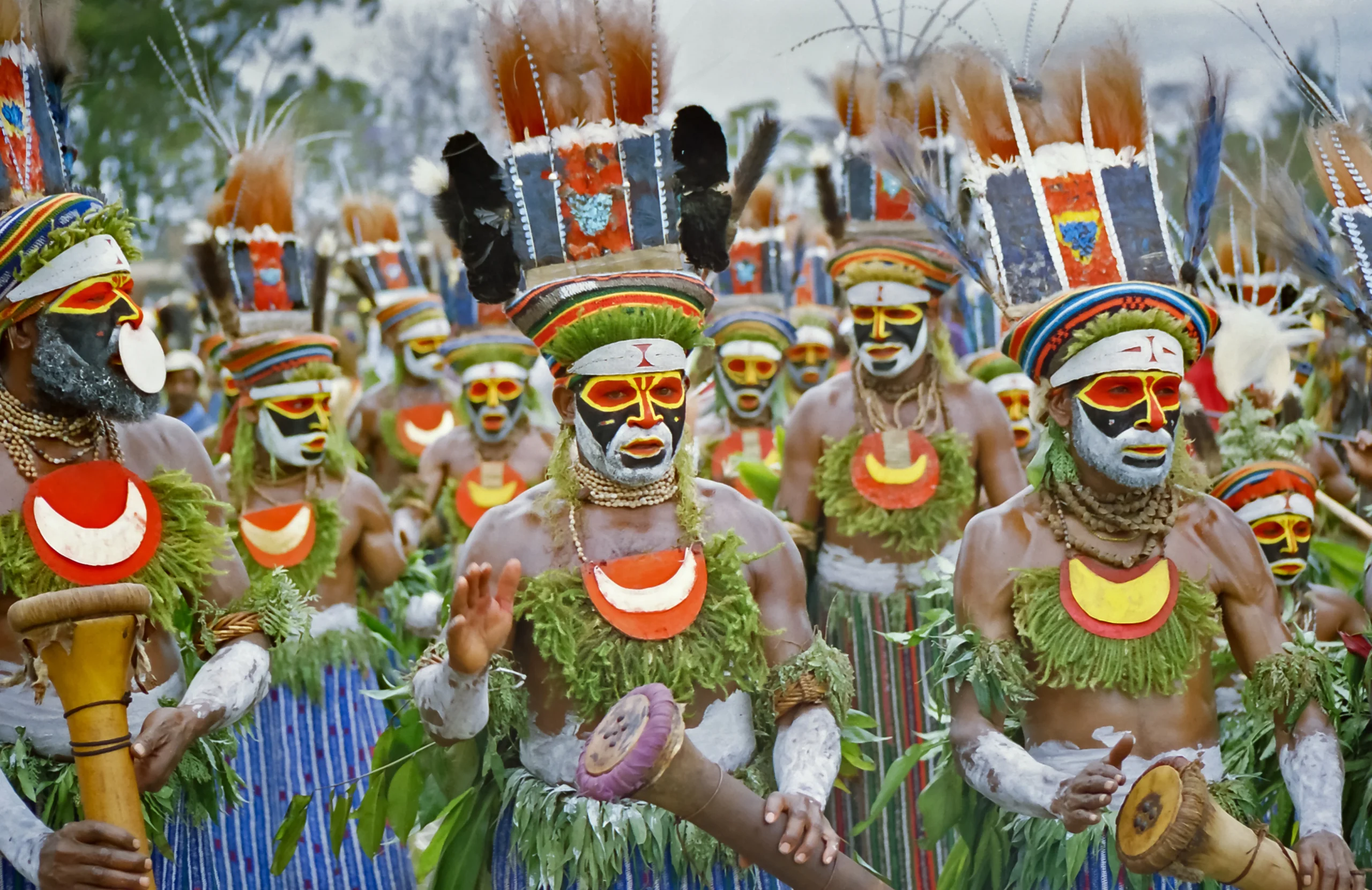
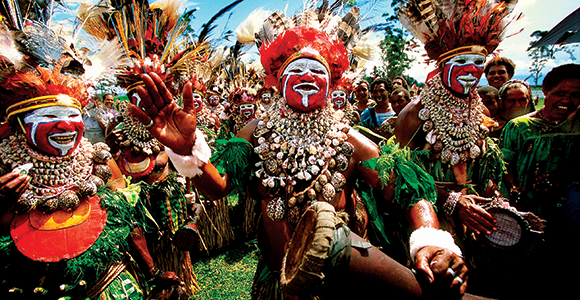
Cultural practices vary widely between regions. Some communities are known for elaborate ceremonial dress and body decoration, while others are recognized for wood carving, weaving, music, or dance traditions. Festivals often bring together different groups to celebrate heritage and cultural expression.
The famous “sing-sing” gatherings are one example of this diversity. During these events, communities wear traditional clothing, paint, and ornaments while performing dances and songs connected to local history and identity.
Even though the country is modernizing in many ways, cultural traditions remain an important part of life for many Papua New Guineans today.
Why Some Papua New Guineans Physically Resemble Africans
One of the main reasons people ask whether Papua New Guineans are African is because some physical features may appear similar at first glance. These similarities are often connected to human adaptation to similar environmental conditions rather than recent shared ethnicity.
Scientists believe that dark skin evolved in multiple human populations living in areas with strong sunlight and high ultraviolet (UV) exposure. Melanin, the pigment that gives skin its color, can help protect the body from intense UV radiation. Because tropical regions receive strong sunlight year-round, darker skin tones developed in several populations across different parts of the world.
Papua New Guinea lies close to the equator, where UV exposure is naturally high. Many African regions also experience tropical climates with strong sunlight. Over very long periods of time, populations living in these environments adapted in ways that supported survival in hot climates.
Curly or tightly textured hair is another feature sometimes discussed in anthropology. Researchers have explored how hair texture may relate to heat management, airflow around the scalp, and environmental adaptation. However, human appearance is shaped by many complex genetic factors, and no single feature defines ancestry by itself.
These shared traits do not mean Papua New Guineans are African. Instead, they show how humans living in similar climates can sometimes develop similar physical characteristics independently.
People often assume that populations who look alike must belong to the same ethnic background. Anthropology and genetics show that this is not always true.
Human groups around the world can develop similar traits even when they are geographically distant and historically separate. This process is sometimes described as convergent adaptation, meaning different populations adapt in comparable ways because they face similar environmental conditions.
A simple example can be seen in animals. Different species living in cold climates may independently develop thick fur, even if they are not closely related. In humans, environmental pressures such as sunlight, humidity, temperature, and diet can influence physical traits over many generations.
Because of this, outward appearance alone cannot accurately explain ancestry or ethnic identity.
Papua New Guineans belong primarily to indigenous Melanesian populations of Oceania. African peoples belong to many different ethnic and regional groups across the African continent. Both regions contain enormous diversity, and neither can be reduced to a single appearance or identity.
Modern anthropology generally avoids oversimplified racial categories because human populations are far more complex than older classification systems once suggested.
Expert insight: dark skin evolved in multiple human populations
Anthropologists and genetic researchers commonly explain that dark skin evolved more than once in human history. It is not exclusive to one continent or one ethnic background.
This is an important clarification because many people historically linked skin color too closely with race. Modern research shows that physical traits can emerge separately in different populations depending on geography and environmental adaptation.
For example, populations in parts of Africa, Melanesia, South Asia, and Australia may all have darker skin tones while still having distinct histories and genetic backgrounds.
In the case of Papua New Guineans, long periods of geographic isolation in Oceania helped shape a unique population history. Over thousands of years, communities in New Guinea developed separately from African populations while maintaining adaptations suited to tropical Pacific environments.
Experts today generally encourage people to think about human diversity in terms of migration, geography, culture, and ancestry rather than relying only on visible appearance. Human identity is shaped by a combination of history, language, environment, and community connections, not by a single physical trait.

The Ancient Origins of Papua New Guineans
Early human migration out of Africa
Although Papua New Guineans are not African in terms of modern ethnicity or regional identity, all modern humans share very ancient origins connected to Africa.
Most scientists agree that early modern humans first developed in Africa before groups gradually migrated outward tens of thousands of years ago. Over long periods of time, human populations spread into the Middle East, Asia, Europe, Oceania, and eventually the Americas.
The ancestors of today’s Papua New Guineans were part of these ancient migration movements. Researchers believe early humans traveled through parts of Southeast Asia before reaching the landmass that included present-day New Guinea and Australia.
These migrations happened so long ago that populations in different regions developed separately over thousands of generations. As groups became geographically isolated, they formed distinct cultures, languages, and genetic characteristics.
This means Papua New Guineans and Africans share extremely ancient human ancestry at the deepest level of human history, but they are separate populations with different regional identities and historical development.
Settlement of New Guinea
New Guinea is considered one of the earliest regions outside Africa to be populated by modern humans.
Archaeological evidence suggests humans reached the New Guinea region tens of thousands of years ago, making it one of the world’s oldest continuously inhabited areas. During prehistoric periods when sea levels were lower, New Guinea and Australia were connected as part of a larger landmass sometimes called Sahul.
This connection allowed early populations to move across the region more easily than they can today. Over time, rising sea levels separated the islands and contributed to the isolation of many local communities.
Ancient migration routes into New Guinea likely passed through island chains and coastal areas of Southeast Asia. These journeys required remarkable adaptation and survival skills because early humans traveled across unfamiliar environments over very long distances.
Once settled in New Guinea, many populations remained relatively isolated from the rest of the world for thousands of years. Mountain ranges, forests, and island geography encouraged the development of highly diverse local societies.
This long separation helped create the unique cultural and genetic diversity associated with Papua New Guinea today.
Genetic uniqueness of Papua New Guineans
Papua New Guineans are often discussed in anthropology because of their distinctive genetic history.
One important factor is geographic isolation. Since many populations in New Guinea lived separately for long periods of time, they developed unique genetic patterns that differ from populations in Africa, Europe, or other parts of Asia.
Researchers have also found that some Oceanian populations, including groups in Papua New Guinea, carry relatively high levels of Denisovan ancestry. Denisovans were an ancient human group related to Neanderthals who lived in parts of Asia long before modern humans spread across the region.
Scientists believe early modern humans interbred with Denisovans during ancient migrations through Asia. As a result, traces of Denisovan DNA remain in some present-day populations, especially in parts of Oceania.
This does not make Papua New Guineans “more ancient” or “less modern” than other humans. Instead, it highlights how complex human migration history really is.
The genetics of Papua New Guinea reflect thousands of years of migration, adaptation, isolation, and cultural continuity. These factors helped shape populations that are distinct from African populations while still being part of the broader human story.
Melanesians, Africans, and Human Diversity
Differences between ancestry and appearance
One of the most important ideas in anthropology is that appearance and ancestry are not always the same thing.
People sometimes assume that skin color alone can identify where someone comes from or what ethnic background they belong to. In reality, human identity is much more complex. Geography, migration history, language, culture, and genetics all play important roles in shaping populations over time.
Two groups may share certain physical features while having very different histories and origins. Papua New Guineans and African populations are an example of this distinction.
Papua New Guineans are indigenous peoples of Oceania and Melanesia. African peoples belong to a vast continent containing thousands of ethnic groups and cultures. Even within Africa itself, physical appearance varies widely between regions.
Anthropologists today generally avoid relying only on visible traits when discussing ethnicity or ancestry. Modern research focuses more on historical migration patterns, cultural identity, and population genetics.
This approach helps explain why people from distant regions can sometimes look similar while still belonging to entirely different cultural and historical backgrounds.
Melanesian identity and Oceanian heritage
Melanesian identity is strongly connected to Oceania and the Pacific region.
For many Papua New Guineans, identity is shaped not only by nationality but also by local community, clan relationships, language, ancestral territory, and cultural traditions. These identities developed over thousands of years within the islands and environments of Melanesia.
Oceanian heritage includes a wide variety of indigenous traditions. Communities across Papua New Guinea have their own ceremonial practices, music, oral histories, art styles, and social systems. Some traditions are connected to the highlands, while others are tied to coastal and island life.
Although modern influences have changed many aspects of daily life, traditional identity remains important in many communities. Family lineage, land connections, and local customs continue to shape social and cultural life.
The term “Pacific Islanders” is also sometimes used to describe peoples of Oceania, including Melanesian populations. However, Pacific cultures are extremely diverse, and each region has its own unique history.
Understanding Papua New Guineans within the context of Melanesia and Oceania provides a more accurate picture than comparing them only through physical appearance.
Anthropologists classify Papua New Guineans separately from African populations
Anthropologists, historians, and genetic researchers classify Papua New Guineans separately from African populations because they come from different geographic regions and population histories.
Papua New Guinea is part of Oceania, while African populations originate from the African continent. These regions developed independently after ancient human migrations spread populations across the world.
Scientific discussions about human populations today generally focus less on old racial categories and more on population history and regional ancestry. This helps avoid oversimplified labels that do not accurately represent human diversity.
Papua New Guineans are commonly studied as part of Melanesian and Oceanian populations. African peoples are studied within the enormous diversity of African regions and cultures.
This distinction is important because identity is not determined by one visible feature. Language, cultural heritage, migration history, and regional development all matter.
Modern anthropology emphasizes that humanity is deeply connected overall, yet still shaped by thousands of years of regional adaptation and cultural evolution. Papua New Guineans and Africans are both part of the broader human family while also maintaining distinct identities and histories.

Culture and Identity in Papua New Guinea
Languages and tribes
Papua New Guinea is famous for its extraordinary linguistic and tribal diversity. The country is home to more than 800 languages, making it one of the most linguistically diverse places in the world.
This diversity developed because many communities lived separately for long periods of time. Mountains, forests, rivers, and islands created natural barriers that limited regular contact between groups. Over generations, communities developed their own languages, customs, and local identities.
In many areas, identity is closely tied to clan membership and ancestral land. People may identify strongly with their village, tribe, or language group in addition to their national identity as Papua New Guineans.
The word “tribe” is often used when discussing Papua New Guinea, although local identities can vary greatly from one region to another. Some communities are organized through clan systems, while others maintain social structures connected to extended family networks and customary leadership traditions.
Despite modern transportation and communication, many local cultures continue to preserve traditional knowledge, stories, songs, and social practices passed down through generations.
Traditional customs and ceremonies
Traditional ceremonies remain an important part of cultural life in many regions of Papua New Guinea.
One of the best-known cultural events is the sing-sing festival. During these gatherings, communities come together to perform traditional dances, songs, and ceremonies while wearing decorative clothing, feathers, shells, and body paint. Each group often has distinctive styles that reflect local history and identity.
Traditional art also plays a major role in cultural expression. Wood carving, weaving, masks, and ceremonial objects are important in many communities. Artistic designs may represent clan heritage, spiritual beliefs, local wildlife, or ancestral stories.
Music and dance are commonly connected to storytelling and celebration. In some regions, performances are linked to harvests, ceremonies, community gatherings, or important social events.
Although modern influences have introduced new forms of entertainment and fashion, many traditional practices continue to be valued as symbols of identity and cultural continuity.
Papua New Guinea’s cultural traditions are highly diverse, so customs vary significantly between regions. Highland communities may have different ceremonial styles from coastal or island populations.
Connection to land and ancestry
For many indigenous communities in Papua New Guinea, land is deeply connected to identity, ancestry, and cultural memory.
Ancestral territory is often seen not only as a physical place but also as part of family history and community heritage. Oral traditions passed down through generations may explain how ancestors settled certain areas, formed clans, or established social relationships.
In many communities, knowledge about the environment is shared through storytelling and daily practices. Forests, rivers, mountains, and coastlines may hold historical and spiritual significance connected to local traditions.
Clan relationships are also important in many parts of Papua New Guinea. Family ties can influence social responsibilities, ceremonies, and connections between neighboring groups.
Even as urbanization and modernization continue, these cultural systems remain meaningful for many people. Traditional identity often exists alongside modern education, technology, religion, and national life.
Understanding these cultural connections helps explain why Papua New Guineans are best understood through their own indigenous and Melanesian heritage rather than through assumptions based only on physical appearance.
Common Misconceptions About Papua New Guineans
Misunderstanding based on skin color
One of the most common misconceptions about Papua New Guineans comes from focusing only on skin color.
Because many Papua New Guineans have dark skin, some people assume they must be African or closely related to African populations. However, skin color alone does not determine ethnicity, ancestry, nationality, or cultural identity.
Human populations in different parts of the world can develop similar skin tones due to long-term adaptation to strong sunlight and tropical environments. This happened independently in several world regions, including parts of Africa, Oceania, South Asia, and Australia.
At the same time, populations with similar skin tones may have completely different languages, histories, traditions, and migration patterns.
This is why anthropologists and historians encourage people to look beyond physical appearance when learning about human diversity. Understanding geography, migration history, and indigenous cultures provides a more accurate picture than relying only on visual similarities.
Confusion between race, ethnicity, and geography
Another reason for confusion is that people often mix together the ideas of race, ethnicity, and geography even though these concepts are not exactly the same.
Race has historically been used as a broad way of grouping people by physical appearance. Modern anthropology considers these categories limited because human populations are far more complex and interconnected than older racial systems suggested.
Ethnicity usually refers more to shared culture, language, traditions, ancestry, and community identity. Papua New Guineans belong to many ethnic groups connected to Melanesian and Oceanian heritage.
Geography refers to where populations developed and lived historically. Papua New Guinea is located in Oceania, not Africa.
When these concepts are separated clearly, the answer becomes easier to understand:
- Papua New Guineans are indigenous peoples of Oceania
- They are primarily associated with Melanesian ancestry
- They are not African in terms of regional or ethnic identity
- Some physical similarities exist because of environmental adaptation rather than recent shared ethnicity
This distinction helps avoid oversimplified conclusions about human populations.
Importance of respectful language
Discussions about identity, ancestry, and appearance should always be approached respectfully.
Historically, some populations were described using oversimplified or inaccurate labels based only on physical traits. Modern anthropology encourages a more careful understanding of cultural diversity and indigenous identity.
Papua New Guinea contains hundreds of communities with their own traditions, histories, and languages. Reducing these identities to simple racial comparisons can overlook the richness and complexity of local cultures.
Respectful language means recognizing that people define themselves through many factors, including ancestry, homeland, language, family history, and cultural heritage.
It is also important to avoid stereotypes. No single appearance represents all Africans, all Melanesians, or any large population group. Human diversity exists both between regions and within them.
Learning about Papua New Guinea through history, anthropology, and cultural context helps create a more accurate and respectful understanding of the people who live there.
Interesting Expert-Level Facts
Papua New Guinea is one of the most fascinating places in the world for anthropologists, linguists, and researchers studying human diversity. Here are several interesting facts that help explain why the region is so unique.
Papua New Guinea is one of the most genetically and linguistically diverse countries on Earth
Papua New Guinea contains an extraordinary number of languages and indigenous communities relative to its population size. Researchers often describe the country as one of the most linguistically diverse places in the world.
Geographic isolation played a major role in this diversity. Mountain ranges, dense forests, and island landscapes limited interaction between communities for long periods of time. As a result, many local languages and traditions developed independently over thousands of years.
Genetic diversity also reflects this long history of separation between populations.
Some Papua New Guinean populations have high levels of Denisovan ancestry
One of the most widely discussed discoveries in modern genetics is the presence of Denisovan ancestry in some Oceanian populations.
Denisovans were an ancient human group related to Neanderthals. Scientists believe early modern humans encountered Denisovans somewhere in Asia during ancient migration periods.
Today, traces of Denisovan DNA remain in some populations of Oceania, including groups connected to Papua New Guinea. This makes the region especially important for studying ancient human migration and population history.
New Guinea was once connected to Australia
During prehistoric ice age periods, sea levels were much lower than they are today. At that time, New Guinea and Australia formed part of a larger connected landmass often called Sahul.
Because of this connection, humans and animals could move across areas that are now separated by ocean water. Rising sea levels later isolated populations and contributed to the development of distinct regional cultures and ecosystems.
This ancient connection helps explain some historical relationships between indigenous populations of New Guinea and Aboriginal Australian populations, although they also developed distinct identities over time.
Human adaptation to tropical climates happened independently in different regions
Dark skin is often associated too narrowly with one part of the world, but anthropology shows that similar environmental conditions can shape similar traits in unrelated populations.
Strong sunlight and high UV exposure influenced skin pigmentation in multiple tropical regions independently. This is one reason some Melanesian populations may visually resemble some African populations despite having different ancestry and migration histories.
The same principle applies to various human traits shaped by climate, geography, and environment over many generations.
Melanesian populations developed distinct identities through long isolation
Many Melanesian populations remained relatively isolated for thousands of years because of ocean distances, rugged terrain, and limited outside contact.
This isolation allowed highly distinct cultural systems, languages, and social traditions to develop across Papua New Guinea and neighboring islands.
Even communities living relatively close to one another sometimes formed very different identities and traditions. This diversity remains one of the defining characteristics of Melanesia today.
FAQ Section
Are Papua New Guineans African
No. Papua New Guineans are not African in terms of ethnicity, geography, or regional identity. They are primarily indigenous Melanesian peoples from Oceania. Although some Papua New Guineans may physically resemble some African populations, their ancestry and cultural history developed separately over thousands of years.
What ethnicity are Papua New Guineans
Papua New Guineans belong to many different ethnic groups, most of which are associated with Melanesian ancestry. The country contains hundreds of indigenous communities with distinct languages, traditions, and cultural identities.
Why do some Papua New Guineans look African
Some Papua New Guineans and some African populations share physical traits such as dark skin and curly hair because humans living in tropical climates can develop similar adaptations over long periods of time. Similar appearance does not mean they share the same modern ethnic identity.
What does Melanesian mean
Melanesian refers to the peoples and cultures of Melanesia, a region in Oceania that includes Papua New Guinea, Solomon Islands, Vanuatu, Fiji, and nearby Pacific islands. The term is geographic and cultural rather than a single ethnic category.
At the deepest level of human history, all modern humans share ancient origins connected to Africa. However, Melanesians and modern African populations developed separately after ancient human migrations spread across the world tens of thousands of years ago.
Where did Papua New Guineans originate from
The ancestors of Papua New Guineans likely arrived through ancient migration routes from Africa into Asia and eventually Oceania. Humans settled the New Guinea region tens of thousands of years ago, making it one of the earliest populated regions outside Africa.
Are Papua New Guineans indigenous people
Yes. The many ethnic groups of Papua New Guinea are considered indigenous peoples of the region. Their communities, traditions, and cultural systems have deep historical roots connected to the island of New Guinea and nearby Pacific areas.
What languages do Papua New Guineans speak
Papua New Guinea is home to more than 800 languages. Many communities speak their own local indigenous languages alongside national or regional languages such as Tok Pisin, English, or Hiri Motu.
Conclusion
The question “are Papua New Guineans African” usually comes from visible physical similarities, especially dark skin and curly hair. However, anthropology, genetics, geography, and history all show that Papua New Guineans are not African populations.
Papua New Guineans are primarily part of the indigenous Melanesian peoples of Oceania. Their ancestors settled the New Guinea region tens of thousands of years ago after ancient human migrations out of Africa and through Asia into the Pacific.
While some physical traits may appear similar to those found in certain African populations, these similarities are largely connected to environmental adaptation rather than recent shared ethnicity. Human populations living in similar tropical climates can develop comparable features independently over time.
Papua New Guinea is also one of the most culturally and linguistically diverse places on Earth, with hundreds of languages, strong indigenous traditions, and deeply rooted local identities.
Understanding this topic through anthropology and human migration history helps move beyond oversimplified ideas about race and appearance. It also highlights the richness and complexity of human diversity across different regions of the world.
If you’re looking for Papua herbal products, start with a trusted source. Experience authentic, high-quality red fruit products at Cahya Red Fruit Papua New Guinea! We offer a wide variety of items besides Red Fruit Papua New Guinea — including Papua ant nest and Papua kebar grass. Check out our herbal wellness product in our website!