Introduction
Papua New Guinea sago is a traditional starch extracted from the soft inner pith of the sago palm, especially Metroxylon sagu. It does not come from the palm’s fruit; the usable starch is stored inside the trunk, then released through harvesting, crushing, washing, and settling. Metroxylon sagu is recognised as a true sago palm with a native range that includes New Guinea, and it grows mainly in wet tropical environments.
In Papua New Guinea, sago is especially associated with lowland, river, wetland, coastal, and some island communities, rather than being equally central to every province or household. Research on sago in Papua New Guinea describes it as important in low and wetland communities, with major consuming areas including Western Province, East Sepik, Sandaun, and Manus.
This guide explains where the sago palm grows, how the starch is traditionally extracted from palm pith, how people prepare it as food, and why sago remains connected to local knowledge, household work, land, and community life.
What Is Papua New Guinea Sago
Sago Is a Palm Starch, Not a Fruit
Sago is best understood as a palm starch. The usable material is stored inside the central pith of the palm trunk, not inside the fruit, seed, or coconut-like flesh. In simple terms, the trunk acts like the palm’s starch-storage structure. When people harvest sago traditionally, they open the trunk, break down the soft inner pith, wash the starch out of the fibres, and collect the settled starch for cooking. Botanical references describe Metroxylon sagu as a palm whose starch is stored in the central part of the bole, or trunk.
This is why sago can appear in several different forms. In a village setting, it may be handled as fresh wet starch soon after extraction. It may also be dried into a flour-like powder, shaped into cakes, cooked into a thick paste or jelly, fried as pancakes, steamed in leaf parcels, or processed commercially into small pearls. These forms can look very different from one another, but they begin with the same basic idea: starch released from palm pith.
The amount and quality of starch in a palm trunk are connected to the palm’s life cycle. Sago palms store starch before reproduction, and older botanical descriptions note that the trunk starch functions as a reserve for flowering and fruiting. For that reason, communities often pay attention to maturity and flowering-related signs when selecting a palm, rather than following one universal harvest age. Growth and readiness can vary by habitat, local palm type, and community management.
The Main Sago Palm Species
The main species associated with true sago is Metroxylon sagu. It belongs to the palm family, Arecaceae, and is commonly described in English as the sago palm or true sago palm. Kew’s Plants of the World Online accepts Metroxylon sagu as a species in the genus Metroxylon and places it in the family Arecaceae.
One important feature of this palm is that it grows in clumps. New shoots, often called suckers or basal shoots, grow around the base. An individual trunk flowers once and then dies, but the clump can continue through the younger suckers. This makes a sago grove different from a single tree standing alone. In many landscapes, a grove may contain palms at different stages: young suckers, growing trunks, mature palms, and older trunks nearing the flowering stage. Agroforestry descriptions of Metroxylon sagu also describe it as a palm that flowers once, then is replaced by one or more suckers.
Spiny and Non-Spiny Sago Palms
In Papua New Guinea, people commonly recognise differences between sago palms with spines and those without spines. However, this should not be treated as a simple national classification system. A 2004 study of genetic and morphological variation in Metroxylon sagu in Papua New Guinea found that the presence or absence of spines did not neatly match genetic patterns, and the study supported recognising only one species of M. sagu in PNG.
Local classification can still be very detailed. Communities may distinguish palms by visible spines, trunk size, pith texture, moisture, maturity, and the qualities people associate with starch production or cooking. Local names also differ between languages and places, so one village’s sago names should not be presented as national terminology.
A careful way to describe it is this: Papua New Guinea has true sago palms that may look and behave differently across landscapes and communities, while the main botanical species remains Metroxylon sagu. The local knowledge used to identify, name, select, and process those palms is part of what makes sago more than just an ingredient. It is also a learned relationship with land, water, plants, and household practice.
Where Sago Grows in Papua New Guinea
Lowlands, Rivers, Wetlands, and Coastal Areas
Sago in Papua New Guinea is most closely linked with wet tropical lowlands, river floodplains, swamp forests, coastal environments, and island settings where palms can grow near reliable water. It is not equally important across the whole country. In many Highlands communities, root crops, especially sweet potato, have historically played a much larger role in everyday food systems, while sago is more strongly associated with selected lowland and wetland communities. A 2004 food crop production study for Papua New Guinea estimated sweet potato as the largest staple crop by production, while also including sago among the country’s major local staples.
Important sago-associated areas include parts of the Sepik River basin, East Sepik Province, Sandaun Province, the Fly River region of Western Province, Gulf Province, Manus, and parts of Madang and New Ireland. A study on sago-growing areas notes that Papua New Guinea includes lowland areas in the northern and southern parts of New Guinea Island, as well as smaller island areas such as Manus and northern New Ireland, where sago has been used as a staple food.
Suggested map caption: Major sago-associated regions in Papua New Guinea include parts of the Sepik River basin, Sandaun, Western Province, Gulf Province, Manus, Madang, and New Ireland. Practices vary within each province and should be identified locally where possible.
Why Sago Palms Suit Wet Environments
The sago palm suits environments where water is part of the landscape. It grows in swampy, waterlogged, and periodically flooded areas where many dryland crops may be harder to maintain. This connection between palm groves and waterways also shapes daily life: people may reach sago areas by walking through wetlands, using small boats, or moving along rivers and creeks.
This does not mean sago is simply a “wild food” waiting to be taken. In many places, sago groves are known, maintained, inherited, and managed through family or customary land relationships. A grove may be close to a village, along a creek, deeper in swamp forest, or near a seasonal waterway. Because traditional processing requires repeated washing and settling, convenient access to water is also important after the palm is cut.
Regional Reference Table
| Region or province | Type of environment | General role of sago | Important editorial qualification |
| East Sepik | Sepik River basin, floodplains, wetlands, lowlands | Strongly associated with sago processing, local dishes, and detailed palm knowledge | Practices differ by village, language group, and household |
| Sandaun | Northern lowlands, river systems, foothill and wetland areas | Important in some lowland and foothill food systems | Do not assume all Sandaun communities use sago in the same way |
| Western Province | Fly River region, wetlands, lowland forests, river communities | Closely linked with river and wetland foodways in several areas | Fly River practices should not be described using East Sepik examples unless clearly compared |
| Gulf Province | Coastal and river delta environments, swampy lowlands | Part of mixed local food systems with fish, coconut, banana, and other foods | Importance varies by community and access to palms |
| Manus | Island environments and coastal communities | Used in some island food traditions and local exchange | Sago may be one staple among several, not necessarily the dominant food everywhere |
| Madang | Coastal, lowland, and riverine areas in some districts | Consumed or traded in selected communities | Avoid treating all of Madang as a single sago region |
The safest way to write about Papua New Guinea sago is to connect each practice to a specific place whenever possible. “Sago in East Sepik,” “sago in the Fly River area,” or “sago in a Manus community” is more accurate than suggesting one uniform national tradition.
How Sago Is Harvested in Papua New Guinea
Selecting a Mature Palm
Traditional sago processing begins before a trunk is cut. Families or experienced processors first identify a palm that appears ready to provide enough starch. This decision is based on local knowledge, not a single national rule. People may look at the size of the trunk, the condition of the crown, the stage of maturity, and signs related to bolting or early flowering.
This timing matters because the starch inside the trunk is connected to the palm’s reproductive stage. Sago starch reserves are generally understood to reach a high point before flowering, while fruiting uses up stored reserves. For that reason, a palm left too far into reproduction may provide less usable starch in the pith. Still, harvest timing should be described carefully, because growth varies by habitat, palm type, and local management.
Felling and Preparing the Trunk
Once a suitable palm has been selected, the area around it is cleared and the trunk is felled. The fronds and outer materials are removed, and the trunk is opened or divided so processors can reach the softer inner pith. The starch-rich pith is enclosed by a harder outer bark, which must be removed or opened before the pith can be worked.
Suggested process diagram: Use an original or properly licensed cross-section of a sago palm trunk. Label the outer bark, inner pith, and starch-bearing pith area. A second simple flow diagram can show the sequence: mature palm selection → felling → opening the trunk → scraping or pounding pith → washing → filtering → settling → wet starch cake.
Pounding or Scraping the Pith
After the trunk is opened, the pith is broken into small fibrous particles. In different communities, this may be described as pounding, scraping, chopping, grating, or milling. The tools also vary. Some processors use specialised adzes, pounders, choppers, or scraping tools; others may use more recent tools where available.
The goal is the same: to break down the palm tissue so the starch granules can be released. Research on sago processing explains that starch is stored inside pith cells, and the pith must be ruptured before water can wash the starch away from the fibre.
Washing and Filtering the Pith
Washing is one of the most important stages. The crushed pith is placed in a washing or filtering area, then water is added and worked through the fibrous material. The starch-rich liquid passes through a filter, while larger plant fibres are held back.
In Papua New Guinea village processing, researchers describe milled pith being washed into a sloping trough, with the starchy liquid running through filters into a collecting container. The same general principle may appear with different equipment: a trough, basin, canoe, container, or locally made structure. Water access matters because water carries the starch away from the fibrous pith and allows the starch suspension to be collected.
The washing may be repeated until little starch remains in the fibre. In simple terms, the worker is separating two things: the coarse plant fibre, which stays behind, and the fine starch, which moves with the water.
Settling and Collecting the Starch
The collected starch suspension is then left undisturbed. During sedimentation, the heavier starch settles at the bottom while clearer water remains above it. The surface water is removed, or decanted, and a compact layer of wet starch remains.
This wet starch layer is often described as a wet starch cake. It can be collected for transport, stored for later use, or cooked soon after processing. At this point, the starch is different from dry commercial flour. It is moist, dense, and shaped by the amount of water left in it.
Traditional Sago Storage
Storage practices vary between communities. Fresh wet sago may be wrapped in leaves, placed in baskets or containers, stored under water, or dried before longer storage. These choices can affect the starch’s texture, smell, moisture, and later cooking behaviour.
It is important not to describe one storage practice as the Papua New Guinea standard. Like palm selection and processing tools, storage reflects local habits, available materials, household routines, distance from the grove, and the form in which the starch will later be prepared.
How Sago Is Eaten in Papua New Guinea
There is no single national sago dish in Papua New Guinea. Preparation varies by province, language group, household, cooking tools, available ingredients, and whether the starch is fresh and wet, dried, or commercially processed. A sago pancake photographed in East Sepik Province, for example, is one documented Papua New Guinea preparation, but it should not be treated as a national standard for all communities.
Sago Jelly or Thick Sago Paste
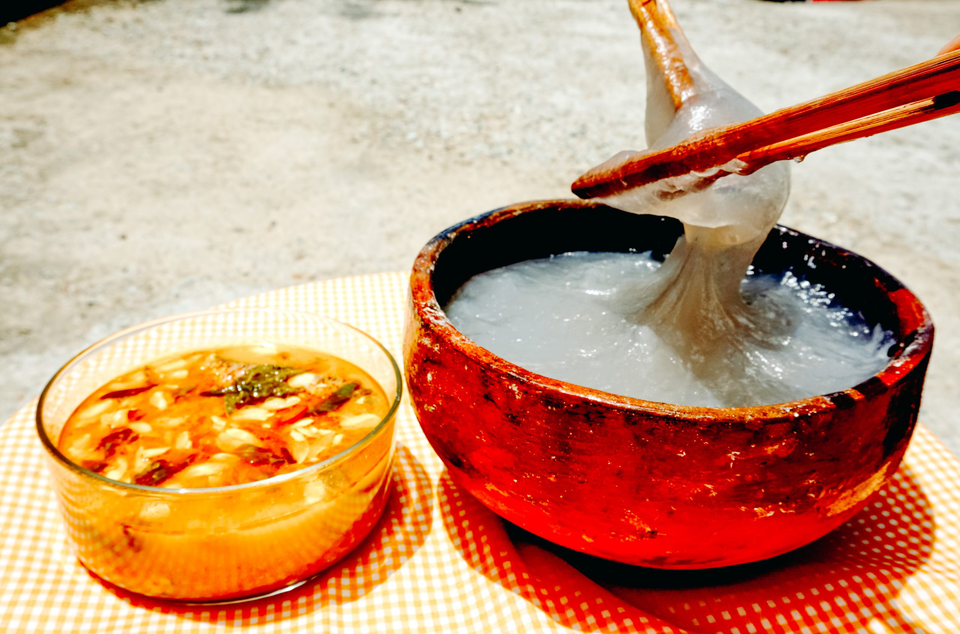
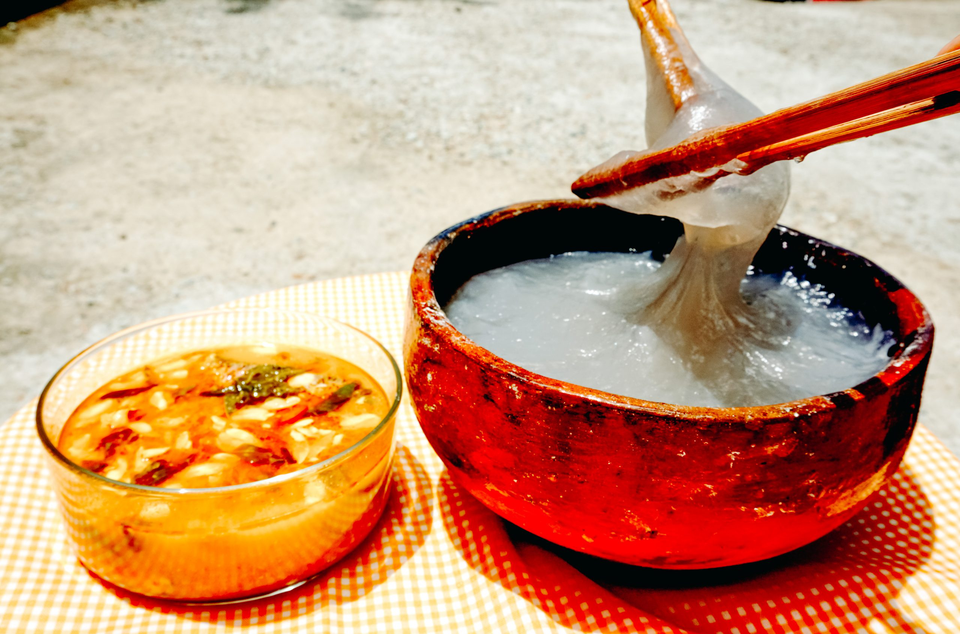
One common way to prepare sago is to mix wet or dried starch with water, then add hot water or heat the mixture until it thickens. As the starch cooks, it can become translucent, sticky, soft, or gelatinous. The final texture depends on the ratio of starch to water, the type of starch being used, and the way the cook works the mixture.
This type of preparation may be described in English as sago jelly, sago paste, or thick cooked sago. It may be eaten with fish, leafy greens, vegetables, coconut-based accompaniments, or other locally available foods. Local names differ, so it is better to use a verified local name only when the community and location are clear.
It is especially important not to automatically call every Papua New Guinea sago paste “papeda.” Papeda is strongly associated with eastern Indonesia, while Papua New Guinea communities have their own local names and methods.
Fried or Baked Sago
Sago can also be fried, baked, or cooked on a hot surface. Dried starch or prepared wet starch may be shaped into cakes, flatbreads, or pancakes. The texture can range from soft and chewy to firm or crisp, depending on moisture, thickness, heat, and added ingredients.
Some preparations use only starch and water. Others may include coconut, banana, or leaf wrapping. Cooking may happen in pans, on heated surfaces, in bamboo, near charcoal, or with hot stones, depending on local tools and household practice. English descriptions of Papua New Guinea food often mention sago pancakes, but this should be understood as one broad category rather than a single fixed recipe.
Sago Soup and Sweet Preparations
Sago may also appear in softer, spoonable, or sweet preparations. In some household and recipe contexts, sago is combined with ripe banana and coconut milk to make a pudding-like or soup-like dish. English-language recipes for saksak or sacsac often describe a banana and sago preparation served with coconut milk, though these modern recipes may use commercial sago pearls rather than freshly extracted village starch.
These dishes should be described carefully. A recipe published online may help introduce the idea, but it does not prove that every household prepares the dish in the same way. Names, textures, ingredients, and serving styles can differ between communities.
Steamed Sago and Leaf-Wrapped Dishes
Sago mixtures can be wrapped in banana leaves, Heliconia leaves, or other locally available leaves before cooking. The starch may be mixed with banana, coconut, or other ingredients, then formed into parcels and steamed, cooked with hot stones, or heated near charcoal.
The leaves work as natural containers. They help hold the mixture together, protect it during cooking, and may add a gentle plant aroma. Leaf wrapping also makes sense in village cooking because it uses materials close to the household environment rather than requiring manufactured containers.
Saksak, Sacsac, and Commercial Sago Pearls
Saksak or sacsac is often introduced to international readers as a Papua New Guinea dessert made with sago and banana. Many modern English-language versions use commercial sago pearls, banana, and coconut milk.
However, commercial pearls are manufactured starch beads. They are not identical in form to freshly extracted wet sago starch from a village processing site. They may still be used in modern cooking, but the form, texture, and source should be described accurately.
Tapioca pearls can also look similar to sago pearls, but they come from cassava root starch, not sago palm pith. FAO material on cassava processing describes tapioca products as being made from cassava flour or starch, while sago refers to starch from palm pith.
For clear writing, use sago jelly, sago paste, sago pancake, leaf-wrapped sago, or a verified local name. Avoid presenting one recipe, one village term, or one Indonesian dish name as the whole story of Papua New Guinea sago.
The Cultural Importance of Sago
Sago as Everyday Food
In some lowland communities, sago is a regular household staple rather than an occasional dish. It may be prepared for morning or evening meals and served with locally available fish, greens, vegetables, banana, or coconut. In a Sowom village case study from East Sepik Province, researchers described sago jelly as a central everyday food, usually eaten with side dishes such as greens, vegetables, fish, and coconut milk. This is a local example, not a rule for every community in Papua New Guinea.
The important point is variation. In some river and wetland areas, sago is deeply woven into household routines. In other places, it may be traded, eaten less often, or replaced in daily cooking by other local or store-bought foods. It would be inaccurate to say that all Papua New Guineans eat sago every day, that sago is the single national food, or that every province prepares it in the same way.
Household and Community Labour
Traditional sago processing often involves more than one person. Palm selection, felling, opening the trunk, pounding or scraping pith, washing, carrying starch, storing it, and cooking it may involve couples, relatives, neighbours, or extended family members. The work can also be shaped by local expectations about age, gender, household responsibility, and kinship.
A careful writer should not turn one community’s work pattern into a national rule. For example, the Sowom study describes particular gendered roles in sago work and cooking in that East Sepik community, including the importance of learning to cook sago jelly through observation and repeated practice. That finding belongs to its documented place and should not be presented as the standard for all Papua New Guinea communities.
Palm Ownership and Customary Land
Sago harvesting is not always a simple matter of gathering an unowned wild resource. Palms may grow on family, clan, or customary land, and rights to harvest may be connected with local ownership, inheritance, permission, and social relationships. In this sense, a sago grove can be part of a wider landscape of belonging.
Customary access may influence who can cut a palm, who helps process it, who receives a share of the starch, and how future palms are protected. In some places, the grove itself is a living resource maintained across generations. The palm produces food, but it also connects people to waterways, walking paths, family histories, and the responsibilities that come with land.
Sago in Exchange, Ceremonies, and Gatherings
Sago can also appear in exchange, hospitality, and ceremonial contexts. In sago-growing areas, cooked sago may be prepared in large quantities for guests. Some communities use sago during weddings, funerals, feasts, or other gatherings. A broader review of sago-growing areas notes that sago may be served to invited guests at special occasions and may be used in gift exchange in areas where it is a staple.
Again, the details matter. Research from Sowom in East Sepik records sago starch as part of bride-price exchange alongside money and pigs, and describes sago jelly being served at weddings and funerals. That should be identified as a Sowom and East Sepik example rather than described as a universal Papua New Guinea custom.
Sago as Cultural Knowledge
Sago knowledge is learned through experience. People learn how to recognise palm varieties, judge maturity, open the trunk, work the pith, wash out the starch, store it, and cook it to the right texture. Local names for palms may preserve detailed observations about spines, trunk form, pith quality, moisture, and cooking behaviour.
This knowledge connects food with land, language, household work, and social relationships. A person who knows sago well is not simply following a recipe. They are reading a palm, reading a landscape, and working within a community’s inherited ways of doing things.
Uses of the Sago Palm Beyond Starch
The sago palm is valued for more than the starch inside its trunk. In Papua New Guinea and wider New Guinea, different parts of the palm may be used for building, household materials, food processing, and everyday tools. This does not mean every community uses every palm part in the same way. Local access, skills, house styles, available plants, and community preferences all shape how the palm is used.
Sago leaves may be used for roof thatching, wall coverings, and other construction materials. Kew’s overview of New Guinea palms describes Metroxylon sagu as especially important in New Guinea, noting that its leaves provide construction materials, particularly thatch. The same source also describes the palm as a major starch source for many lowland communities.
Other palm parts may also have practical uses. FAO material on Papua New Guinea notes that sago leaves are used for house roofs and walls, fronds for wall cladding, and midribs for fish traps. This makes the palm useful in household life even after the starch has been removed.
In some places, palm midribs may become tool parts, fish-trap material, or structural pieces. Leaves may serve as wrapping material, temporary shelter material, or containers during processing and cooking. The trunk, once opened, may help form temporary troughs or work surfaces, depending on the local method. Processing residue may be left to break down, used around the household, or handled according to local practice.
A careful way to describe the sago palm is as a multipurpose palm. It provides starch, but it may also support roofing, wall cladding, fish traps, wrapping, household containers, processing equipment, and other everyday materials. These uses show why sago is not only a food plant. In many sago-growing areas, it is part of the built environment, the kitchen, the processing site, and the wider landscape of village life.
Regional Differences in Papua New Guinea Sago Traditions
Sepik River and East Sepik Traditions
The Sepik River region is one of the best-known sago areas in Papua New Guinea. In parts of East Sepik, sago is closely connected with wetlands, river travel, household processing, local cooking, and community identity. Studies of sago-growing areas describe the Sepik River area as a place where sago is a staple food and where stories about the origin of sago are part of local cultural knowledge.
A documented example from Sowom village in East Sepik Province shows how detailed sago knowledge can be in one community. The study describes sago as a staple food in Sowom, with sago jelly eaten with side dishes, sago starch used in gift rituals, and the palm also valued for house construction material. This example is useful because it shows how one community connects sago with food, labour, ceremony, and materials, but it should not be treated as a complete description of all East Sepik communities.
East Sepik traditions may include local classification of palm varieties, household processing routines, storage practices, and ceremonial uses. The important point is not that every village follows the same pattern, but that the Sepik region contains long-established sago landscapes where people have built deep practical knowledge around the palm.
Western and Fly River Areas
Western Province, including the Fly River region, has a strong relationship with wetlands, rivers, and lowland environments. Sago is especially relevant in places where waterways shape movement, settlement, fishing, and access to palms. A sago-growing areas review identifies the Fly River delta, together with the Sepik River basin, as one of Papua New Guinea’s important sago areas.
The Fly River region should not be described simply by copying East Sepik examples. Local processing, storage, transport, and cooking practices may differ according to village location, river access, seasonal conditions, and household routines. In river and wetland areas, transport by canoe or other small craft may influence how palms are reached, how starch is carried, and how food moves between households or settlements.
Western Province also reminds us that sago is part of a wider wetland food system. It may sit alongside fishing, gathering, gardening, and trade, rather than existing as an isolated ingredient.
Gulf and Coastal Communities
In Gulf Province and other coastal settings, sago may be part of mixed subsistence systems that include fishing, coconut, banana, gardens, forest resources, and small-scale exchange. A National Library of Australia catalogue record for Stanley Ulijaszek’s work specifically identifies “sago, subsistence agriculture and fishing” in a coastal Elema community of Gulf Province, which reflects how sago can sit beside other coastal livelihood activities rather than replace them.
Coastal communities may process starch for household use, gatherings, or local exchange. Cooking may include thick sago preparations, cakes, or mixtures with coconut and banana, depending on the community. As with other regions, local names and methods should be identified carefully. It is better to write “in a coastal Gulf community” or “among some Elema communities” when the source is specific, rather than saying “all Gulf people prepare sago this way.”
Island and Other Provincial Traditions
Sago is also known in island and northern coastal areas, including Manus, parts of New Ireland, and parts of Madang. A study of sago-growing areas notes that Papua New Guinea’s sago regions include lowland areas on the main island and smaller island areas such as Manus and northern New Ireland.
In these places, sago’s role can range from an important staple to a supplementary or traded food. Some households may process starch locally, while others may buy, exchange, or prepare sago in more occasional ways. Island food systems often include many other local foods, so sago should be described as part of a broader pattern rather than the single defining food.
Regional differences are central to understanding Papua New Guinea sago. The palm may be the same species, and the basic starch-extraction principle may be similar, but local landscapes, languages, tools, recipes, names, and customs give each sago tradition its own shape.
Papua New Guinea Sago Versus Indonesian Papua Sago
Papua New Guinea and Indonesian Papua are connected by the same island, but they are not the same political or cultural setting. Papua New Guinea is an independent country occupying the eastern half of New Guinea and nearby islands, while the western half of New Guinea is part of Indonesia.
This distinction is important when writing about sago. Both sides of New Guinea have long relationships with sago palms, wetland environments, and palm-starch foods. Shared ecology, however, does not mean identical names, dishes, customs, or community histories. A sago paste in Papua New Guinea should not automatically be described with an Indonesian food name unless a reliable source clearly shows that the name is used in that specific Papua New Guinea community.
Papeda is a good example. Papeda is widely associated with eastern Indonesia, especially Maluku and Papua, and is commonly described as a sago-based porridge or congee. Indonesia’s official tourism information describes papeda as a traditional food made from sago and often consumed in Maluku, while other Indonesian sources also connect it with Papua and Maluku.
Papua New Guinea has related sago-paste preparations, but the safer wording is usually sago jelly, sago paste, thick cooked sago, sago pancakes, sago soup, steamed sago, or a verified local name. This respects the fact that Papua New Guinea has many languages and community-specific food traditions. It also prevents Indonesian Papua terminology from being used as if it represents all of Papua New Guinea.
Editorial note: Do not use Indonesian locations, communities, dish names, images, or government data as evidence about Papua New Guinea unless the distinction is clearly labelled. Indonesian Papua occupies the western side of New Guinea island. Papua New Guinea is the independent country on the eastern side. Their sago traditions may be related, but they should not be merged into one story.
For this article, “Papua New Guinea sago” should refer to sago traditions within Papua New Guinea. When Indonesian Papua or Maluku is mentioned, it should be framed as a neighbouring or related eastern Indonesian context, not as proof of Papua New Guinea practice.
Sago Starch, Sago Flour, Sago Pearls, and Tapioca
Sago can be confusing because the same word is used for several related forms. In traditional Papua New Guinea settings, sago often begins as fresh wet starch extracted from palm pith. In shops or recipes, however, “sago” may refer to dry flour, small pearls, or even products made from other starches. This is why the source and form should be described clearly.
| Product | Source | Form | Common use |
| Sago starch | Sago palm trunk pith, especially from Metroxylon sagu | Wet or dry starch | Thick pastes, cakes, soups, leaf-wrapped dishes, and other local preparations |
| Sago flour | Dried and milled or powdered sago starch | Dry powder | Cooking, baking, thickening, and making cakes or pancakes |
| Sago pearls | Processed starch formed into beads | Small dry spheres | Puddings, desserts, and modern sweet preparations |
| Tapioca pearls | Cassava root starch | Processed beads | Desserts, drinks, puddings, and bubble-tea-style preparations |
The main difference is the plant source. Palm sago comes from the pith inside the trunk of the sago palm. A 2008 review describes sago starch as a commercial starch obtained from the stem of the sago palm, Metroxylon sagu. Tapioca, by contrast, is made from cassava root starch; FAO material on cassava processing discusses tapioca as a cassava-based product, with starch extracted from cassava roots before being processed into different forms.
This distinction matters when describing Papua New Guinea sago. Freshly extracted wet sago starch from a village processing site is not the same physical product as a packet of dry pearls from a shop. Sago flour is closer to the original starch source, but it has been dried and powdered. Sago pearls are manufactured beads, often used for desserts and sweet dishes.
Commercial naming can also be inconsistent. Some products sold as “sago pearls” may be made from tapioca or another starch rather than true palm sago. Culinary references commonly note that sago and tapioca pearls can look similar but come from different plant sources, so ingredient labels should be checked before describing a product as genuine palm sago.
For clear writing, use the most specific term available: wet sago starch, dried sago flour, commercial sago pearls, or tapioca pearls made from cassava. This helps readers understand whether the article is discussing a traditional palm-starch food, a dried kitchen ingredient, or a modern manufactured pearl.
How Sago Traditions Are Changing
Sago traditions in Papua New Guinea are not frozen in the past. They continue through household practice, local knowledge, and village cooking, but they also adapt as communities gain access to rice, packaged foods, markets, schools, roads, and new work routines. Papua New Guinea’s National Food Security Policy 2018–2027 notes that when rural people move to urban areas, consumption of local staples tends to fall while rice consumption rises.
The labour required for traditional processing is one reason change happens. Felling a mature palm, opening the trunk, pounding or scraping the pith, washing the fibre, settling the starch, and carrying the wet starch home can take time and coordinated effort. ACIAR material on food security in Papua New Guinea describes sago processing as a long process in which the trunk is cut and pounded to release starch.
Some changes involve tools. Small-scale mechanisation, such as rasping or extraction equipment, is sometimes discussed as a way to reduce the physical work of processing sago. Research on sago machinery describes improved household-scale machines as suitable for adoption in sago-producing areas, including Papua and Papua New Guinea, although actual use depends on cost, maintenance, skills, and local acceptance.
Market use is another part of the modern picture. Wet starch may still be prepared for household cooking, while dried starch can be easier to move, store, sell, or use in small-scale food production. Earlier Papua New Guinea sago research has discussed the possibility of refining traditionally processed starch for local food markets, but this should not be confused with saying that all sago communities are becoming commercial producers.
At the same time, sago knowledge needs active transmission. Local palm names, maturity signs, processing skills, storage practices, and cooking textures are usually learned through observation and participation. If younger people spend less time in sago groves or village kitchens, some details may become harder to pass on.
Change also includes pressure on land and wetlands. Papua New Guinea has a high proportion of land under customary tenure, so discussions about sago landscapes often overlap with family, clan, and community land rights.
A balanced view should show both continuity and adaptation. Sago remains important in many places, but the way people harvest, store, sell, cook, and talk about it can shift with changing livelihoods, markets, tools, and access to other foods.
Frequently Asked Questions About Papua New Guinea Sago
What is Papua New Guinea sago made from?
Papua New Guinea sago is made from the starch-rich pith inside the trunk of the sago palm, especially Metroxylon sagu. The starch is released by opening the trunk, breaking down the pith, washing the starch from the fibre, and allowing the starch-rich water to settle. Metroxylon sagu is widely described as a true sago palm and a major source of starch from palm stems.
Is sago a fruit?
No. Traditional palm sago is not the fruit of the sago palm. The starch is primarily obtained from the soft inner pith of the trunk, rather than from fruit, seed, or coconut-like flesh.
Is sago the same as tapioca?
No. Traditional sago comes from the pith of a sago palm trunk, while tapioca comes from cassava root starch. They can look similar when processed into pearls, but they come from different plants.
Is sago flour the same as sago pearls?
No. Sago flour is powdered starch, usually dried and milled into a fine form for cooking. Sago pearls are processed starch beads used in puddings, desserts, and some modern sweet preparations. Commercial naming can be inconsistent, so the ingredient label is the best way to know whether a product is made from true palm sago or cassava-based tapioca.
Where is sago eaten in Papua New Guinea?
Sago is especially associated with several lowland, coastal, river, wetland, and island communities. Important sago areas include parts of the Sepik River basin, Western Province, Sandaun, Gulf Province, Manus, Madang, and New Ireland. Its importance differs greatly by region, so it should not be described as equally central to every Papua New Guinea community.
How is sago starch traditionally extracted?
The basic process begins with selecting and felling a mature palm. The trunk is opened, the pith is pounded or scraped, water is worked through the crushed fibres, and the starch-rich liquid is filtered into a container. After settling, the clearer water is removed and a wet starch cake remains.
What does Papua New Guinea sago taste like?
The starch itself is generally mild. Much of the eating experience comes from texture and from the foods served with it. Sago may be chewy, gelatinous, soft, firm, fried, baked, steamed, or pudding-like, depending on the preparation and the amount of water, heat, and added ingredients.
Is papeda a Papua New Guinea dish?
Papeda is primarily associated with eastern Indonesia, especially Papua and Maluku. Papua New Guinea has related sago-paste preparations, but they should not automatically be called papeda unless a reliable source identifies that name in a specific Papua New Guinea community. For Papua New Guinea, clearer general terms include sago jelly, sago paste, thick cooked sago, sago pancakes, sago soup, or a verified local name.
What foods are commonly served with sago?
Depending on the community, sago may be served with fish, leafy greens, vegetables, banana, coconut milk, or other locally available foods. The combination depends on place, household practice, season, and access to gardens, rivers, forests, markets, or the sea.
Is sago still eaten in Papua New Guinea?
Yes. Sago is still eaten in Papua New Guinea, especially in communities where it remains connected to local wetlands, river systems, household cooking, and customary food traditions. However, the frequency and importance of sago vary substantially between regions and households.
Conclusion
Papua New Guinea sago is starch extracted from the pith inside the trunk of the sago palm, especially Metroxylon sagu. It is not a fruit, seed, or coconut-like palm product. Its most familiar traditional form begins as wet starch released from the palm trunk through cutting, scraping or pounding, washing, filtering, settling, and collecting.
Its importance is strongest in particular lowland, river, wetland, coastal, and island communities, including areas connected with the Sepik River, Western Province, Gulf Province, Sandaun, Manus, Madang, and New Ireland. Even within these regions, sago traditions are not identical. Each community may have its own palm names, processing tools, storage methods, cooking styles, and ways of sharing the finished starch.
Sago also shows how food can connect with land, labour, household knowledge, material culture, and social life. A single palm may provide starch for cooking, leaves for thatching or wrapping, and materials for everyday village use. In some communities, sago also appears in gatherings, exchange, and ceremonies, while in others it may be part of a broader food system alongside fish, coconut, banana, root crops, vegetables, rice, and market foods.
The most accurate way to understand Papua New Guinea sago is to see it as a family of local traditions rather than one national dish. It can become sago jelly, thick paste, pancakes, cakes, soups, steamed parcels, or sweet preparations. It should also be clearly distinguished from Indonesian Papua’s papeda traditions, commercial sago pearls, and tapioca pearls made from cassava.
Explore more stories about Papua’s traditional foods, plants, landscapes, and cultural heritage.