Searching for papua plant indoor usually means looking for tropical plants associated with Papua or the wider New Guinea region that can be grown as ornamental plants indoors. New Guinea is especially important botanically: research coordinated by the Royal Botanic Gardens, Kew identifies it as the world’s most floristically diverse island, with ecosystems ranging from lowland rainforest to montane forest and high-elevation habitats. (kew.org)
Many plants occurring across these tropical environments are adapted to warm conditions, abundant moisture, filtered forest light, or life on trees and other elevated surfaces. Some of these characteristics can translate well to indoor cultivation, although not every Papuan species suits an ordinary living room. This guide focuses on ornamental plants with genuine connections to Papua and New Guinea, particularly tropical aroids, foliage plants, epiphytic ferns, and orchids, while explaining the growing conditions that make each group distinctive.
What Does “Papua Plant Indoor” Mean?
The phrase papua plant indoor is not a formal botanical category. In everyday searches, it can refer to several related ideas: plants native to Indonesian Papua, species occurring elsewhere on New Guinea, ornamental plants associated with the broader Papuasian flora, or tropical species from the region that can adapt to indoor cultivation.
These meanings should not be treated as identical. New Guinea is the geographic island, while Papua New Guinea is an independent country occupying its eastern portion. The western part of the island belongs to Indonesia and is often described geographically as Indonesian New Guinea or Western New Guinea. The name Papua can also refer more specifically to Indonesian administrative areas, so using it as a synonym for the entire island can create confusion.
For this guide, Papua indoor plants are discussed within the wider New Guinea context when botanically relevant, but individual species should still be identified according to their documented geographic distribution.
Papua vs Papua New Guinea
New Guinea is one large island divided politically between Indonesian territory in the west and the independent state of Papua New Guinea in the east. A plant recorded from Papua New Guinea should therefore not automatically be described as native to Indonesian Papua, even though both regions belong to the same island.
The distinction becomes especially important with species that have relatively restricted natural ranges. Some occur across much of New Guinea, while others may be known only from particular mountain systems, lowland forests, islands, or political regions.
Why Botanical Origin Matters
Accurate origin helps readers understand a plant’s natural environment instead of relying only on its appearance. Many plants sold as “tropical” may look similar while coming from completely different parts of the world.
For example, climbing aroids occur in several tropical regions, but visual resemblance does not prove that two species share the same geographic origin or ecological requirements. Even plants within the same genus may have very different distributions.
For that reason, botanical origin is best checked at the species level whenever possible. A genus may extend across Southeast Asia, New Guinea, and Pacific islands, while a particular species within it may occupy only a much smaller range. This species-level approach gives a more accurate foundation for discussing genuine indoor plants from Papua and New Guinea.
Why Papua Has Such Remarkable Tropical Plant Diversity
New Guinea supports an unusually rich range of plant life because it combines a tropical location with highly varied landscapes and habitats. Its vegetation includes extensive lowland rainforest, montane forest, wetlands, coastal environments, and high-elevation ecosystems. Kew’s botanical research records more than 13,000 plant species on the island and highlights habitat diversity, complex geology, and the meeting of Southeast Asian, Australian, and Pacific biogeographic influences as important factors behind this richness. (kew.org)
For indoor growers, this diversity has an important implication: there is no single set of conditions that represents every Papuan plant. A species growing close to a humid lowland forest floor occupies a very different ecological niche from an orchid attached to a tree branch or a plant occurring in cooler mountain forest.
Understanding those differences is more useful than simply labeling every species a “tropical plant.”
Lowland Rainforest Plants
Lowland rainforest environments are generally warm and moisture-rich, with plants growing at many different levels between the forest floor and canopy. Beneath taller vegetation, competition for sunlight can favor plants capable of making effective use of diffuse or filtered light.
Several characteristics familiar to houseplant growers make sense in this environment. Broad foliage can help intercept available light, while climbing species can use surrounding vegetation to move upward rather than investing in a self-supporting trunk. Some climbing aroids also develop aerial roots, which help them attach to surfaces as they ascend.
These adaptations partly explain why selected New Guinea foliage plants can work well indoors. A room with appropriate filtered light, warmth, root aeration, and vertical support can reproduce certain features of their natural growing strategy, even though it cannot duplicate a rainforest.
Montane Plants
Elevation changes the picture considerably. New Guinea contains extensive highlands, and its vegetation ranges from tropical lowlands to montane forests and even alpine environments. (kew.org)
As elevation increases, temperatures and other environmental conditions can differ substantially from those experienced by plants at lower elevations. A species from a mountain forest therefore should not automatically be treated like one originating in a hot lowland habitat.
This is an important distinction when choosing Papua tropical plants for indoor cultivation. The word tropical describes a broad geographic context; it does not guarantee that every species prefers identical temperature, moisture, or light conditions.
Epiphytes and Climbing Plants
An epiphyte is a plant that grows on another plant for physical support without using it as its conventional soil substrate. Tropical forests provide countless potential growing surfaces, including trunks, branches, bark crevices, moss-covered areas, and pockets where organic material accumulates.
Epiphytic plants often develop roots adapted to environments with considerable air exposure rather than continuously dense, compact soil. Climbing plants may similarly use trunks and other vertical surfaces to reach more favorable growing positions.
These natural habits become highly relevant indoors. An epiphytic fern may perform better with an open growing medium or mounted arrangement, while a climbing aroid may benefit from a board, moss pole, or other vertical surface. Matching the growing setup to the plant’s natural habit is often more useful than treating every species as an ordinary potted houseplant.
Best Papua and New Guinea Plants for Indoor Growing
Not every plant native to Papua or New Guinea is suitable for a normal living room. Some species occupy specialized ecological niches and may need greenhouse-like humidity, temperature control, strong filtered light, or substantial growing space. For a practical Papua plant indoor collection, it is better to focus on plants whose growth habits can reasonably be accommodated indoors.
The groups below include genuine New Guinea connections, but their distributions differ. Some are restricted to New Guinea, while others occur across a much wider Indo-Pacific range.
Alocasia Species
Alocasia is one of the most relevant aroid groups for collectors interested in New Guinea plants. Several species have documented distributions on the island, including Alocasia lauterbachiana, Alocasia wentii, and Alocasia brancifolia.
Alocasia lauterbachiana is native from northern New Guinea to the Bismarck Archipelago, while A. wentii is recorded from New Guinea. Alocasia brancifolia occurs in both Maluku and New Guinea. (powo.science.kew.org)
These plants are primarily valued indoors for their distinctive foliage and upright form. They generally suit warm conditions, bright indirect light, and an aerated growing medium that can hold some moisture without remaining densely waterlogged.
Their terrestrial or semi-terrestrial growth also makes them easier to accommodate in conventional containers than many highly specialized epiphytes.
Environmental changes can affect their growth rhythm. An Alocasia moved from a nursery, greenhouse, or humid growing area into a different indoor microclimate may temporarily produce slower growth or change its foliage. Such changes should be considered alongside light, temperature, moisture, and acclimation rather than automatically being interpreted as disease.
Rhaphidophora Hayi
Rhaphidophora hayi is especially interesting because of its unusual climbing habit. Kew records the species from New Guinea, the Bismarck Archipelago, Solomon Islands, and northern Queensland, with records covering both Indonesian Papua and Papua New Guinea. (powo.science.kew.org)
Rather than hanging freely like a typical trailing vine, juvenile growth can shingle against a surface. Shingling means that the leaves remain relatively flat and close to the vertical support as the stem climbs.
Indoors, this habit makes R. hayi particularly suitable for a wooden board, bark-like slab, or another vertical structure. Its growth form can create a compact vertical display without requiring the broad horizontal spread of some larger foliage plants.
Providing something to climb is more than a decorative choice. It allows the plant to express a growth strategy much closer to the one it uses in its natural habitat.
Epipremnum Species
Epipremnum is an Indo-Pacific aroid genus containing several vigorous climbers. Two useful examples for this discussion are Epipremnum pinnatum and Epipremnum amplissimum.
E. pinnatum has a very broad native distribution extending from tropical and subtropical Asia into the Pacific, including New Guinea. It should therefore be described as a widespread Indo-Pacific species rather than a plant unique to Papua. E. amplissimum has a native range extending from New Guinea toward Vanuatu. (powo.science.kew.org)
Both illustrate an important characteristic of climbing aroids: juvenile and mature plants may look considerably different.
When a climbing aroid is allowed to ascend a suitable support, changes may occur in leaf size, spacing, orientation, and mature foliage shape. Plants kept permanently trailing may retain a more juvenile appearance for longer.
Aerial roots can also help climbing stems interact with their support, making poles, boards, and trellises useful components of an indoor display.
Scindapsus and Related Climbing Aroids
Scindapsus and related climbing aroids can also be relevant when exploring Papuasian and Indo-Pacific foliage plants. They often combine decorative leaves with climbing or trailing growth, characteristics that work particularly well in vertical indoor arrangements.
Geographic accuracy remains important, however. A plant should not be called a Papua species simply because it belongs to a tropical Asian aroid genus.
Individual species identification matters because distributions within a genus can be surprisingly different. One species may occur on New Guinea, while another may be restricted to another part of Malesia or Southeast Asia.
For collectors, a correctly identified plant provides a much stronger basis for researching its natural habitat and likely growing preferences.
Bird’s-Nest Ferns
Bird’s-nest-type ferns, particularly members of Asplenium, offer a different form from climbing aroids. Their fronds typically emerge from a central rosette, creating a broad architectural shape that works well as a tabletop or stand-mounted foliage plant when the species remains a manageable size.
Depending on the species, these ferns may grow terrestrially or as epiphytes. In natural forests, the rosette can intercept falling leaves and other organic debris, gradually creating a small accumulation of material around the plant.
That ecology matters indoors. An epiphytic fern should not automatically be treated like an ordinary garden plant planted deeply in dense soil. Root aeration, moisture balance, humidity, and airflow all deserve consideration.
Platycerium Wandae
For a more advanced example, Platycerium wandae is a large epiphytic staghorn fern native to Maluku, New Guinea, and the Bismarck Archipelago. (powo.science.kew.org)
Like other staghorn ferns, it develops different frond forms. Shield fronds grow around the mounting area and help form the plant’s base, while fertile fronds extend outward and carry the reproductive structures.
Its epiphytic habit makes mounting especially appropriate, but its potential mature size must be considered before purchase. This is not an ideal plant for a narrow shelf or a small tabletop collection.
For that reason, P. wandae is better regarded as a collector plant for experienced growers or spacious indoor growing areas than as a conventional beginner houseplant.
New Guinea Orchids
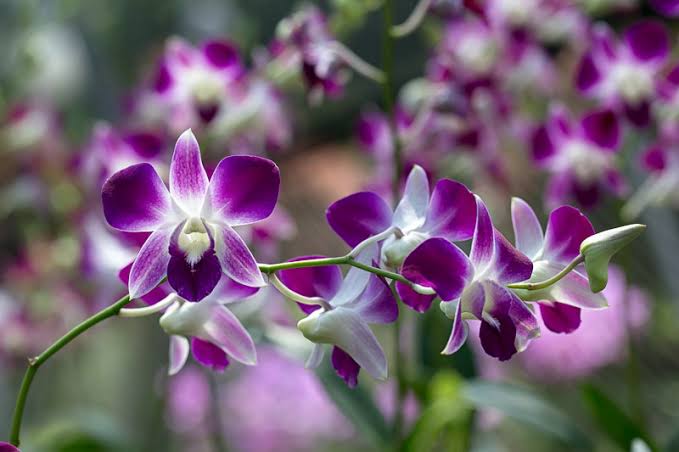
New Guinea is also exceptionally important for orchids. Genera such as Dendrobium and Bulbophyllum include numerous species associated with the island, including many epiphytes. For example, Kew records New Guinea species of Dendrobium and describes Bulbophyllum inclinatum from western New Guinea as a pseudobulbous epiphyte. (powo.science.kew.org)
Their diversity makes broad care rules unreliable.
An orchid from a warm lowland forest may require quite different conditions from one originating at greater elevation. Light exposure, moisture, air movement, temperature, and drying rate should therefore be considered at species level.
Root aeration is particularly important for epiphytic orchids because their roots are not naturally adapted to remaining buried in dense conventional potting soil. Depending on the species, suitable cultivation may involve bark-based media, baskets, or mounting.
There is no useful universal watering schedule for “New Guinea orchids.”
Begonia and Other Forest-Understory Plants
New Guinea also contains numerous Begonia species and other plants associated with humid forest environments. Botanical records include species such as Begonia novoguineensis, which is native to New Guinea, as well as species restricted to particular parts of the island. (powo.science.kew.org)
Begonias are especially interesting as ornamental plants because of the diversity of their leaf forms, textures, patterns, and growth habits. Species associated with shaded forest environments can sometimes suit protected indoor cultivation where light is filtered rather than harsh.
However, “likes humidity” should not be interpreted as “likes stagnant conditions.” Certain specialist forest plants can be sensitive when high moisture is combined with poor airflow or unsuitable substrate.
Many botanical New Guinea begonias and other uncommon understory species are therefore better viewed as collector plants than standard household varieties. Before choosing one, it is worth checking the species’ natural habitat, growth habit, expected mature size, and cultivation history rather than selecting it solely for unusual foliage.
Quick Comparison of Papua Indoor Plant Types
Different Papua indoor plants can vary substantially in growth habit, space requirements, and environmental preferences. The table below offers a practical overview of the main plant groups discussed in this guide.
| Plant Group | Growth Habit | Light | Humidity | Space Needed | Experience Level |
| Alocasia | Upright | Bright indirect | Moderate–high | Medium | Intermediate |
| Rhaphidophora | Climbing | Bright indirect | Moderate–high | Vertical | Beginner–intermediate |
| Epipremnum | Climbing or trailing | Medium–bright indirect | Moderate | Vertical or trailing | Beginner–intermediate |
| Bird’s-nest fern | Rosette | Filtered light | Moderate–high | Medium | Intermediate |
| Platycerium | Epiphytic | Bright filtered | Moderate–high | Large vertical area | Advanced |
| New Guinea orchid | Mostly epiphytic | Species-dependent | Species-dependent | Small–medium | Intermediate–advanced |
Exact requirements vary by species. Even plants within the same genus can come from different elevations, forest layers, or moisture conditions, so this comparison should be treated as a starting point rather than a fixed care formula.
Growth habit is especially useful when choosing an indoor plant. A climbing species may need less floor space but more vertical support, while a large epiphytic fern can eventually occupy considerably more wall area than its young size suggests. Matching the plant’s natural form to the available indoor space can make cultivation and display much easier over time.
Light Requirements for Papua Tropical Indoor Plants
Light is one of the most important factors when growing tropical plants indoors, but terms such as “shade” and “low light” can be misleading. Many plants associated with New Guinea forests naturally grow beneath taller vegetation, where direct tropical sun is reduced by the canopy. Even so, these habitats can still receive substantial diffuse light throughout the day.
For that reason, many Papua tropical plants perform best in bright or medium indirect light rather than in genuinely dark rooms. Indoor placement should be based on how much usable light reaches the foliage, not simply on whether a plant is described as a rainforest species.
Bright Indirect Light
Bright indirect light generally means a well-lit position where the plant receives plenty of ambient light without prolonged exposure to intense direct sun.
This type of placement can suit many foliage aroids, climbing plants, ferns, and selected orchids associated with tropical forest environments. A position near a bright window with filtered sunlight may work well, although the ideal distance from the glass depends on window orientation, local climate, curtains, nearby buildings, and seasonal changes.
Indoor window light also differs from light in a tropical forest. In nature, plants may receive changing patches of light, reflections from surrounding vegetation, and long periods of diffuse illumination. Indoors, a plant may receive strong light from only one direction for part of the day.
Rotating suitable potted plants occasionally can help maintain more balanced growth, although mounted climbers and epiphytes may be intentionally positioned toward their main light source.
Why “Rainforest Plant” Does Not Always Mean Low Light
A common mistake is assuming that a forest-understory plant will be comfortable in almost any dim indoor position.
Forest shade and a dark room are not equivalent.
Under a rainforest canopy, light is filtered by leaves and branches, but the surrounding environment can still be much brighter than a room located far from a window. Some understory species are adapted to diffuse light rather than to extremely low light.
This distinction is particularly important for climbing aroids. In nature, a young plant may begin near the forest floor and then climb toward brighter positions. Its light environment can change significantly as it matures.
When natural indoor light is limited, a suitable grow light can sometimes provide more consistent illumination. The goal is not to create intense exposure, but to provide enough light for steady, compact growth without abruptly stressing foliage that has adapted to lower levels.
Signs That Placement May Need Adjustment
Plants often respond visibly when their light environment is not well matched to their needs. These responses should be treated as observations rather than automatic diagnoses, because watering, temperature, root condition, and acclimation can produce similar changes.
Possible signs that a plant may need more light include:
- unusually elongated growth between leaves
- smaller new leaves than expected
- loss of compact growth
- slow development despite otherwise stable conditions
- a climbing plant producing weak growth while searching toward a brighter direction
Sudden exposure to much stronger light can create a different set of changes. Leaf discoloration, pale patches, or damaged areas may appear after a plant is moved too quickly from filtered light into intense direct sun.
Gradual leaf acclimation is therefore useful when changing placement. Moving a plant step by step toward brighter conditions gives its foliage more time to adjust than shifting it immediately between very different light environments.
For indoor growers, the most practical approach is to observe the plant over time and consider light together with temperature, humidity, watering, and airflow. No single lighting label can describe the requirements of every species from Papua or New Guinea.
Humidity and Airflow
Many plants associated with Papua and New Guinea come from environments where atmospheric moisture is relatively high. Indoors, however, simply increasing humidity does not automatically reproduce rainforest conditions. Air movement, temperature, plant spacing, and how quickly surfaces dry are equally important.
This is especially relevant for tropical aroids, epiphytic ferns, and orchids. These plants may appreciate a more humid indoor microclimate, but they still benefit from air circulation around their leaves, roots, and growing medium.
Humidity Is Only Part of the Equation
High humidity and stagnant air are not the same as a healthy tropical environment.
In a forest, humid air is constantly influenced by wind, temperature shifts, evaporation, rainfall, and movement through different vegetation layers. Indoors, a tightly packed group of plants with little ventilation can create pockets where leaves and substrate remain damp for much longer than expected.
For that reason, humidity should be considered together with airflow. A plant may tolerate or prefer moist air while still needing enough circulation for foliage and root zones to exchange air effectively.
There is also no single humidity level that suits every New Guinea species. A lowland aroid, a montane orchid, and an epiphytic fern can occupy very different natural niches even though all are broadly described as tropical plants.
Creating a Stable Indoor Microclimate
Consistency is often more useful than chasing extreme humidity levels.
Grouping plants with broadly similar environmental preferences can help create a more stable local microclimate. Leaves release moisture through transpiration, so a collection of compatible plants may experience slightly different conditions from a single isolated pot.
Other practical considerations include:
- keeping plants away from strong heating or cooling drafts
- leaving enough space between leaves for air movement
- avoiding abrupt changes between very dry and very humid conditions
- using a humidifier where appropriate if the room is consistently dry
- checking that increased humidity is not accompanied by continuously wet substrate
Plant placement also matters. A tightly enclosed shelf may retain more humidity than an open room, while a position directly in front of an air conditioner can create rapid moisture loss and temperature fluctuations.
The aim is to create a reasonably stable indoor microclimate that matches the plant’s general ecology. For many Papua indoor plants, balanced humidity and gentle air circulation are more practical than trying to imitate the rainforest through humidity alone.
Choosing the Right Potting Medium
A suitable growing medium should reflect how a plant’s roots function in nature rather than relying on the idea that every indoor plant needs ordinary “soil.” Many tropical species associated with Papua and New Guinea grow in loose forest material, on tree surfaces, among bark crevices, or in organic debris where roots receive both moisture and air.
For indoor cultivation, the key properties are usually drainage, moisture retention, and root aeration. The exact balance depends on whether the plant is terrestrial, climbing, or epiphytic.
Aroids
Many aroids benefit from an open, aerated substrate that allows excess water to drain while retaining enough moisture around the root zone.
Common components can include:
- orchid bark
- coco coir or other coco material
- perlite
- pumice
- other coarse, porous materials
The goal is not to follow one rigid ingredient formula. A useful aroid mix should maintain enough structure that air-filled spaces remain between particles rather than collapsing into a dense, waterlogged mass.
This is especially relevant for plants such as Alocasia, Rhaphidophora, and Epipremnum. Their root systems need access to moisture, but prolonged saturation can greatly reduce oxygen around the roots.
Container choice also affects how a substrate behaves. A small pot with generous drainage may dry differently from a large decorative planter filled with the same material.
Epiphytic Plants
Epiphytes require a different way of thinking about the root zone.
In nature, many epiphytic plants grow on trunks, branches, or other exposed surfaces rather than rooting deeply into mineral soil. Their roots may experience frequent moisture while also receiving substantial airflow.
Indoors, placing such plants in dense, fine-textured potting material can create conditions very different from their natural habitat. More open media, baskets, slabs, or mounted arrangements may be more appropriate depending on the species.
This principle is particularly important for epiphytic ferns and orchids, where root-zone oxygenation can be just as important as moisture availability.
Orchids and Epiphytic Ferns
Many epiphytic orchids are grown successfully in bark-based media because coarse particles create spaces that allow air to move around the roots. Some species may also be grown in baskets or mounted directly onto suitable surfaces.
Sphagnum moss can be useful where greater moisture retention is needed, but its suitability depends on the plant, climate, container, and watering habits. A material that works well in a warm, fast-drying environment may remain too wet in a cooler or less ventilated room.
Epiphytic ferns can have similarly varied requirements. Some adapt well to open organic media, while mounted species may perform better when their roots are allowed to interact with bark, moss, or other airy materials.
The most useful principle is simple: substrate structure is often more important than a fixed recipe. A good growing medium should provide the balance of moisture, drainage, and air that matches the plant’s natural root ecology.
How to Water Papua Indoor Plants
Watering should respond to the plant, container, and environment rather than follow a fixed calendar. Two specimens of the same species can dry at very different rates depending on light, temperature, pot size, root mass, airflow, humidity, and substrate structure.
For Papua indoor plants, it is more useful to check the growing medium and observe how quickly moisture is being used than to assume every plant needs water on the same day each week.
A plant in a warm, bright position may dry much faster than one growing farther from a window. Likewise, a small pot filled with chunky material can lose moisture quickly, while a large container with a finer substrate may remain damp much longer.
Why a Fixed Weekly Schedule Can Be Misleading
A weekly watering routine sounds convenient, but it ignores changing indoor conditions.
During brighter or warmer periods, plants may use water more quickly. In cooler conditions or lower light, moisture can remain in the root zone for longer. Newly repotted plants, recently purchased plants, and specimens with relatively small root systems may also behave differently from established ones.
Instead of watering automatically, check the substrate first. Depending on the plant and growing medium, this may involve feeling the upper layer, checking the pot’s weight, or observing how quickly an airy mix loses moisture between waterings.
The objective is not to let every tropical plant become completely dry. It is to understand its wet-dry cycle and avoid repeatedly adding water when the root zone is still heavily saturated.
Drainage and Root-Zone Oxygen
Roots require both water and oxygen.
When a substrate remains waterlogged for long periods, much of the air space between particles can become filled with water. This reduces the amount of oxygen available around the roots.
That balance is especially important for many aroids and epiphytic plants. Species adapted to tree surfaces, loose organic material, or porous forest substrates often experience moisture without remaining continuously buried in dense, saturated media.
Good drainage therefore involves more than having a hole in the bottom of the pot. Substrate porosity, container size, root density, and airflow all influence how quickly excess moisture leaves the root zone.
The most practical approach is to combine observation with the plant’s natural growth habit. Rather than asking, “How often should I water this plant?” ask, “How quickly is this plant using moisture in its current environment?”
Temperature for Tropical Papua Plants
Many plants associated with Papua and New Guinea come from warm tropical environments, so stable indoor warmth can suit a wide range of ornamental species. However, temperature preferences should not be generalized too aggressively.
New Guinea has major differences in elevation, and plants from hot lowland forests can experience very different conditions from species growing in montane habitats. This means there is no single temperature range that is automatically correct for every plant from the region.
Lowland aroids and many tropical foliage plants often adapt well to consistently warm indoor conditions, especially when sudden cold exposure is avoided. By contrast, some montane orchids and other high-elevation species may be accustomed to cooler conditions or more noticeable temperature changes.
Abrupt shifts can be more disruptive than small, gradual seasonal changes. Moving a plant from a warm greenhouse into a strongly air-conditioned room, for example, can create a very different environment in a short period.
For indoor growers, the most useful approach is to consider the plant’s altitudinal range and natural habitat when that information is available. A species labeled simply as a “tropical plant” may still have temperature preferences shaped by whether it comes from lowland rainforest, foothill forest, or higher-elevation habitat.
Stable conditions, appropriate airflow, and protection from strong heating or cooling drafts are therefore more practical starting points than applying one universal temperature rule to all Papua and New Guinea plants.
Give Climbing Plants Something to Climb
Many tropical aroids associated with New Guinea are natural climbers. Instead of spreading permanently across the ground, they use tree trunks and other vertical surfaces to move upward through the forest.
Indoors, providing a suitable support can help these plants express a more natural growth habit. Common options include:
- moss poles
- wooden boards
- plant trellises
- bark-like supports
- other stable vertical surfaces
The best support depends on the species. Some climbers attach closely to a flat surface, while others simply benefit from having a structure that guides their stems upward.
Rhaphidophora hayi is a particularly good example. Its juvenile leaves can grow close against a vertical surface in a shingling pattern, creating a very different appearance from an ordinary trailing vine. A flat board or similar support can therefore showcase the plant’s natural form especially well.
Why Climbing Changes Plant Form
Vertical growth can influence more than the direction of the stem.
As certain climbing aroids mature on a suitable support, they may show changes in:
- internode length
- leaf size
- leaf orientation
- stem thickness
- mature leaf morphology
Some species produce progressively larger or differently shaped leaves as they climb. In other aroids, mature foliage may eventually develop features that are absent from juvenile leaves.
This juvenile-to-mature leaf transition is one reason a climbing plant kept permanently trailing may look quite different from a well-established specimen growing vertically.
Support also affects how a plant uses indoor space. A climber trained upward can create a strong vertical display without occupying as much floor area as a broad, freestanding foliage plant.
For a practical Papua plant indoor setup, it is therefore worth considering the plant’s natural growth direction before deciding where to place it. A suitable vertical surface can become part of both the cultivation method and the overall design.
How to Choose a Papua Plant Indoor for Your Home
Choosing the right Papua plant indoor is easier when you start with the conditions in your home rather than the appearance of the plant alone. Available floor space, vertical space, light, humidity, and the amount of attention you can provide should all influence the decision.
A compact climber may be more practical than a large fern in a small apartment, while a spacious room may be able to accommodate a dramatic Alocasia or mounted epiphyte. Mature size matters just as much as the size of the plant at the time of purchase.
For Small Spaces
In smaller rooms, look for plants that remain manageable or can be trained vertically.
Good options may include:
- compact juvenile foliage plants
- smaller bird’s-nest-type ferns
- manageable climbing aroids
- young Rhaphidophora grown on a narrow board or support
Vertical growth can be especially useful because it allows the plant to develop without occupying large amounts of floor space.
Before buying, check how large the species can become at maturity. A plant that looks suitable for a shelf when young may eventually need a much larger growing area.
For Vertical Displays
Climbing plants are particularly useful for narrow spaces, plant walls, shelves, and other displays where height is available.
Suitable groups can include:
- Rhaphidophora
- Epipremnum
- selected Scindapsus
- other climbing aroids with documented New Guinea or Papuasian connections
Moss poles, wooden boards, trellises, and similar supports can help guide their growth upward. Species such as Rhaphidophora hayi are especially effective when the support also highlights their natural shingling habit.
When choosing a climber, consider how easily the support can be expanded. Some plants may eventually outgrow a short pole or board.
For Statement Plants
A statement plant works best when its foliage, size, or growth form becomes a focal point rather than one element in a crowded collection.
Alocasia species can fill this role well because of their upright stems and prominent leaves. Larger epiphytic ferns can also create a strong architectural effect, particularly when mounted vertically.
These plants generally need more visual and physical space than compact tabletop specimens. It is worth considering not only pot diameter but also the eventual spread of the foliage.
Leaving some open space around a large plant can often display its structure more effectively than surrounding it with many smaller specimens.
For Experienced Collectors
Collectors who already understand indoor microclimates may be interested in more specialized plants, including:
- uncommon New Guinea orchids
- large or unusual epiphytic ferns
- specialist begonias
- plants from narrower ecological or altitudinal ranges
These species may require closer attention to temperature, substrate structure, humidity, airflow, mounting method, or seasonal changes.
Before purchasing a specialist plant, research its natural habitat rather than relying on a generic tropical-plant label. Information about elevation, whether it grows terrestrially or epiphytically, mature size, and preferred light environment can reveal whether the species realistically matches your indoor conditions.
The most suitable plant is therefore not necessarily the rarest or most visually unusual one. A better choice is a species whose natural growth habit can be supported by the space and environment you already have.

Common Mistakes When Growing Papua Tropical Plants Indoors
Many problems with Papua tropical plants begin when growers apply the same care routine to species with very different ecological backgrounds. A climbing aroid, an epiphytic fern, and a montane orchid may all come from tropical New Guinea, but that does not mean they should be grown in identical conditions.
Understanding the plant’s natural habit is usually more useful than following a generic “tropical plant” formula.
1. Assuming All Rainforest Plants Tolerate Dark Rooms
Rainforest shade is not the same as very low indoor light.
Plants growing beneath a forest canopy can still receive substantial diffuse illumination throughout the day. A dark corner several meters from a window may provide far less usable light than a shaded tropical understory.
Instead of choosing placement based only on the word “shade,” consider how bright the room remains during the day and whether the plant maintains compact, steady growth.
2. Planting Epiphytes in Dense Soil
Epiphytic plants are adapted to growing on trees, branches, bark, or other exposed surfaces where their roots receive significant airflow.
Placing them in heavy, compact media can create a root environment that is very different from their natural habitat. Epiphytic orchids and ferns may be better suited to coarse bark, open substrates, baskets, or mounted arrangements depending on the species.
The main goal is to preserve moisture while maintaining enough air around the roots.
3. Watering Strictly by Calendar
A fixed watering day ignores changes in temperature, light, pot size, airflow, and substrate drying rate.
The same plant may need water more frequently during a bright, warm period and less frequently when conditions are cooler or darker. Large pots also tend to retain moisture differently from smaller containers.
Checking the growing medium before watering is usually more informative than following a rigid weekly schedule.
4. Combining High Humidity With Poor Airflow
Humidity alone does not recreate rainforest conditions.
A tightly packed indoor plant collection may hold moisture around leaves and substrate for long periods if the surrounding air barely moves. This can produce an environment that differs greatly from a humid but ventilated forest.
Plant spacing and gentle circulation should therefore be considered alongside humidity.
5. Moving Plants Abruptly Between Very Different Environments
Plants often need time to adjust when moved between a nursery, greenhouse, outdoor growing area, and indoor room.
Sudden changes in light, temperature, humidity, or airflow can affect foliage and growth. A plant accustomed to filtered greenhouse light, for example, may respond poorly if placed immediately in intense direct sun.
Gradual acclimation is generally more useful than making dramatic environmental changes all at once.
6. Buying Plants Without Checking Their Botanical Identity
Names used in plant shops and collector markets are not always precise. Similar-looking species may also be sold under broad common names.
Accurate identification matters because species within the same genus can differ in natural range, mature size, growth habit, and preferred conditions.
When possible, look for a complete botanical name rather than relying only on a label such as “Papua aroid” or “New Guinea plant.”
7. Assuming Every Plant Sold as a “Papua Plant” Actually Comes From Papua
This is one of the easiest factual mistakes to make.
Plants may be marketed according to appearance, collector terminology, trade routes, or broad regional associations rather than confirmed botanical origin. Some species sold beside Papuan plants may naturally come from Borneo, the Philippines, tropical America, or other regions.
Checking species-level distribution helps separate genuine botanical origin from marketing language.
8. Ignoring Mature Plant Size
Young tropical plants can be misleadingly compact.
A small Alocasia may eventually produce much larger leaves, while a mounted fern can occupy considerable wall space as it matures. Climbing plants may also need taller supports over time.
Before buying, consider the plant’s mature dimensions, growth direction, and support requirements. Planning for its future size makes it easier to maintain an attractive indoor display without repeatedly relocating or restricting the plant.
How to Style Papua Plants Indoors
Papuan and New Guinea plants can add strong structure, texture, and vertical interest to an interior. The most effective displays usually come from combining different growth habits rather than placing several similar plants together.
Leaf shape, plant height, mature size, and growth direction all influence how a tropical arrangement looks over time. A compact fern creates a very different visual effect from an upright Alocasia or a climbing aroid trained against a wall.
Tropical Foliage Corner
A tropical foliage corner works best when plants are arranged at different heights and with contrasting leaf forms.
For example, an upright Alocasia can provide height and bold foliage, while a lower-growing fern adds softer texture closer to the base. A climbing plant can introduce vertical movement without requiring much additional floor space.
Useful design principles include:
- combining broad and narrow foliage
- varying plant heights
- mixing upright and spreading growth
- leaving enough space for each plant’s mature form
- avoiding overcrowding simply to create an “indoor jungle” effect
Decorative planters can help unify the arrangement, but plant containers should still provide suitable drainage and enough room for the root system.
Vertical Plant Display
Vertical displays are especially well suited to climbing and epiphytic plants.
Rhaphidophora, Epipremnum, and other climbing aroids can be trained onto moss poles, wooden boards, trellises, or bark-like supports. Their upward growth makes good use of wall space and can highlight changes in leaf size and orientation as the plant matures.
Mounted epiphytic ferns can add another layer to the display. Rather than placing every plant in a conventional floor pot, a wall-mounted or board-mounted specimen can create a more natural presentation that reflects its growth habit.
When building a vertical display, make sure the support is stable and large enough for future growth. A structure that looks generous for a young plant may become restrictive once stems, aerial roots, and mature foliage develop.
Statement Specimen
A single dramatic plant can sometimes create a stronger effect than a crowded collection.
An Alocasia with distinctive upright foliage or a large epiphytic fern can become the focal point of a room when given enough surrounding space. This approach also makes it easier to appreciate the plant’s natural architecture.
Statement plants work particularly well beside simple furniture, against uncluttered walls, or in locations where their foliage has room to spread without constant contact with nearby objects.
The key is scale. A specimen should suit both the available light and the physical dimensions of the room. Styling a plant successfully means considering how it will look at maturity, not only how it appears when first purchased.
Rare Does Not Always Mean Suitable for Indoors
A rare plant is not automatically a good indoor plant.
Some Papuan species attract collectors because they are unusual, visually distinctive, or difficult to find in cultivation. However, rarity says very little about whether a plant will adapt to a normal home environment.
Certain species come from narrow ecological niches with highly specific combinations of light, temperature, moisture, airflow, and elevation. A plant that performs well in a specialized greenhouse may struggle in an ordinary room even when it receives careful attention.
Before buying a rare Papua plant, it is useful to research several basic points:
- natural habitat
- elevation or altitudinal range
- terrestrial or epiphytic growth habit
- typical mature size
- preferred light environment
- expected moisture conditions
- need for vertical support or mounting
These details can reveal whether the plant is realistic for the space available.
Elevation is especially important. Plants from cool montane environments may behave very differently indoors from species originating in hot lowland forests. Even though both come from New Guinea, their preferred conditions may not overlap closely.
The same applies to mature size. A rare epiphyte may look compact when purchased but eventually require a large mounting area, while a climbing aroid may need considerably more vertical space as it develops.
For collectors, the most practical approach is to choose plants whose natural ecology can be reasonably matched indoors. Rarity can make a specimen interesting, but suitability should still come first.
Choose Cultivated Plants Rather Than Wild-Collected Specimens
When buying unusual Papua ornamental plants, origin matters almost as much as botanical identity. A rare species may be appealing to collectors, but plants with uncertain provenance can raise questions about how the specimen entered cultivation.
Whenever possible, favor nursery-propagated or clearly cultivated plants rather than specimens described as recently collected from the wild.
Propagation allows desirable species to circulate in cultivation without relying continually on removal from native populations. Botanical conservation organizations also treat propagation and well-documented living collections as important components of plant conservation. (bgci.org)
Look for Clear Plant Provenance
Plant provenance simply means information about where the plant material came from. In horticulture, this can help distinguish nursery-grown stock from material originating directly from a wild population. BGCI similarly uses provenance to describe the original source of plant material and emphasizes documentation as part of managing traceable living collections. (bgci.org)
For an ordinary buyer, useful signs of transparent sourcing can include:
- a reliable botanical name
- information that the plant was nursery propagated
- details about the grower or propagation source
- a clear distinction between cultivated material and wild-origin material
Not every cultivated plant will come with extensive documentation, especially common ornamental varieties. However, greater transparency becomes more valuable when dealing with rare species or specialist collector plants.
Responsible Collecting Starts With Cultivated Stock
Choosing propagated plants can also make practical sense for indoor growing. A specimen already established in nursery conditions has experienced cultivation before reaching the buyer, whereas a plant taken directly from a highly specific natural habitat may face a much greater environmental change.
This does not mean every nursery-grown plant is automatically easy to maintain. Specialized orchids, epiphytes, and montane species may still require demanding conditions. Cultivation history does, however, provide useful context when evaluating whether a plant has adapted successfully to horticultural environments.
For collectors interested in unusual Papua plants for indoors, the most responsible approach is therefore to combine botanical identification with clear provenance. Choose established cultivated stock when possible and be cautious about plants whose origin cannot be reasonably explained.
Papua Plants vs Popular Tropical Houseplants
Not every tropical houseplant belongs to the flora of Papua, New Guinea, or the wider Papuasian region. Plants from different continents can develop surprisingly similar appearances when they occupy comparable forest environments.
This is especially noticeable among aroids. Climbing stems, aerial roots, large leaves, and adaptations to filtered forest light occur in several unrelated tropical regions. As a result, plants displayed together in an indoor jungle may look ecologically similar while having very different geographic origins.
Groups with important Papuasian or wider Indo-Pacific connections include:
- Alocasia
- Epipremnum
- Rhaphidophora
- Scindapsus
These genera are distributed more broadly than Papua alone, so individual species still need to be checked before being described specifically as Papuan or New Guinean.
By contrast, several of the world’s most familiar houseplant genera belong naturally to the American tropics. Monstera, Philodendron, and Anthurium are Neotropical groups rather than native Papuan plant groups. Kew, for example, records Philodendron as native from Mexico through tropical America, while familiar Monstera species such as Monstera adansonii are native to tropical America. (powo.science.kew.org)
This distinction does not make American tropical plants any less suitable for indoor growing. It simply means they should not be presented as Papua New Guinea houseplants based on appearance alone.
The comparison is useful because tropical interiors frequently combine plants from multiple continents. A Monstera may stand beside an Alocasia, while a Philodendron may grow near an Epipremnum. Visually, they can create a cohesive tropical display, but botanically their origins are different.
For readers specifically looking for indoor plants from Papua or New Guinea, species-level identification remains the most reliable approach. Geographic origin should come from documented botanical distribution rather than leaf shape, common trade names, or the general “tropical” appearance of the plant.
FAQ About Papua Plant Indoor
What Is a Papua Plant Indoor?
A Papua plant indoor generally refers to an ornamental plant associated with Papua, New Guinea, or the broader Papuasian flora that can be cultivated indoors.
It is not a formal botanical category. The term may include plants native specifically to Indonesian Papua, species found elsewhere on New Guinea, or tropical plants from the wider region that have characteristics suitable for indoor growing.
Because geographic ranges vary, the botanical origin of individual plants should ideally be checked at species level.
Which Papua Plants Can Grow Indoors?
Several plant groups associated with New Guinea can adapt to indoor cultivation when their environmental needs are matched reasonably well.
Examples include selected:
- Alocasia species
- Rhaphidophora and other climbing aroids
- Epipremnum species
- bird’s-nest-type ferns
- staghorn ferns
- Dendrobium and Bulbophyllum orchids
- Begonia species
Suitability depends heavily on the individual species. Some adapt relatively well to household conditions, while others require specialized humidity, temperature, mounting, or lighting arrangements.
Are Papua Plants Difficult to Grow?
Some are relatively manageable, while others are better suited to experienced collectors.
Climbing aroids that tolerate normal indoor conditions can be easier to accommodate than specialized montane orchids or large epiphytic ferns. Difficulty often depends on how closely the available indoor environment matches the plant’s natural ecological niche.
Before purchasing an uncommon species, consider its light requirements, root habit, mature size, temperature preference, and whether it naturally grows terrestrially or as an epiphyte.
Do Papua Plants Need High Humidity?
Not every species requires the same level of humidity.
Many plants from humid New Guinea forests appreciate moderate to high atmospheric moisture, but requirements vary according to habitat, elevation, and growth habit. A lowland aroid may behave differently from a montane orchid even though both originate from the same island.
Humidity should also be considered alongside airflow. Continuously moist, stagnant conditions are not equivalent to a well-ventilated tropical forest environment.
Can Papua Tropical Plants Grow in Low Light?
Some tolerate filtered or moderate light, but “rainforest plant” should not automatically be interpreted as “dark-room plant.”
Forest understory species may grow beneath a canopy, yet they can still receive considerable diffuse light throughout the day. A poorly illuminated room far from a window can be substantially darker than natural forest shade.
For many tropical foliage plants, medium to bright indirect light is therefore more suitable than extremely low indoor light.
What Potting Mix Is Suitable for Papua Indoor Plants?
There is no universal potting mix for every Papua or New Guinea plant.
The growing medium should match the plant’s root ecology. Many aroids benefit from an aerated substrate containing coarse, porous materials such as bark, coco components, perlite, or pumice.
Epiphytic orchids and ferns may need even greater root aeration and can sometimes be grown in bark-based media, baskets, sphagnum, or mounted arrangements.
The most important principle is to balance moisture retention with drainage and air around the root zone.
Are All Tropical Plants Papua Plants?
No.
Tropical plants occur across many regions, including Southeast Asia, New Guinea, Pacific islands, tropical America, Africa, and other warm parts of the world.
A plant can have broad leaves, aerial roots, or a climbing habit without having any natural connection to Papua. Appearance alone is therefore not a reliable indicator of geographic origin.
Are Monstera and Philodendron Native to Papua?
No. Monstera and Philodendron are primarily Neotropical genera, meaning their natural distributions are centered in tropical parts of the Americas rather than Papua or New Guinea.
They are widely grown alongside Indo-Pacific plants because they share a tropical appearance and similar ornamental appeal. However, they should not be described as native Papua plants.
For readers specifically looking for New Guinea indoor plants, genera such as Alocasia, Epipremnum, Rhaphidophora, and selected Scindapsus species are more relevant starting points, provided the distribution of each individual species is verified.
Final Thoughts on Choosing a Papua Plant Indoor
Papua and the wider New Guinea region support extraordinary tropical plant diversity, but only some species are practical choices for indoor cultivation. The best papua plant indoor option is not necessarily the rarest or most dramatic plant. It is the one whose natural growth habit, mature size, and environmental preferences can be matched reasonably well inside the home.
Light, humidity, airflow, temperature, substrate structure, watering habits, and vertical space all matter. Climbing aroids may benefit from supports, epiphytic plants often need greater root aeration, and montane species may respond differently from plants originating in warmer lowland forests.
Accurate botanical identification also makes a major difference. Checking species-level distribution helps distinguish genuine Papua or New Guinea plants from tropical species that merely look similar.
For collectors, provenance deserves the same attention. Choosing nursery-propagated or clearly cultivated stock can support more responsible plant collecting while making it easier to understand how a specimen has entered cultivation.
A well-chosen Papua indoor plant should fit both the room and the plant’s ecology. When those two factors align, the result is a collection that is not only visually distinctive but also botanically informed.
If you’re looking for Papua herbal products, start with a trusted source. Experience authentic, high-quality red fruit products at Cahya Red Fruit Papua New Guinea! We offer a wide variety of items besides Red Fruit Papua New Guinea — including Papua ant nest and Papua kebar grass. Check out our herbal wellness product in our website!